Do you need insurance for a golf cart in North Carolina?
Golf carts, low-speed vehicles and the town rules that decide what you must carry, from an independent insurance company on the North Carolina coast since 1977.
Golf carts, low-speed vehicles and the town rules that decide what you must carry, from an independent insurance company on the North Carolina coast since 1977.
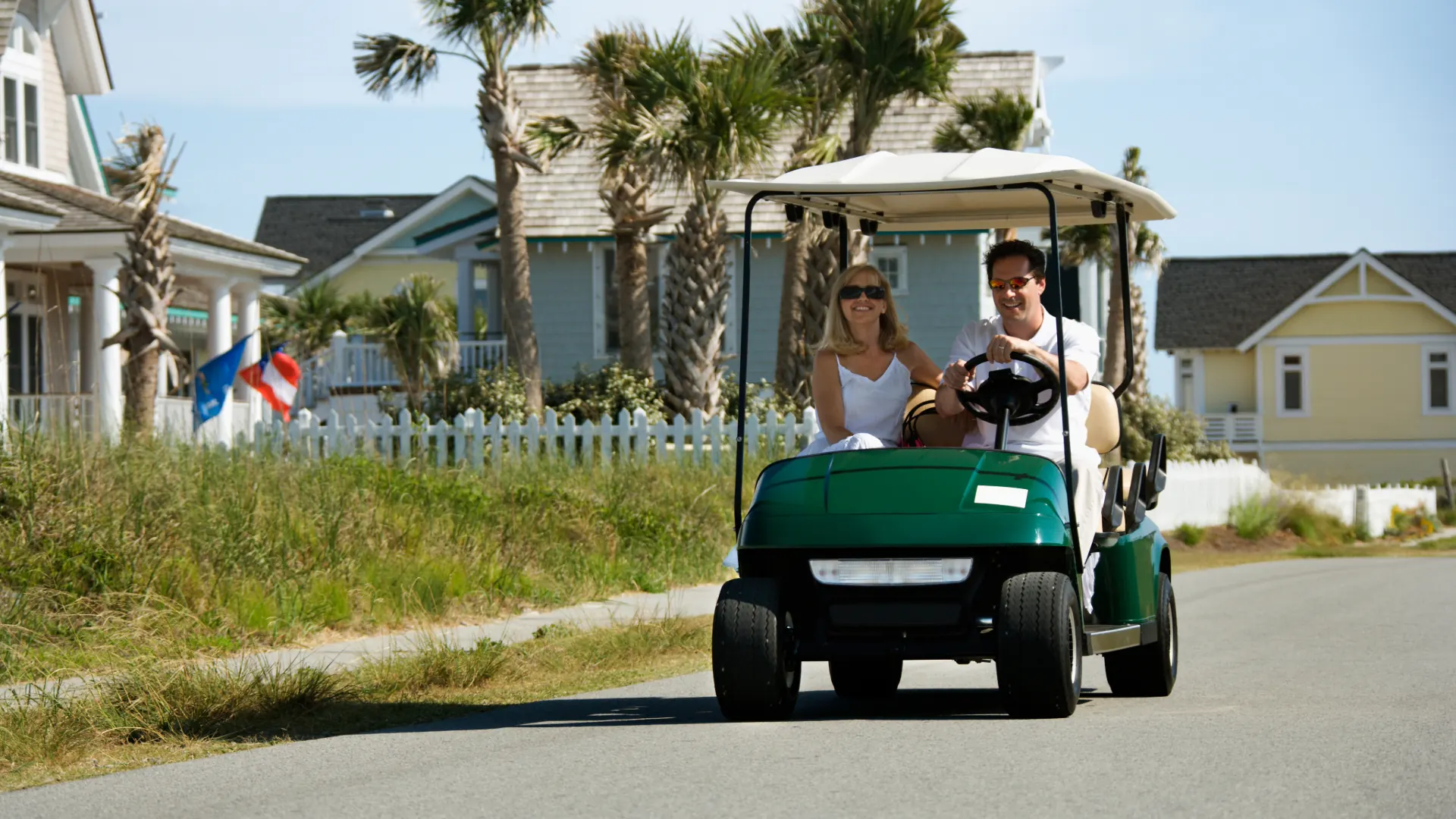
It depends on where you drive it and what it is. A golf cart used only on a golf course or private property has no state insurance requirement, but towns that let carts on public streets usually require liability insurance at auto levels. A low-speed vehicle (LSV) is registered with the DMV and must carry auto liability insurance like a car.
Most homeowners policies give little or no protection once the cart leaves your property, and none for renting it to guests. A separate golf cart policy, or an LSV listed on an auto policy, closes that gap. Sizemore Insurance compares many insurance companies to find the right fit for how you use the cart.
Liability. Pays for injuries and property damage you cause to others while driving the cart, including legal defense. This is the coverage towns ask to see before they issue a permit. Forms, limits and exclusions vary by insurance company, and your own policy governs.
Collision. Pays to repair or replace your cart after it hits another vehicle or object or overturns, minus your deductible.
Comprehensive. Covers theft, vandalism, fire, falling objects and many weather events. Carts parked under beach houses and at rentals are common theft targets, so this matters on the coast.
Uninsured and underinsured motorist. Pays for your injuries when a driver with no insurance or too little insurance hits your cart. On an LSV listed on a North Carolina auto policy, these coverages follow the auto policy rules.
Medical payments. Pays medical bills for you and your passengers after a covered accident, regardless of fault. Carts have no doors and few have airbags, so passengers can be thrown in a minor collision.
Custom parts and accessories. Covers lift kits, upgraded seats, lithium batteries, sound systems, lights and enclosures. Many policies cap accessories unless you list them, so tell us what you added.
Guest and permissive use. Covers family members and guests you allow to drive. Check how the policy treats renters or paying guests, because personal policies often exclude rental use.
Golf course and community use. Covers the cart on the course, in a private community and on the streets your town allows. Some policies limit coverage to certain locations, so match the policy to where you actually drive.
Forms, endorsements and availability vary by insurance company. Your own policy governs.
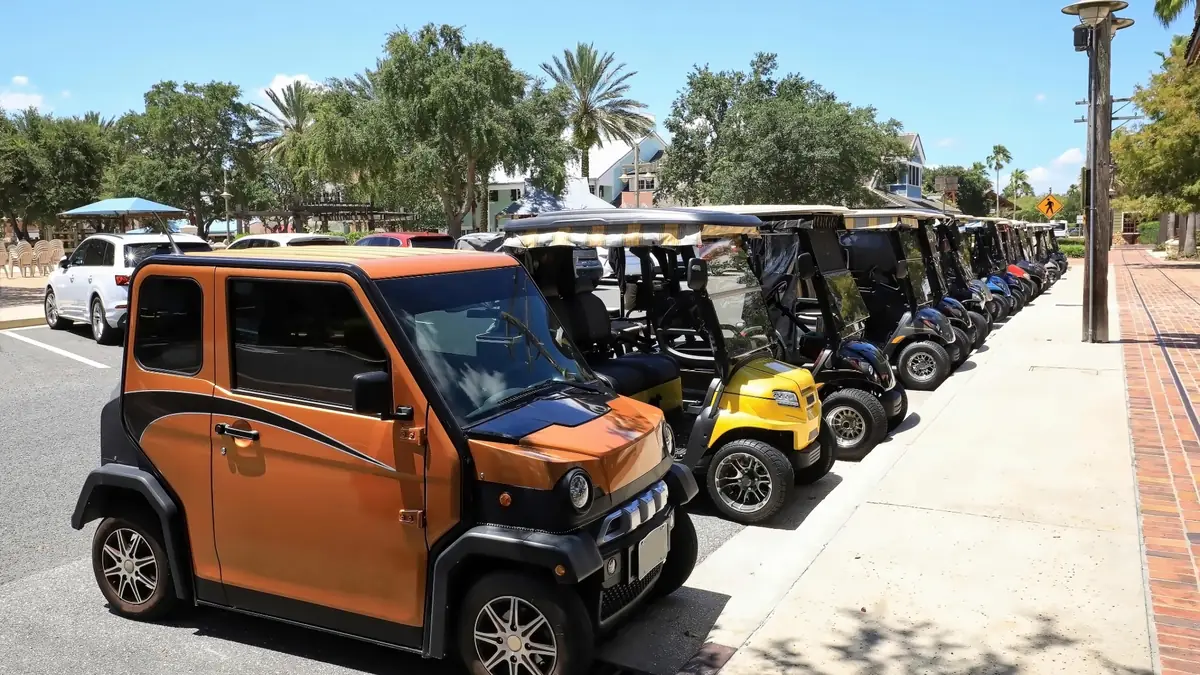
Golf cart and LSV are different vehicles. State law defines a golf cart as a vehicle built for golf courses that cannot exceed 20 mph. A low-speed vehicle is a four-wheeled vehicle with a top speed greater than 20 mph but less than 25 mph (G.S. 20-4.01(12b) and (27)g).
The DMV will not register a golf cart. The DMV must refuse registration for a vehicle that is a golf cart (G.S. 20-54(8)). To get a plate, a licensed manufacturer has to upfit the cart into a low-speed vehicle with a 17-character VIN and a Manufacturer's Certificate of Origin (NCDMV).
Towns and counties decide whether carts may use streets. A city or county may, by ordinance, allow golf carts on public streets with a speed limit of 35 mph or less. It may require registration, charge a fee, and set equipment, operator and hours rules. No one under 16 may drive a golf cart on a public street, road or highway (G.S. 160A-300.6, G.S. 153A-245).
LSVs must be registered and insured. A low-speed vehicle may only use roads posted 35 mph or less, may cross faster roads at intersections, and must have headlamps, stop and turn lamps, reflectors, a parking brake, mirrors, a windshield and wipers, a speedometer, seat belts and a VIN. It must be registered and insured under G.S. 20-50 and G.S. 20-309 and meet the federal LSV standard (G.S. 20-121.1, 49 CFR 571.500).
LSV liability minimums are 50/100/50. An LSV registered in North Carolina needs at least $50,000 per person and $100,000 per accident for bodily injury and $50,000 for property damage (G.S. 20-279.21). These limits apply to policies new or renewed on or after July 1, 2025 (NCDOI).
Auto policies can list an LSV. The North Carolina personal auto program has an approved endorsement, NC 03 24, that lists a low-speed vehicle as a covered auto with liability, medical payments, uninsured and underinsured motorist, comprehensive and collision (NC Rate Bureau).
Impaired driving law applies. The impaired driving law covers anyone who drives any vehicle on a highway, street or public vehicular area (G.S. 20-138.1). A golf cart is not an exception.
We do not publish a single price. These are the factors insurance companies weigh:
A licensed advisor quotes your actual situation across more than 100 insurance companies.
State law does not require insurance on a golf cart used only on a course or private property. Towns that allow carts on streets usually require liability insurance at auto levels, and a registered low-speed vehicle must carry auto liability insurance.
Usually only in a limited way, and mostly on your own property or the golf course. Once the cart is on a public street, most homeowners policies exclude it, so you need a golf cart or auto policy for street use.
The DMV does not register golf carts. Some towns require their own annual cart registration and sticker, and a cart converted to a low-speed vehicle must be registered with the DMV.
A licensed manufacturer must upfit it to low-speed vehicle standards and issue a 17-character VIN and certificate of origin. You then insure it and register it with the DMV like a car.
Only where your town or county allows it by ordinance, and only on roads posted 35 mph or less. A registered low-speed vehicle may use roads posted 35 mph or less statewide unless the state restricts a road.
The state law that lets towns allow carts on streets dates to 2009. Most recent changes are local, such as Carolina Beach phasing carts off its streets after 2027. Auto liability minimums, which apply to LSVs, rose to 50/100/50 for policies new or renewed on or after July 1, 2025.
No one under 16 may drive a golf cart on a public street, road or highway. Many towns also require a valid driver's license, and some set a higher age.
A standalone golf cart policy covers most carts, and a low-speed vehicle can be listed on a North Carolina auto policy with an LSV endorsement. We compare many insurance companies for both.
It depends on the cart's value, where you drive it, who drives, the limits you pick and whether guests or renters use it. We quote your actual cart and use rather than an average.
On public streets, only if your town or county ordinance allows it. Private and gated community roads follow the community's rules, but you still need liability coverage that applies there.
Yes, tell us before guests drive it. Personal golf cart and homeowners policies often exclude rental use, and a guest injury claim can land on you as the owner.
Forms, endorsements and availability vary by insurance company. Your own policy governs.
Sizemore Insurance is an independent insurance company founded in North Carolina in 1977. Tell us what you need to protect, and a licensed advisor will compare more than 100 insurance companies to find the coverage that fits. Insurance made just for you.
Sources: G.S. 20-4.01, definitions (golf cart, low-speed vehicle); G.S. 20-54, DMV refuses registration of golf carts; NCDMV, vehicle types (low-speed vehicles and golf cart upfits); G.S. 160A-300.6, city regulation of golf carts on streets; G.S. 153A-245, county regulation of golf carts on roads; G.S. 20-121.1, operation of low-speed vehicles; G.S. 20-50, registration required; G.S. 20-309, financial responsibility for registered vehicles; 49 CFR 571.500, federal safety standard for low-speed vehicles; G.S. 20-279.21, motor vehicle liability policy limits; NC Department of Insurance, auto changes effective July 1, 2025; NC Rate Bureau circular A-21-5, low-speed vehicle endorsement NC 03 24; G.S. 20-138.1, impaired driving.
Forms, exclusions, endorsements, and availability vary by insurance company. This page is general information, not a policy or legal advice. Review your own policy or talk to your advisor.