A rental property is not a house you happen not to live in. It is an income-producing asset with a stranger living in it, and the coverage reflects both of those facts.
Here is the whole list, starting with what is not optional.
The Core
A landlord or dwelling policy, not a homeowners policy. Occupancy is a material fact and a homeowners policy on a rented property is one of the most common expensive mistakes in this category. It gets its own article.
Dwelling coverage, the limit that rebuilds the structure. It should be set to replacement cost rather than to what you paid or what it appraised for.
Liability coverage, for injury to a tenant, a tenant’s guest, or anyone else on the property. The default limit on a dwelling policy is generally low for an investor.
Loss of rents, which replaces the rental income while a covered loss makes the unit unrentable. This is the coverage that protects the reason you bought the property, and it is the one most often set too low.
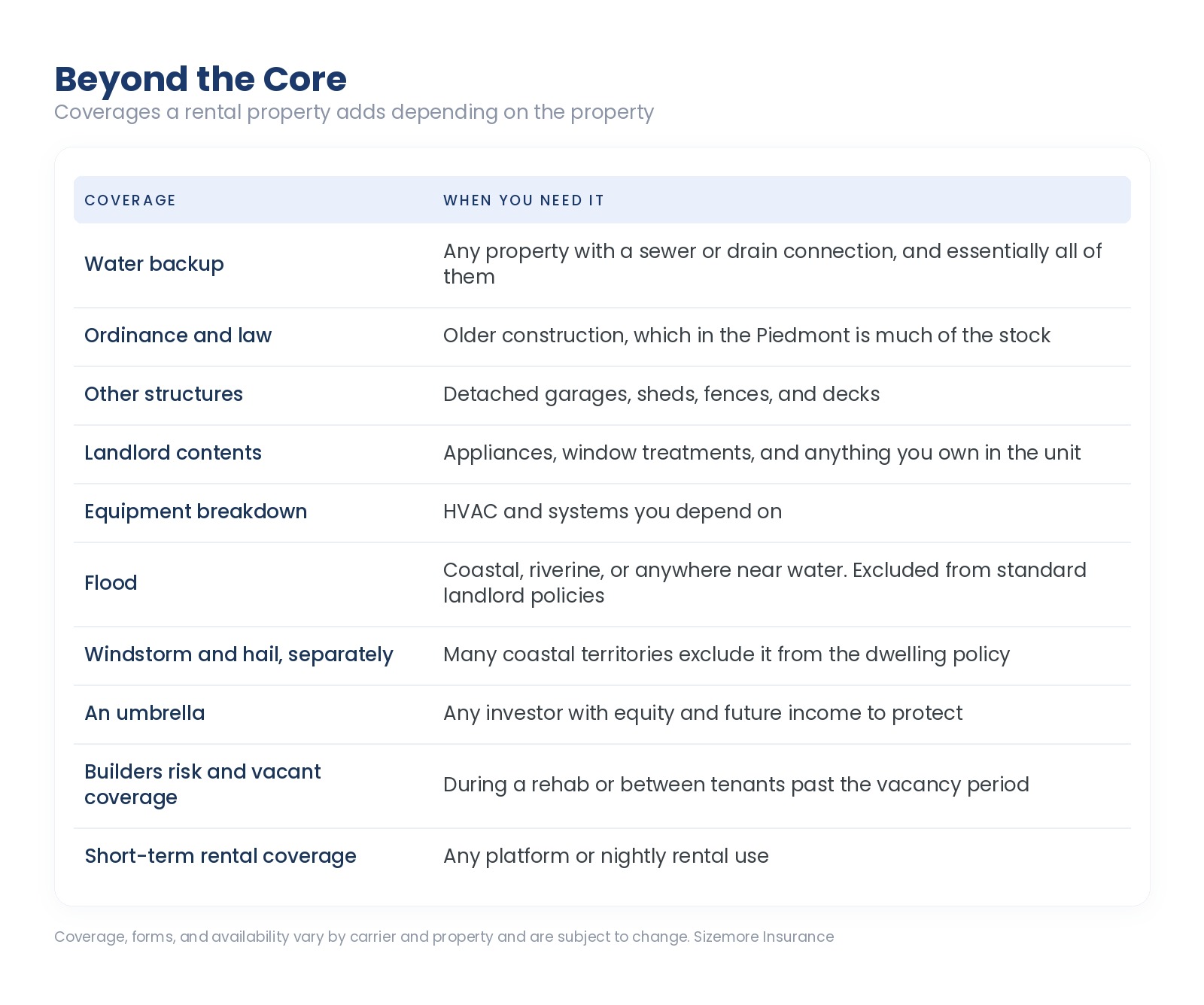
The takeaway: loss of rents, liability limits, and water backup are three of the most commonly underbuilt items on a Carolina rental, and all three are inexpensive to fix.
Coverage, forms, and availability vary by carrier and property and are subject to change.
How the Property Changes It
Single-family long-term. The simplest placement. Dwelling policy, real liability limits, loss of rents, water backup.
Duplex through fourplex. Still a dwelling form in most cases, with more units generating more exposure and a loss of rents calculation across units.
Five units and up. Generally a commercial form rather than a dwelling policy, which changes the income coverage from loss of rents to business income and rental value.
Short-term rental. A different occupancy. Standard landlord coverage frequently does not contemplate nightly rental, and platform host protection is not your policy.
A coastal rental. Add flood, and expect windstorm to be written separately with a percentage named storm deductible.
A rehab or a flip. Builders risk during construction and vacant coverage between phases, because a standard landlord policy is written for an occupied rental.
Where This Gets Complicated
Your lender has requirements and they are frequently more specific than your own judgment would be. Replacement cost, a correct mortgagee clause, flood where mapped, and a limit no lower than the loan.
The policy has to name the right owner. If an LLC or a trust holds title and the policy names you personally, that is a gap and it has its own article.
Vacancy is the exposure investors underestimate. Most policies restrict coverage past a stated vacancy period, commonly 30 to 60 days, and between tenants is exactly when a property is empty.
Renters insurance is the tenant’s coverage, not yours, and requiring it is a separate and worthwhile conversation.
Older Piedmont housing stock raises insurability questions rather than pricing ones. Knob and tube, fuse panels, and polybutylene narrow the market.
The form matters as much as the limit. A DP1 with a low limit and a DP3 with the right limit are very different policies, and that comparison has its own article.
Common Questions
Can I use my homeowners policy on a rental?
Generally not. Once it is rented, occupancy has changed and a landlord or dwelling form is the right policy.
What is loss of rents?
Coverage replacing rental income while a covered loss makes the property unrentable, up to a limit and a period.
Do I need an umbrella as a landlord?
Usually. Rental property creates liability exposure to tenants and guests, and an umbrella is inexpensive relative to it.
Is flood included?
No. Flood is excluded from standard landlord policies and requires a separate policy.
What about a short-term rental?
Different occupancy, frequently requiring a policy or endorsement built for it. Platform protection is not your policy.
What if the property sits empty between tenants?
Most policies restrict coverage past a stated vacancy period. Tell us before it sits.
The Bottom Line
- Use a landlord or dwelling form, not a homeowners policy.
- Set dwelling coverage to replacement cost, not to purchase price.
- Size loss of rents to your actual rent, with a realistic repair period.
- Raise liability above the default and price an umbrella.
- Add water backup, because it is inexpensive and it is a common loss.
- Tell us about vacancy, rehab, or short-term use before it happens rather than after.
Sizemore Insurance is an independent insurance company founded in North Carolina in 1977, writing in both North Carolina and South Carolina. Send us the address, the rent, and how the property is held and we will build it correctly. Insurance made just for you.
Coverage, forms, requirements, and availability vary by carrier, lender, and property and are subject to change. Nothing here is legal advice. Review your own policy or talk to your advisor.