

A homeowners policy is written for a house you live in. The rating, the underwriting, and the form all assume that.
Renting the house nightly or weekly to strangers is a different activity with a different loss profile: more people through the door, more turnover, less supervision, and a commercial revenue stream. Many homeowners forms are not written for it, and several contain provisions that specifically address it.
The consequence is not theoretical. Carriers investigate occupancy and use after a loss, and a claim on a house being operated as a short-term rental under a standard homeowners policy is where owners discover the gap.
Business pursuits. Standard homeowners liability contains an exclusion for business activities. Operating a lodging business out of the house falls within it on many forms.
Rental to others. Many forms limit or exclude coverage where the residence premises is rented to others, with narrow exceptions for occasional rental of part of the home.
The residence premises definition. Coverage frequently hinges on the house being your residence. A property you do not occupy, rented to guests year-round, may not meet the definition at all.
Personal property. Furnishings you bought specifically to operate the rental are arguably business property, which carries a low sublimit under a homeowners form.
Loss of rental income. A homeowners policy pays additional living expense when you cannot live in your home. It does not replace revenue you were earning from guests.
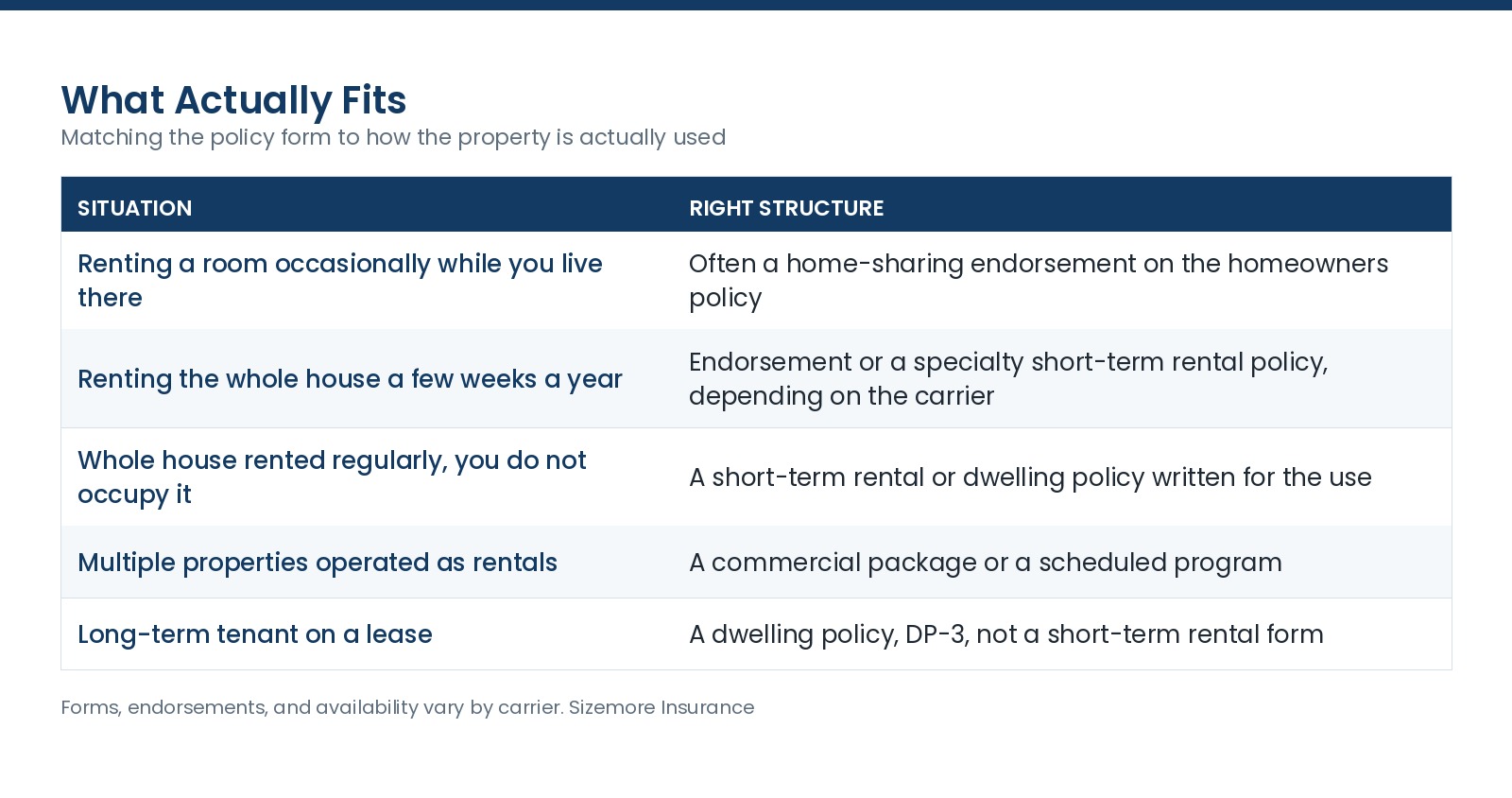
The takeaway: the form has to match how the property is actually used, and the market for these forms is mature. This is not an exotic placement. It is a routine one that owners do not know to ask for.
Forms, endorsements, and availability vary by carrier. Your own policy governs.
Building coverage at replacement cost, sized to rebuild rather than to purchase price.
Liability written for guest exposure, at a limit that reflects strangers in the house. Guest injury is where the large numbers in this class come from, and an umbrella above the primary is worth pricing.
Contents as business personal property, covering the furnishings you bought to operate the rental rather than treating them as household goods.
Loss of rental income, so a covered loss that takes the property offline during peak season does not simply eliminate the revenue.
Coverage between bookings, which is the gap the platform programs do not address at all.
Theft and damage by guests, which standard forms handle poorly and which specialty forms address directly.
Occasional rental and a rental business are different things. A week at Thanksgiving is not the same as a property listed year-round. Where the line falls varies by carrier, which is exactly why the conversation should happen before you list rather than after a loss.
Disclosure is the whole game. A carrier that knows the use can price it and cover it. A carrier that does not know is a carrier with a defense at claim time, and in a serious case a material misrepresentation is a policy problem rather than a pricing one.
Local ordinances are a separate question. Asheville, Wilmington, Charleston, Myrtle Beach, and several coastal towns in both states regulate short-term rentals differently, and permitted use affects both your operation and sometimes your placement. That is a local government question rather than an insurance one, and it is worth resolving first.
Direct bookings sit outside the platform programs entirely. If you take reservations off-platform, whatever protection the platform offers does not follow.
A mortgage may restrict it. Some loan documents limit rental use. Read yours before you build a business on the property.
Multiple properties change the structure. Past two or three, a commercial package or a scheduled program is usually cleaner and less expensive than separate specialty policies.
Does homeowners insurance cover Airbnb in North Carolina or South Carolina?
Generally not for regular short-term rental use. Business pursuits and rental exclusions, and the residence premises definition, are all in play.
What if I only rent a few weeks a year?
Some carriers permit occasional rental, and some offer an endorsement. It depends on the form, which is why you ask before you list.
Is the platform's host protection enough?
No, and it is not designed to be. It is a supplement to your own coverage, not a substitute for it.
Do I need a commercial policy?
Not usually for one property. A short-term rental policy or an endorsement typically fits. Multiple properties are a different conversation.
Will my premium go up?
Usually, and less than owners expect relative to the revenue. The larger issue is that the wrong form can produce no coverage at all.
What happens if I do not tell my carrier?
The carrier finds out at the claim, and that is the worst possible moment. Disclosure costs premium. Nondisclosure can cost the claim.
Sizemore Insurance is an independent insurance company founded in North Carolina in 1977, writing in both North Carolina and South Carolina. Tell us how the property is actually used and we will place the form that matches it. Insurance made just for you.
Forms, exclusions, endorsements, and availability vary by carrier. Local short-term rental regulation varies by jurisdiction and is not an insurance matter. Review your own policy or talk to your advisor.