
Reviewed by Joseph "JJ" Johnson, Chief Operating Officer, NPN 7594559 · October 10, 2026
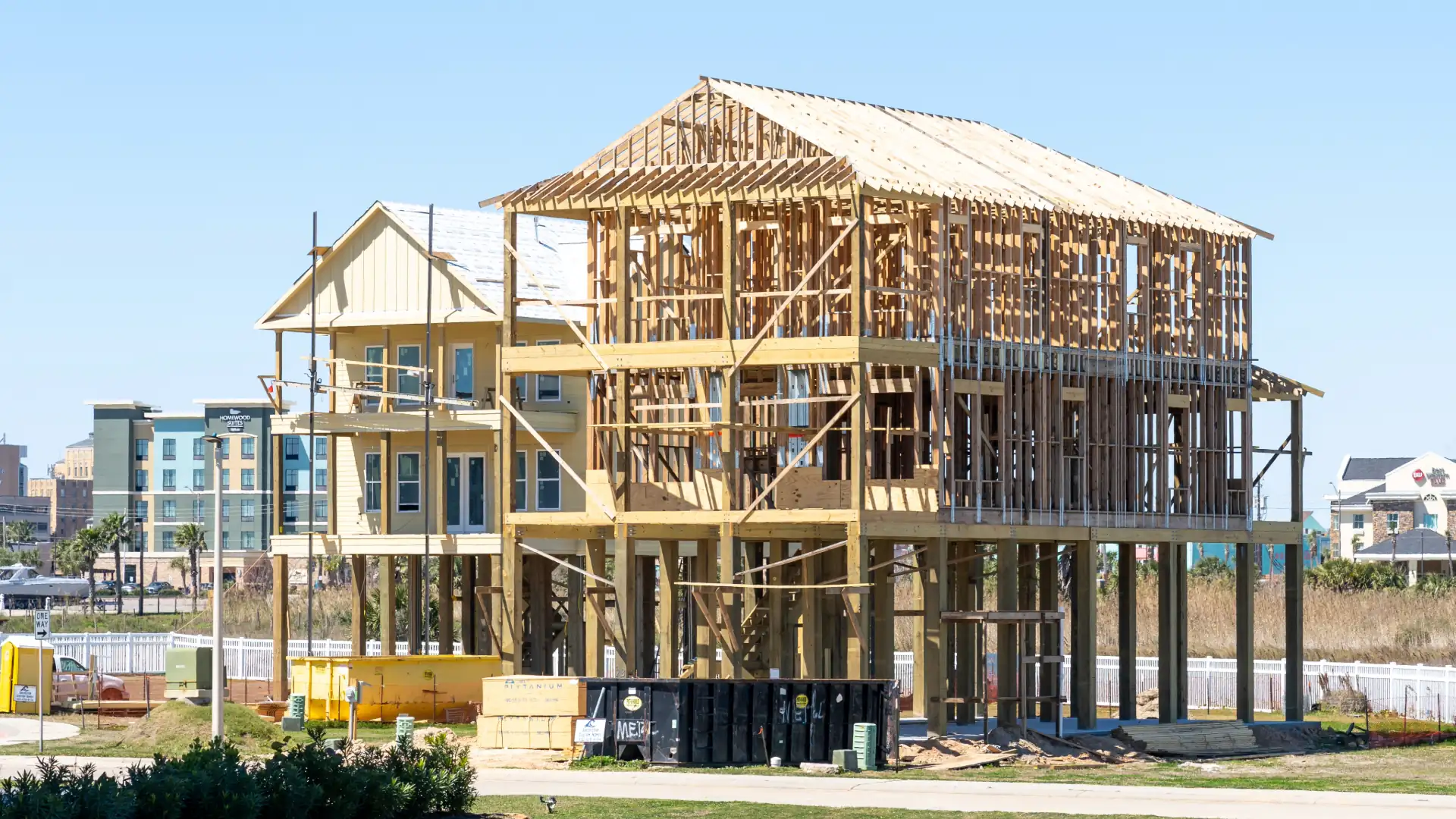
A house under construction near the water is at its most exposed before it is finished. The walls are open, the roof may not be sheathed, materials are stacked on the lot, and hurricane season does not wait for the framing inspection.
Builder's risk insurance is the policy that covers the building while it goes up (what builder's risk covers). On the North Carolina coast, it rarely works alone. Wind, the named storm deductible and flood each need their own answer, and the time to settle them is before the first load of lumber arrives, not when a storm shows up on the forecast.
Flood and storm surge. Most builder's risk forms exclude or sharply limit flood and storm surge. The standard commercial causes of loss form, for example, excludes flood, surface water and storm surge (ISO CP 10 30 sample). On a lot near the sound or the ocean, flood is a separate decision.
Wind on the coast. In the 18 coastal counties, wind and hail is often written apart from the main policy, and named storms usually carry a percentage deductible instead of a flat dollar amount. The NC Department of Insurance's example is 2% of $300,000, or $6,000 (NCDOI).
Materials that are not installed. Theft and some damage to materials sitting on the lot can be limited until they are part of the building (ISO CP 10 30 sample). A storm that scatters a pallet of shingles is a different claim from one that tears off a finished roof.
The homeowners form. The NC Insurance Underwriting Association, the Coastal Property Insurance Pool once called the Beach Plan, says it plainly in its manual: "BUILDERS RISK: Not eligible on Homeowner form" (NCIUA Manual of Rules, 2026).

The takeaway: on the coast, builder's risk covers the build, but wind and flood decide whether the coverage holds up in a hurricane. Each piece has to be chosen on purpose.
Forms, endorsements and availability vary by insurance company. Your own policy governs.
It has construction options, just not on a homeowners form. The Beach Plan's manual lists a dwelling under construction endorsement (DP 11 43) for its dwelling policies and builder's risk forms for commercial policies (NCIUA manual). Its builder's risk application offers the dwelling under construction option only when the applicant will live in the home once it is finished (NCIUA application AP-15).
Wind only, alongside a private builder's risk policy. When the main builder's risk coverage comes from a private insurance company's inland marine policy, the manual allows the Beach Plan to write a commercial wind and hail policy around it (NCIUA manual). Wind and hail policies from the Beach Plan need an active primary policy that excludes wind (NCIUA coverage areas).
Build to the wind code. State law treats one and two family homes built in substantial compliance with the NC building code, including its design-wind requirements, as insurable in the Beach Plan's territory (G.S. 58-45-5). The builder's risk application asks for a certificate that the home is being built that way (AP-15).
Timing matters. The Beach Plan stops binding new or increased coverage after 12:01 AM on the day after a named storm's center enters an area of the Atlantic set out in its manual (NCIUA manual). Private insurance companies set their own limits. If the policy is not bound before a storm forms, it may not be bound until the storm passes.
Forms, endorsements and availability vary by insurance company. Your own policy governs.
The federal flood policy can cover a building under construction. The Standard Flood Insurance Policy covers a building under construction at the insured location, with conditions (44 CFR Part 61, App. A(1)).
Materials must be enclosed. Construction materials are covered only while stored in a fully enclosed building at the location or on adjacent property (SFIP). Lumber under a tarp on an open lot is not.
Walls and roof change the deal. Until the building has at least two rigid exterior walls and a fully secured roof, the flood deductible doubles. If the lowest floor is below the base flood elevation in certain A and V zones, coverage does not apply until the building is walled and roofed. If work stops before then, coverage can end after 90 days (SFIP).
The waiting period. Flood policies usually take 30 days to start. The wait does not apply when the policy is bought in connection with making or increasing a loan (42 U.S.C. 4013), which is how most construction loans handle it.
Forms, endorsements and availability vary by insurance company. Your own policy governs.
Does builder's risk cover hurricane damage in North Carolina?
It can cover wind damage from a hurricane, but on the coast wind may be written separately or carry a percentage named storm deductible. Storm surge and flood are usually excluded and need a flood policy.
Can I get builder's risk through the Beach Plan?
Not on a homeowners form. The Beach Plan's manual offers a dwelling under construction endorsement on dwelling policies, commercial builder's risk forms, and wind and hail coverage alongside a private builder's risk policy, subject to its rules.
Do I need flood insurance while my house is being built?
If the lot is in a flood zone and you have a loan, your lender will usually require it. Even outside a mapped zone, a home near the water can flood, and builder's risk usually will not pay for it.
When should I buy builder's risk on the coast?
Before materials are delivered and well before hurricane season. Once a named storm is close, the Beach Plan and many insurance companies stop writing new coverage until it passes.
What happens to the flood policy when construction is finished?
The doubled deductible stops applying once the building has its walls and a secured roof. Tell us when you are close to the final inspection so the flood policy is updated for the finished home and lines up with the wind and homeowners policies.
Does it matter whether I am in the beach area or the coastal area?
Yes. The Beach Plan writes some coverages only in the beach area, south and east of the Intracoastal Waterway, and wind coverage across all 18 coastal counties. Where your lot sits changes which options exist.
Sizemore Insurance is an independent insurance company founded in North Carolina in 1977, with offices from Wilmington and Leland to Southport, Shallotte, Hampstead and Charlotte. We line up builder's risk, wind and flood for homes going up from Topsail Island to Ocean Isle Beach, then move the finished house to the right homeowners and wind coverage. Insurance made just for you.
Keep reading. Builder's risk insurance in North Carolina; What Happens to Builder's Risk When Your House Is Finished?; Do You Need Builder's Risk for a Home Renovation in North Carolina?.
Sources: NCIUA Manual of Rules and Procedures, 2026; NCIUA coverage areas; NCIUA and NCJUA builder's risk application (AP-15); G.S. 58-45-5; NC Department of Insurance, windstorm and hail; ISO Causes of Loss, Special Form (sample); Standard Flood Insurance Policy, 44 CFR Part 61, App. A(1); 42 U.S.C. 4013.
This article is general information, not a coverage determination or legal advice. Forms, exclusions, endorsements and availability vary by insurance company and change over time. Review your own policy or talk to your advisor.