

Coastal property owners feel this as carriers becoming unreasonable. It is more useful to understand it as arithmetic, because the arithmetic tells you what changes it.
Four things drove capacity out of coastal wind, and none of them is about the individual property.
Reinsurance cost. Insurance companies buy catastrophe protection of their own, and global reinsurance pricing rose sharply in recent years. Every carrier writing property in a coastal state pays that cost and passes it through. This is one of the largest drivers, and it is rarely explained to homeowners.
Catastrophe frequency and severity. Helene alone produced an estimated $59.6 billion in damage and recovery needs in North Carolina, according to the state’s December 2024 assessment, much of it far from the coast. Losses at that scale work through rate structures and through carrier appetite for years.
Rebuild cost inflation. The same storm costs more to repair than it did five years ago, which raises expected losses independent of how often storms arrive.
Concentration. A carrier can write a great deal of coastal property profitably right up until one event damages all of it at once. Managing that means limiting how much sits in one place, which produces declines that have nothing to do with the individual property.
That last one is why a well-maintained house with a new roof and no claims can still get non-renewed. The account was fine. The carrier’s map was not.
Roof age and condition.
In much of eastern North Carolina, roof age determines whether a standard carrier will write a property at all, not just what they charge. Thresholds have tightened, and past one the options narrow to a payment schedule, a higher rate, or a decline.
That is the factor an owner controls, and it is why so much of this section comes back to the roof.
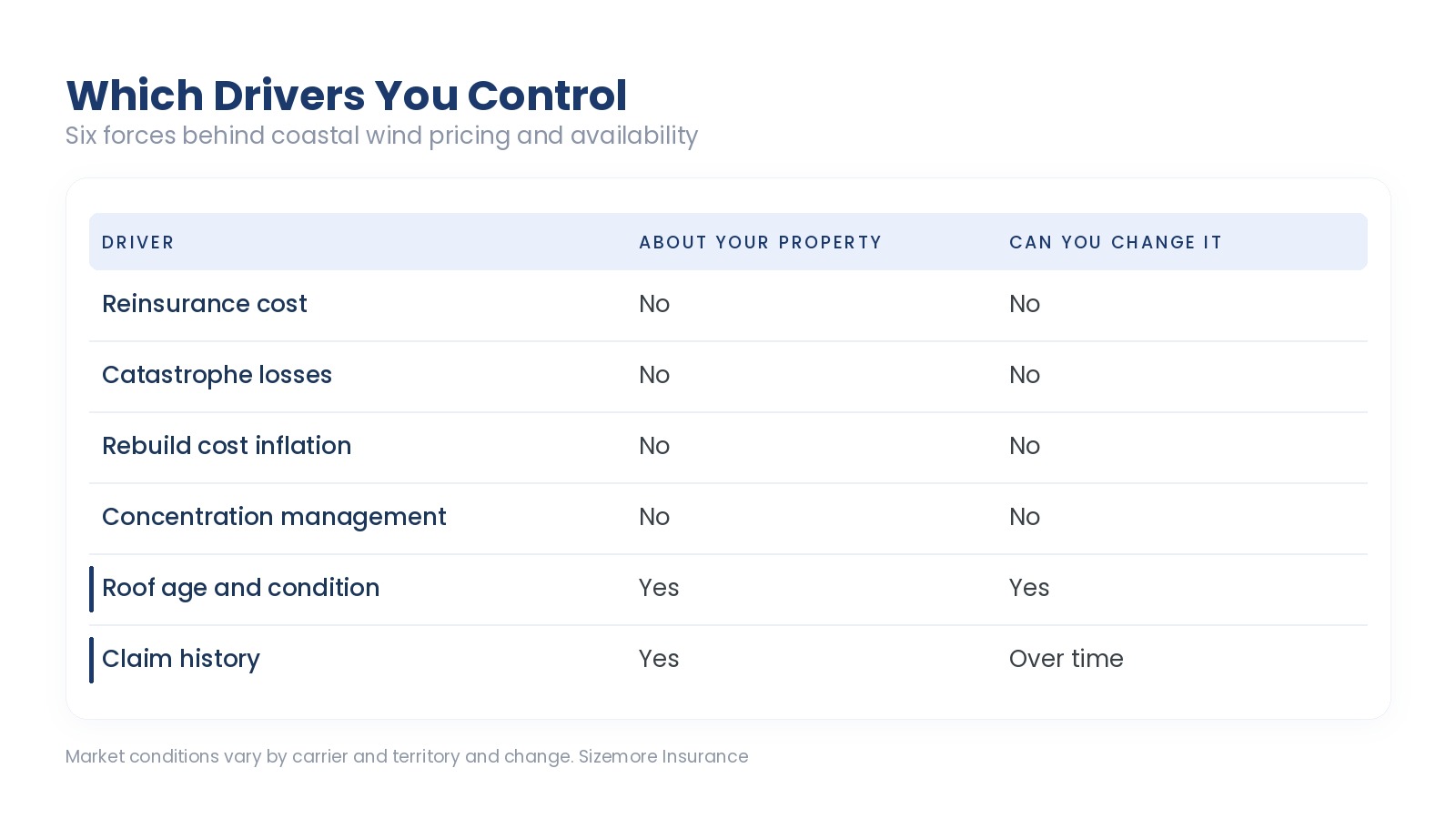
The takeaway: four of the six are market conditions and two are yours, and the roof is the one that moves.
Market conditions vary by carrier and territory and change.
Rate adequacy improved. North Carolina homeowners rates rose an average of 7.5 percent statewide on June 1, 2025 and again on June 1, 2026 under a negotiated settlement, and dwelling rates rise an average of 5 percent on October 1, 2026 and again on October 1, 2027. Carriers price to expected loss, and rate closer to adequacy helps bring capacity back.
Mitigation is now recognized in the rate structure. The dwelling settlement announced in April 2026 included mitigation credits for fortified homes and roofs in many eastern North Carolina territories. That is the industry paying for construction quality rather than only recommending it.
Base rates are locked for now. The homeowners settlement bars another base rate request before June 2027, which makes this a stable window rather than the front edge of a spiral.
Appetite is shifting rather than disappearing. Some carriers pulled back and others moved in. That is why re-marketing matters more in this market than in most.
Rate adequacy and affordability pull against each other, and that tension is what rate proceedings are about. A rate too low drives capacity out. A rate too high is a burden on owners. The settlements are the negotiated middle.
Concentration decisions are opaque. A carrier reducing exposure in your county does not explain why, and there is nothing about your property to fix.
Mitigation credits are still developing, particularly on the commercial side where they are carrier by carrier rather than built into a rate structure.
Reinsurance pricing is global, which means events elsewhere in the world affect what you pay here.
Surplus lines absorbed a lot of the displaced business, which is why so many coastal properties sit there now, and it is a legitimate market rather than a failure.
Why did my carrier drop me when I have no claims?
Frequently concentration management or roof age. The first has nothing to do with your property.
Are rates going to keep rising?
North Carolina homeowners base rates are locked from another request before June 2027. Beyond that depends on catastrophe losses and reinsurance costs.
What is reinsurance and why does it affect me?
Carriers buy catastrophe protection of their own and pass the cost through. It is one of the largest drivers of coastal pricing and it is set globally.
Is capacity coming back?
Appetite is shifting rather than uniformly disappearing, which is why re-marketing every year matters.
What can I actually change?
The roof, and over time your claim history.
Does mitigation help?
Increasingly yes, and the recent dwelling settlement built credits into many eastern North Carolina territories.
Sizemore Insurance is an independent insurance company that has been placing coverage in North Carolina since 1977. Send us your declarations page and we will tell you which of these six drivers is affecting your property and which one you can change. Insurance made just for you.
Rate figures reflect North Carolina Department of Insurance settlement information and are subject to change. Loss figures are estimates from published state reporting. Market conditions and appetite vary and change. Review your own policy or talk to your advisor.