

On much of this coast, one building is covered by two policies from two companies with two renewal dates.
That is a normal structure and it works. It also creates five specific places where things fall between the two, and every one of them is checkable in an afternoon.
The wind policy covers windstorm and hail. Frequently through the North Carolina Insurance Underwriting Association or a specialty carrier.
The companion policy covers everything else: fire, theft, water from inside the building, and generally liability and loss of use.
Neither covers flood. That is a third policy.
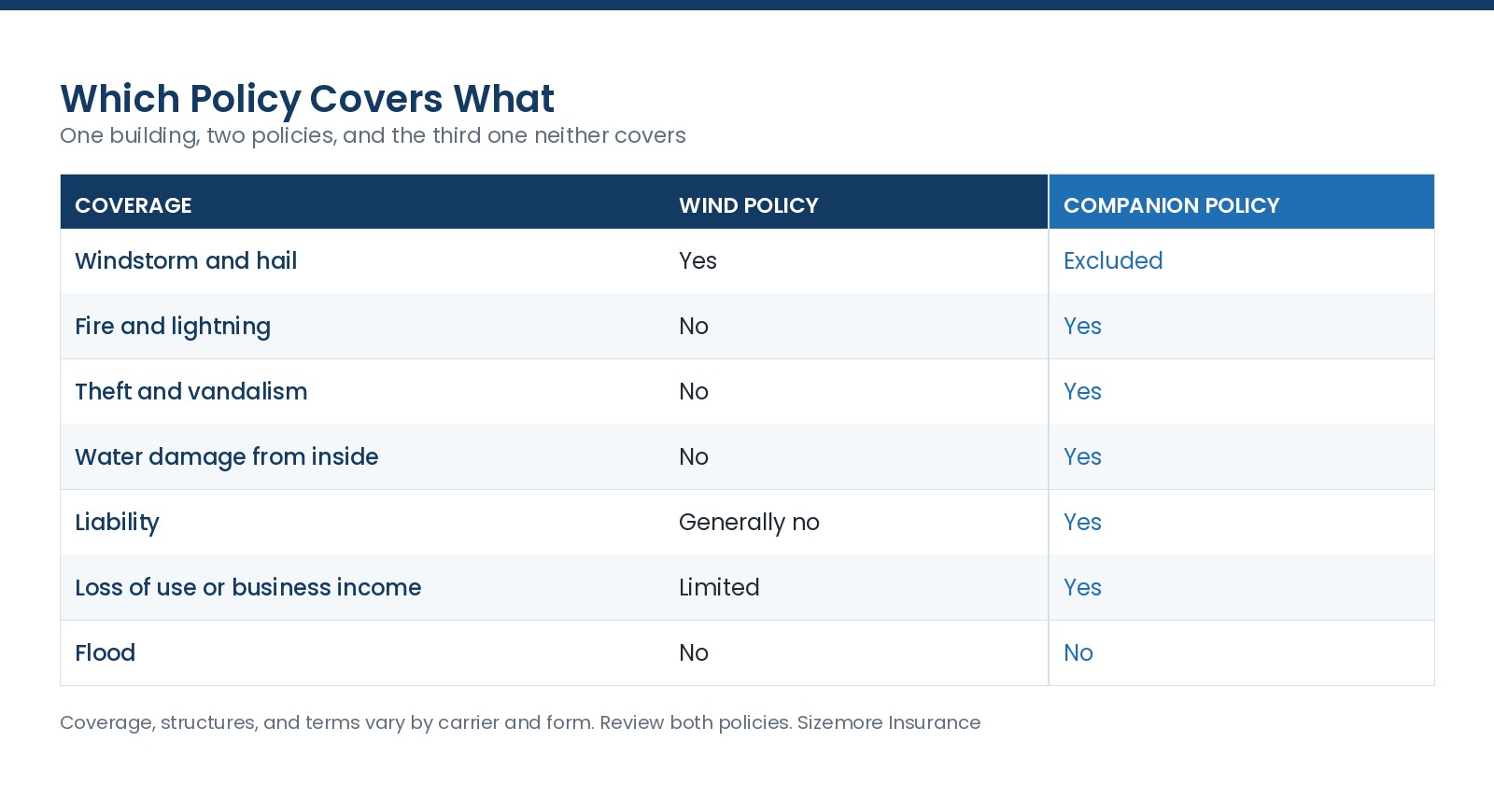
The takeaway: liability and loss of use live in the companion policy, and if that policy is narrow they can be missing entirely.
Coverage, structures, and terms vary by carrier and form. Review both of your policies.
The practical problem is that one event produces two claims and an argument about which policy owns which damage.
A roof comes off in the wind. Rain enters. The interior is damaged, the flooring is ruined, and contents are lost.
The roof is clearly the wind policy. The rain that entered through the opening the wind created is generally the wind policy too. Water that rose from outside is neither and is flood. Water from a pipe that failed unrelated to the storm is the companion policy.
Which is why documentation decides these claims. Photograph the roof and the openings before the season. Photograph everything before anything is moved after. Report to both carriers the same day.
A single carrier is simpler. Where the standard market will write the whole risk, that is generally the better structure, because there is no argument about ownership of a loss and one renewal to review. Ask us to re-market annually.
Excess wind above the cap has to be structured deliberately so there is no gap between the residual layer and the excess layer.
A lender wants evidence from both. Mortgagee wording has to be right on each policy, and a lapse on either triggers force-placed coverage.
Commercial property has the same structure with an additional complication, because business income and ordinance and law are both weaker on the wind side.
Condominium associations have their own version, where wind may be excluded from the master policy.
Do not assume both renewed. Two dates, two bills, and two chances to miss one.
Why do I have two policies on one building?
Because windstorm and hail was excluded from the main policy and written separately, which is common in coastal territories.
Which policy has my liability?
Generally the companion policy. A wind-only policy usually carries none. Confirm it is there.
Which one do I call after a storm?
Both, the same day. One event frequently produces two claims.
Do I pay two deductibles?
If both policies respond, yes.
Can I get back to one policy?
Sometimes, and roof condition is usually the lever. Ask us to re-market at every renewal.
What if my property is worth more than the wind cap?
You need an excess wind layer above it, structured so there is no gap.
We have been an independent insurance company in North Carolina since 1977 and we build these structures regularly. Send us both policies and we will tell you what falls between them. Insurance made just for you.
Coverage, structures, limits, and terms vary by carrier and form. Review your own policies or talk to your advisor.