If you are leased on to a motor carrier, their policy generally covers you while you are working for them. The question this coverage answers is what happens the rest of the time.
Two terms get used for it and they are not synonyms, which is the source of most of the confusion.
The Two Terms
Bobtail describes the physical situation of operating a tractor without a trailer attached. Bobtail coverage responds in that situation.
Non-trucking liability describes the business situation of operating outside of dispatch, meaning not in the service of the motor carrier you are leased to. Non-trucking liability responds then.
They overlap and they are not the same question. One is about the equipment configuration and one is about what you are doing.
Unladen appears in some policy language as a third term, generally meaning operating without a load, and its definition varies by form.
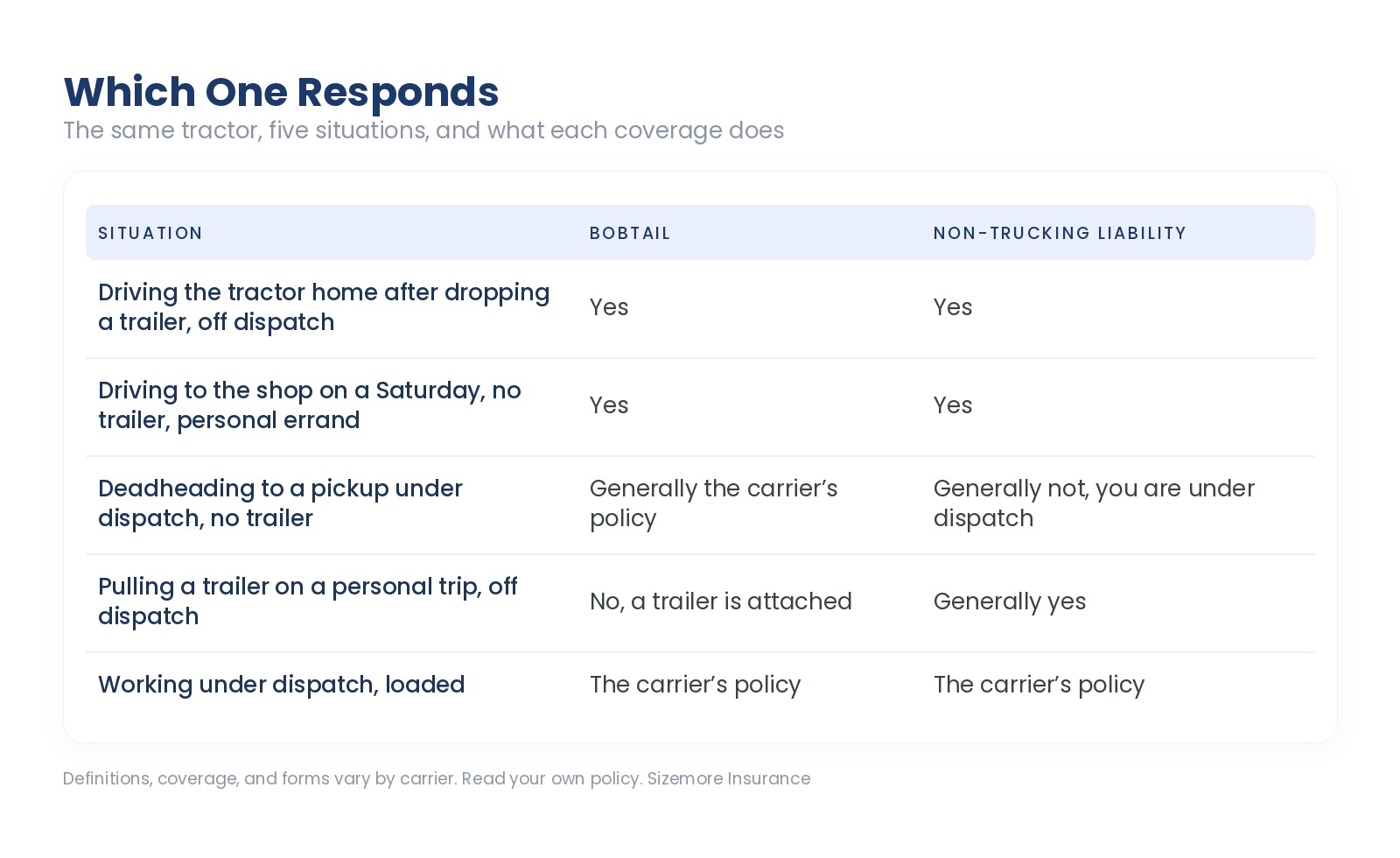
The takeaway: the question that decides coverage is usually whether you were under dispatch, which makes non-trucking liability the more useful of the two concepts.
Definitions, coverage, and forms vary by carrier. Read your own policy.
Why the Gap Exists
Under a lease, the motor carrier’s policy is written to cover their operation. Federal leasing regulations give the carrier control and responsibility for the equipment while it is in their service.
Outside that service, you are operating a commercial vehicle on your own account, and the carrier’s policy is generally not intended to respond. Your personal auto policy will not either, because it excludes vehicles of this type and this use.
So there is a genuine gap, and it is the one this coverage fills.
The Gray Areas
This is where claims get argued.
Deadheading to a pickup. Generally under dispatch, which means the carrier’s policy. Generally.
Between loads. Depends on whether you are still in the carrier’s service and what the lease says.
Driving to a repair shop. Depends on whether the repair is in service of the carrier’s operation.
Fuel stops and breaks during a trip. Generally under dispatch.
A load you took directly, outside the lease. This is a different problem entirely and it is closer to operating without authority than to a coverage question.
The lease agreement is what defines dispatch for most of these, and reading it is the only way to know where the line sits for your specific arrangement.
Where This Gets Complicated
Non-trucking liability is narrower than a primary liability policy. It is not a substitute for having your own coverage if you get your own authority.
It does not cover cargo, and there is no cargo when you are off dispatch.
It does not cover physical damage to your tractor. That is a separate policy and it is yours regardless of dispatch, because the carrier’s physical damage coverage generally does not extend to owner-operator equipment.
If you get your own authority, this coverage stops fitting. A carrier with its own authority needs primary liability that covers all use, not a narrow off-dispatch product.
Some motor carriers require it and deduct it from settlements. Confirm what you are actually being provided and at what limit, because it is frequently less than you would buy yourself.
Multiple leases complicate the dispatch question considerably.
Personal use of a commercial vehicle raises questions beyond insurance, including regulatory ones about markings and logging.
Common Questions
What is bobtail insurance?
Coverage for operating a tractor without a trailer attached.
What is non-trucking liability?
Coverage for operating outside of dispatch, when the motor carrier’s policy generally does not respond.
Are they the same thing?
No. One is about the equipment configuration and one is about what you are doing. They overlap.
Do I need it if I am leased on?
Generally yes, because the carrier’s policy covers you in their service and not otherwise.
Do I need it if I have my own authority?
No. You need primary liability covering all use. This is a narrower product built for a different situation.
Does my personal auto policy cover me driving the tractor?
No. Personal auto policies exclude vehicles of this type and use.
The Bottom Line
- Read the lease to find out how dispatch is defined for your arrangement.
- Carry non-trucking liability if you are leased on, because the gap is real.
- Confirm the limit, particularly if the motor carrier is providing it and deducting for it.
- Carry your own physical damage, because the carrier’s coverage generally does not reach your tractor.
- Understand it is narrow. It is not a substitute for primary liability.
- Change the structure when you get your own authority, because this product no longer fits.
Sizemore Insurance is an independent insurance company that has been placing coverage in North Carolina since 1977. Send us your lease and your current coverage and we will tell you exactly where the gap sits. Insurance made just for you.
Definitions, coverage, forms, and lease provisions vary by carrier and agreement. Nothing here is legal advice or a coverage determination. Review your own lease and policy or talk to your advisor.