Anyone who gives you a number without asking about your authority, your radius, and your commodity is guessing.
Trucking premiums vary more between two operations than almost any other class of business insurance. Two carriers with one truck each, in the same county, can be quoted very differently and both quotes can be correct.
Here is what actually drives it, ranked, and which parts you can move.
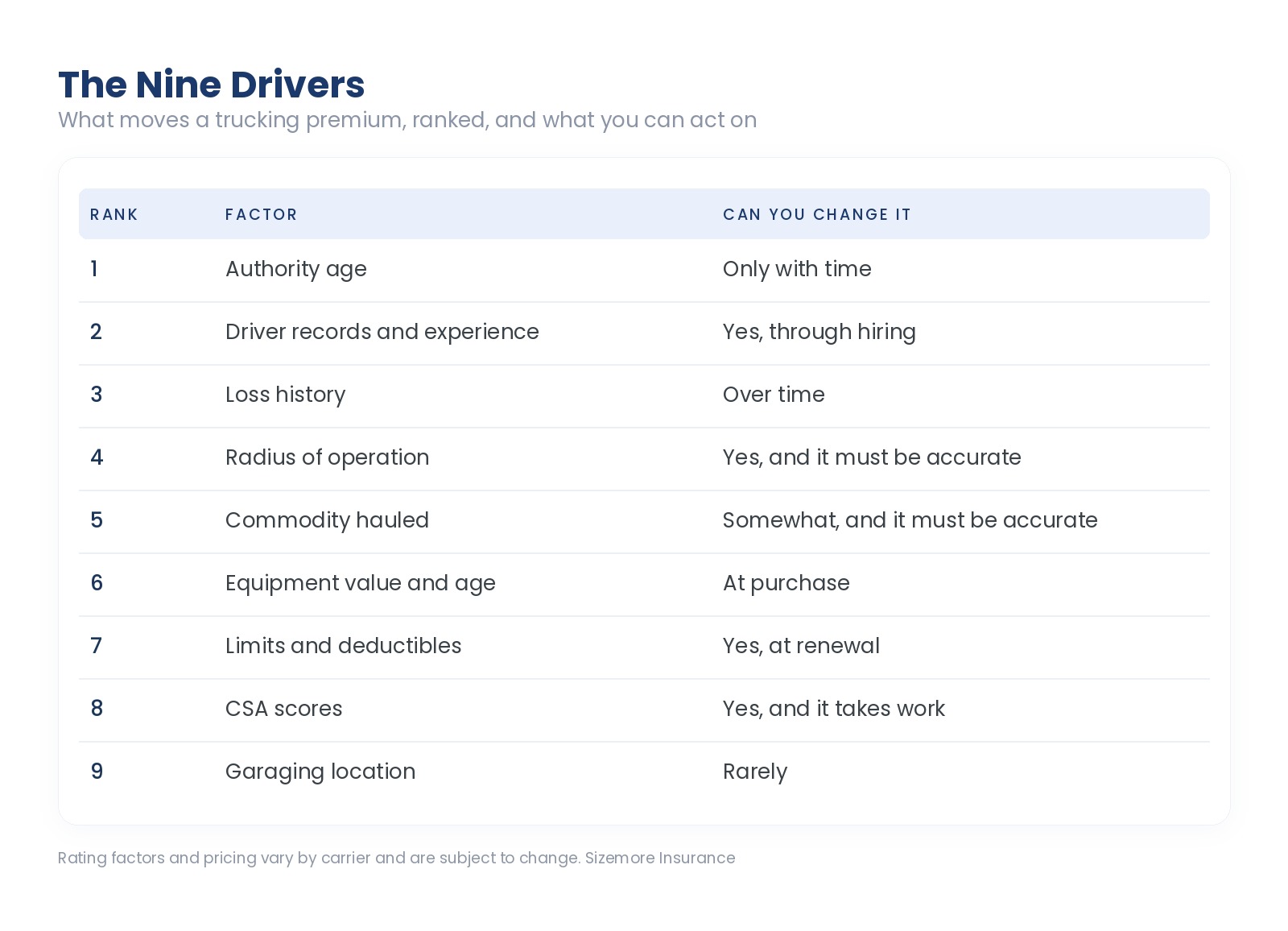
The takeaway: the top three are largely time and hiring, and the ones you can act on this month are radius accuracy, commodity accuracy, limits, and deductibles.
Rating factors and pricing vary by carrier and are subject to change. Get a quote for your specific operation.
Why Year One Is the Most Expensive
New authority is priced as an unknown. There is no loss history, no operating record, and no CSA data, and underwriters have seen enough new ventures fail in the first eighteen months to price accordingly.
That is not a penalty aimed at you. It is the absence of information.
It also means the price comes down as the information accumulates, which is why the first renewal, the eighteen-month mark, and the two-year mark are all worth re-marketing around. A clean record can earn real reductions over time.
The corollary is that a claim in year one is disproportionately expensive, because it becomes most of what an underwriter knows about you.
The Two Things That Have to Be Accurate
These are worth separating out because getting them wrong costs money in both directions.
Radius. Your operating distance from your base is a rated item and frequently a warranted one. Understating it to save premium is a misrepresentation that can defeat a claim on a load outside the stated radius. Overstating it is money you did not need to spend.
Commodity. What you haul drives cargo pricing and it drives eligibility. Hauling outside your declared schedule can void a cargo claim. Broadening the schedule properly costs something and it costs less than a denied claim.
Both of these have their own articles in the problems and gaps section because both produce real denials.
What Actually Lowers It
Time and a clean record. The strongest lever, and it is not fast.
Driver quality. Motor vehicle records are read closely, and hiring standards are underwriting currency. A carrier with documented hiring standards presents differently than one without.
CSA score management. Correcting bad data through the formal challenge process, coaching on the categories that matter, and timing improvements ahead of a renewal.
Accurate radius and commodity, which prevents both overpaying and having a claim denied.
Deductibles, particularly on physical damage, where a higher deductible on equipment you could self-insure to a point produces real savings.
Telematics and cameras, which are covered separately. The honest read is that they win claims more reliably than they cut premiums, and both are worth something.
Shopping at the right moment, meaning 45 to 60 days ahead of renewal with a clean submission package, not the week before.
Where This Gets Complicated
A cheap quote frequently leaves something out. Compare the coverages line by line, particularly cargo limit, trailer interchange, and whether general liability is included.
Premium finance affects cash flow, not cost. A low down payment is a financing structure, and the missed payment consequence reaches your filings.
Contract requirements can exceed what you were planning to buy, and finding that out after you have committed to a lane is expensive.
Loss history follows the operation, and it follows the people. Closing and reopening under a new authority to shed it is a pattern underwriters screen for.
Physical damage on older equipment is worth running the math on the same way you would on a personal vehicle.
Workers compensation is a separate market with its own rating, and in trucking it is a meaningful share of the total.
Common Questions
How much does trucking insurance cost?
It depends on authority age, driver records, loss history, radius, commodity, and equipment. New authority is the most expensive period and a quote on your specific operation is the only meaningful number.
Why is my first year so expensive?
There is no operating history to price against, so you are priced as an unknown.
How fast does it come down?
Meaningfully over the first two to three years with a clean record, and a claim resets much of that progress.
What is the fastest thing I can control?
Accurate radius and commodity, deductible structure, and driver hiring standards.
Does shopping help?
Yes, at the right moment, with a clean submission package, 45 to 60 days out.
Do cameras lower my premium?
Sometimes modestly, and they are more reliably valuable at claim time.
The Bottom Line
- Get quoted on your actual operation, because a general number is not useful.
- Make radius and commodity accurate, in both directions.
- Build documented driver hiring standards, because underwriters read them.
- Work your CSA scores ahead of a renewal rather than after.
- Re-market at the milestones: first renewal, eighteen months, and two years.
- Compare coverages line by line, because a cheap quote frequently left something out.
Sizemore Insurance is an independent insurance company that has been placing coverage in North Carolina since 1977. Tell us your authority date, your radius, and what you haul and we will give you a real number. Insurance made just for you.
Rating factors, pricing, and availability vary by carrier and operation and are subject to change. Review your own situation with your advisor.