Carriers frequently skip this one, reasoning that a trucking business is a truck and the truck is covered.
Then a broker contract requires it, or somebody gets hurt at the yard, or a load falls off a forklift during unloading, and the auto policy points at the general liability policy that does not exist.
What It Covers
Premises liability. Your yard, your terminal, your office. Someone injured on your property.
Operations away from the vehicle. Work you perform that is not the operation of the truck itself.
Products and completed operations, which matters more than it sounds for carriers who do anything beyond haul.
Personal and advertising injury, including certain claims arising from your business communications.
Contractual liability assumed under an insured contract, which is how broker agreement indemnity language gets covered.
Defense costs, generally in addition to the limit.
The Loading and Unloading Question
This is where auto liability and general liability meet, and where a gap can open.
Injury or damage arising from the use of the auto is generally an auto liability matter. Injury or damage from your operations that is not the use of the auto is generally general liability.
Loading and unloading sits between them, and the answer depends on the facts: who was doing the work, what equipment was involved, and whether the truck was in use.
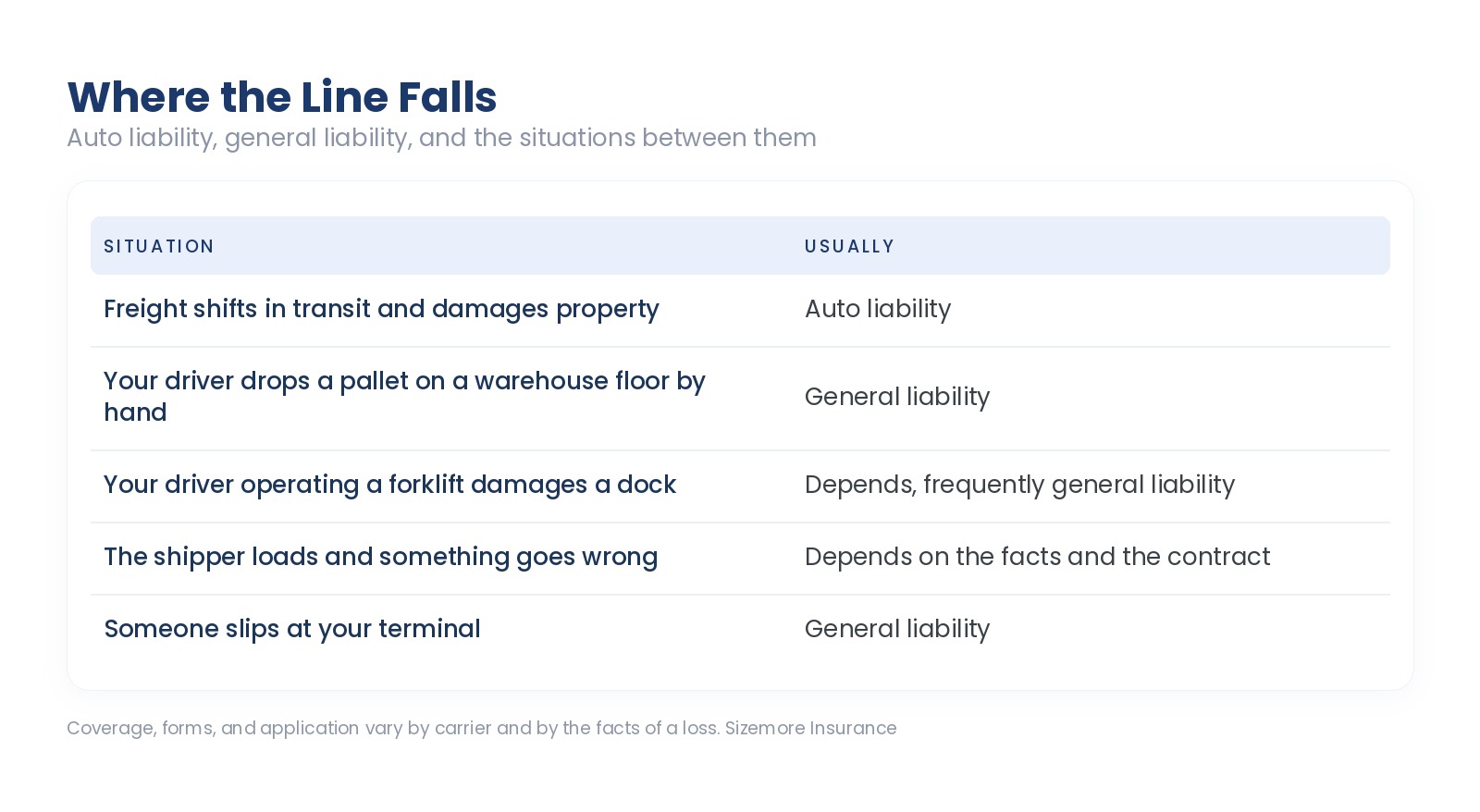
The takeaway: carrying both is what prevents the argument, and carriers who skip general liability are betting that every loss will fall on the auto side.
Coverage, forms, and application vary by carrier and by the facts of a loss. Nothing here is a coverage determination.
Why Brokers Require It
Broker and shipper contracts commonly require general liability at a stated limit alongside auto and cargo. That is frequently the reason a carrier buys it, and it is a legitimate reason.
The contract may also require additional insured status, a waiver of subrogation, and primary and non-contributory wording. Those are three separate requests, each with a cost and an implication, and agreeing to them without reading is how carriers end up with obligations they did not price.
Where This Gets Complicated
A terminal or yard changes the exposure substantially. Property, premises liability, and employee exposure all scale with a physical location.
Pollution is frequently excluded on a general liability form, and a fuel spill is a real trucking exposure. That is a separate conversation.
Employee injury is workers compensation, not general liability.
Damage to property in your care is generally excluded from general liability and covered by cargo, garagekeepers, or bailee coverage depending on the situation.
Warehousing or brokering on the side are different exposures with different coverage, and a carrier who also brokers freight has a specific gap worth addressing.
A package policy may bundle it with property and auto, which simplifies claims coordination.
Additional insured status is not free and it is not automatic. Adding a broker as additional insured requires an endorsement.
Common Questions
Do I need general liability if I have commercial auto?
Auto covers the use of the vehicle. General liability covers everything else your business does, and brokers frequently require it.
Why does my broker require it?
Contracts commonly specify auto, cargo, and general liability limits, plus additional insured status.
Does it cover loading and unloading?
Sometimes, depending on the facts. Carrying both auto and general liability is what prevents the gap.
Does it cover damage to the freight?
No. That is cargo coverage.
Does it cover employee injuries?
No. That is workers compensation.
What is additional insured status?
An endorsement giving another party status under your policy. It is a separate request with a cost and it is not automatic.
The Bottom Line
- Carry it, because the gap between auto and general liability is real and brokers require it anyway.
- Read the broker contract’s insurance section before agreeing to it, particularly the additional insured, waiver, and primary wording requests.
- Address pollution separately, because it is frequently excluded.
- Address your terminal or yard if you have one, since that is where the premises exposure lives.
- Tell us if you also broker freight, because that is a different exposure entirely.
- Ask about a package if you want claim coordination under one carrier.
Sizemore Insurance is an independent insurance company that has been placing coverage in North Carolina since 1977. Send us a recent broker contract and we will tell you whether your program meets what you signed. Insurance made just for you.
Coverage, forms, exclusions, and contractual requirements vary by carrier, form, and agreement. Nothing here is legal advice or a coverage determination. Review your own contracts and policy or talk to your advisor.