Reviewed for insurance accuracy by Brad Sizemore, Owner and CEO, NPN 6595451 · November 25, 2026
Most homeowners assume that anything underground and outside the house belongs to the utility.
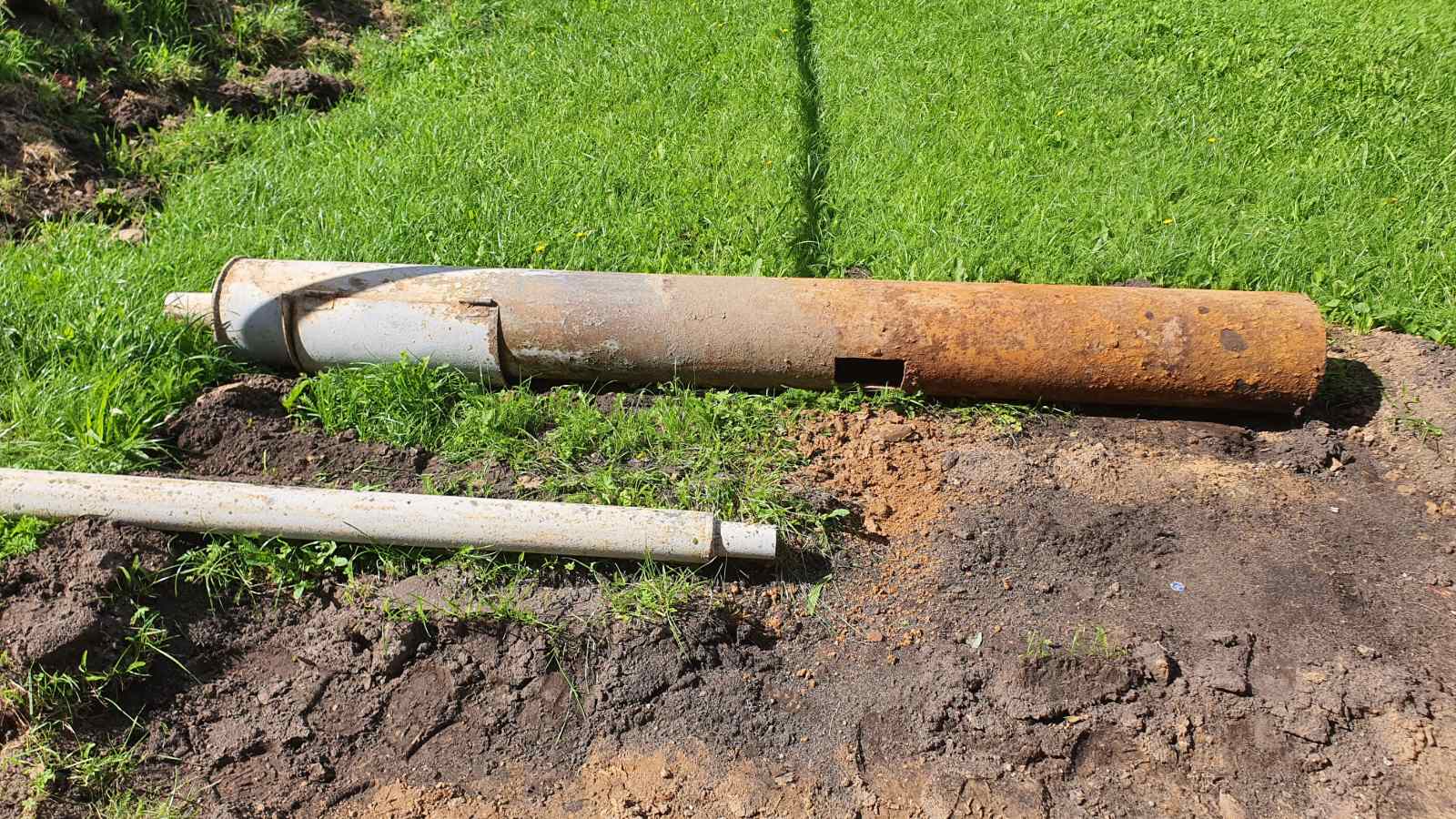
It usually does not. From the point where the utility’s responsibility ends, which is frequently at the street or the meter, the buried lines running to your house are yours. The water line, the sewer lateral, the electric service, the gas line, and the data and cable lines.
When one fails, you pay to dig it up, repair it, and put the yard back. Service line coverage is an inexpensive endorsement that pays to repair or replace those lines, and to dig up and restore the yard, when they fail from causes the base policy specifically excludes.
The repair or replacement of the failed line.
Excavation, which on a long run through a mature yard is frequently the largest part of the bill.
Restoration of the landscape, driveway, or hardscape disturbed to reach it.
Loss of use, if the failure makes the home uninhabitable while it is fixed.
Sometimes the cost of an outside specialist to locate the failure.
A standard homeowners policy excludes wear, tear, deterioration, rust, corrosion, and damage caused by roots or vermin. Those are precisely how buried lines fail.
A tree root that finds a clay sewer lateral over fifteen years is not a sudden accidental event. It is the ordinary aging of a buried pipe, and it sits outside the base form.
Service line coverage is written specifically to reach those causes, which is what makes it useful.
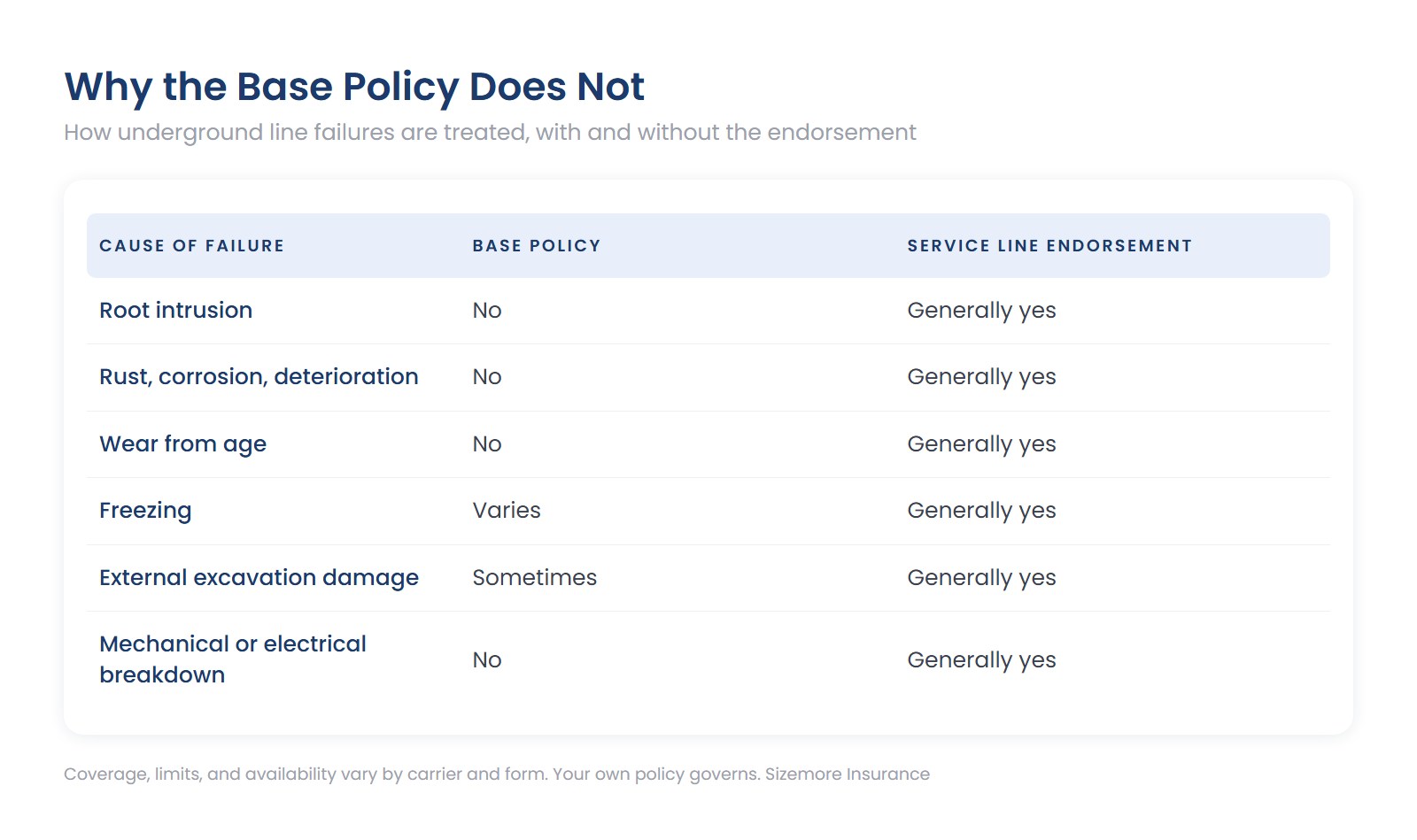
The takeaway: this endorsement covers the causes the base policy specifically excludes, which is why it exists.
Coverage, limits, and availability vary by carrier and form. Your own policy governs.
Service line is typically one of the least expensive endorsements available, commonly a small annual amount for a limit around $10,000 with a modest deductible, frequently $500.
For context, replacing a sewer lateral under a driveway, or a water line running two hundred feet through a mature yard, routinely runs several thousand dollars and can run considerably more once restoration is included.
Older homes are the higher exposure. Clay sewer laterals, galvanized water lines, and cast iron are all common in downtown neighborhoods and all fail eventually.
Long runs cost more to fix. A rural property with a well, a septic system, and a long driveway has more buried line than a house on a small lot, and more of it to excavate.
Septic and well systems may or may not be included. Ask specifically if you have either, because in much of North Carolina that is the relevant question.
Utility-owned portions are not yours. The endorsement covers lines you are responsible for. Where the responsibility line falls varies by utility and by connection.
Some utilities market their own protection plans. Those are service contracts rather than insurance. They may fit, and compare them to what the endorsement costs before subscribing to several.
It does not cover the sewer backup itself. If a failed lateral causes water to back up into the house, water backup coverage handles the interior damage and service line handles the pipe. Two different endorsements, frequently needed together.
Who is responsible for the water line to my house?
Usually the homeowner, from wherever the utility’s responsibility ends. Confirm with your utility.
Does homeowners insurance cover a broken sewer line?
Not under the base policy, because the usual causes are excluded. Service line coverage addresses it.
How much does the endorsement cost?
Typically a small annual amount for a $10,000 limit. Ask and compare it to a single excavation bill.
Does it cover my septic system?
Sometimes, and it varies by form. Ask specifically.
Is this the same as the utility’s protection plan?
No. Those are service contracts. Compare cost and scope before buying both.
Do I need water backup too?
They cover different things. Service line covers the pipe, water backup covers the interior damage.
Sizemore Insurance is an independent insurance company founded in North Carolina in 1977. Send me your declarations page and I will tell you whether you have this and what it would cost to add. Insurance made just for you.
Sources: North Carolina Department of Insurance, consumer guidance on homeowners coverage and endorsements in North Carolina (ncdoi.gov); North Carolina Rate Bureau, the North Carolina homeowners policy forms and their exclusions (ncrb.org).
Coverage, limits, deductibles, and availability vary by carrier and form. Review your own declarations page or talk to your advisor.
Coverage details: North Carolina Home Insurance