Reviewed for insurance accuracy by Brad Sizemore, Owner and CEO, NPN 6595451 · November 16, 2026
View reviewer profileThe old neighborhoods in our downtowns are some of the best housing stock in this state. They are also, from an underwriting perspective, four questions in a trench coat. Whether an older home is easy or hard to insure comes down to four building systems, and updating them widens the carrier list.
Electrical, plumbing, roof, and heat. Answer those four well and an older home is a routine placement. Answer any of them badly and the carrier list gets short quickly, regardless of how beautifully the house has been kept.
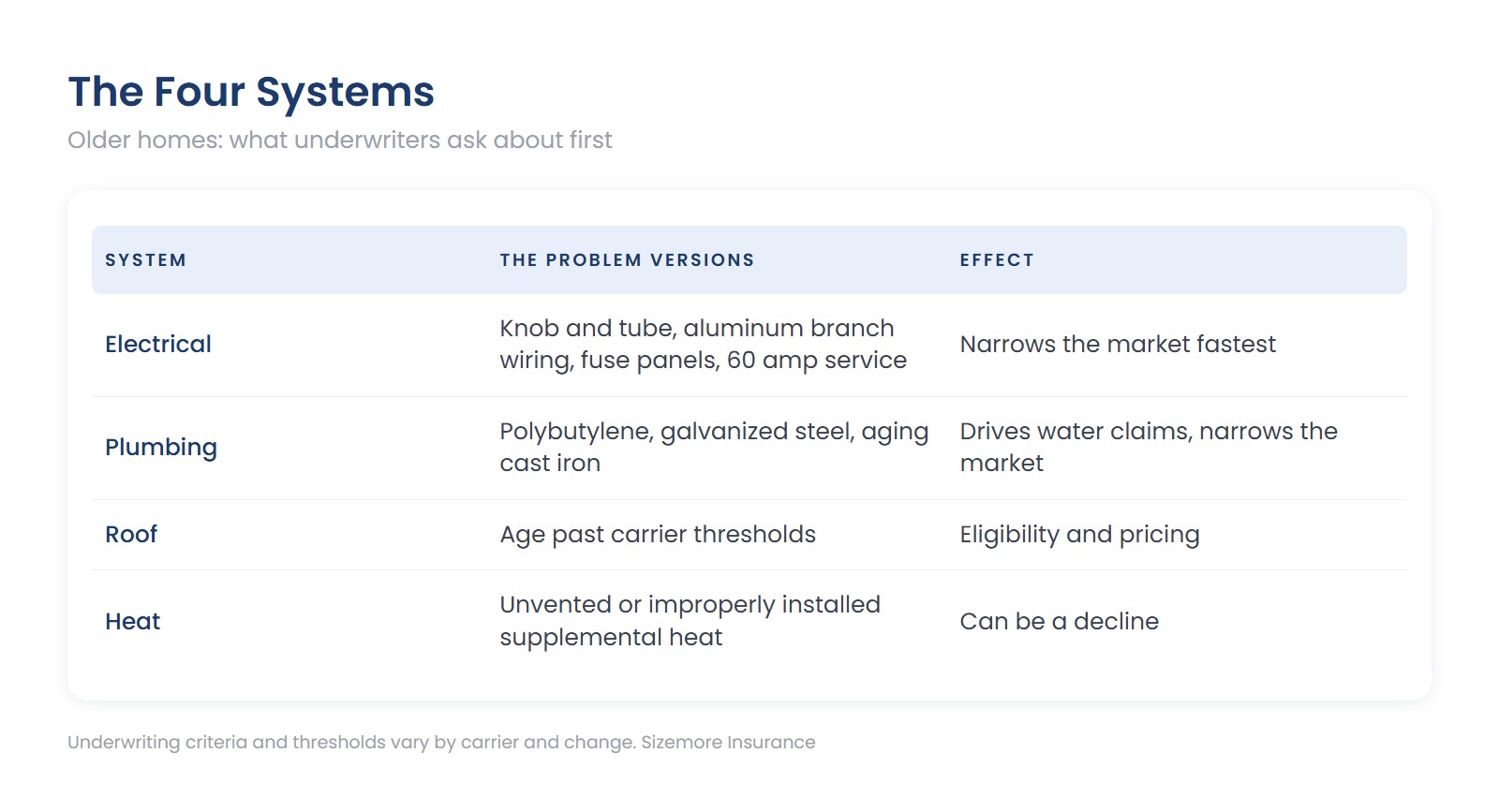
The takeaway: electrical is the first thing an underwriter asks about on an older house, and plumbing is what actually produces the claims.
Underwriting criteria and thresholds vary by carrier and change.
Knob and tube wiring is the oldest of these and most carriers will not write a home with active knob and tube circuits. Partial remaining runs in an attic are a common finding during renovation and they need to be addressed and documented.
Aluminum branch wiring, common in homes built in a window of the late 1960s and early 1970s, is a recognized concern at connections. Approved remediation methods exist, and a documented remediation by a licensed electrician meaningfully changes the underwriting conversation.
Fuse panels narrow the market on their own. A modern breaker panel with adequate service capacity is one of the higher-return updates an owner of an older home can make.
Service capacity matters too. A house wired for 1955 loads that now runs central air, a home office, and an induction range is carrying a real exposure.
Polybutylene supply piping, used in a window from roughly the late 1970s into the mid 1990s, has a failure history and many carriers restrict or decline it.
Galvanized steel corrodes internally, restricts flow, and eventually fails.
Cast iron waste lines deteriorate over decades and produce their own set of problems.
Repiping is expensive and it is the kind of capital work that changes both the underwriting and the claim frequency that follows. Water is one of the most common homeowners claims and it originates here.
Immediately, at the next renewal or placement: a panel replacement, a repipe, a roof replacement, or a documented aluminum wiring remediation all widen the carrier list and improve the rate.
Over time: fewer water claims, which matters more than any single-year credit in a market where frequency drives non-renewal.
Underwriters price what is documented. An upgrade nobody told the carrier about does not exist. Send invoices, permits, and completion dates to your advisor when the work is done rather than mentioning it at renewal.
Ordinance or law coverage is close to essential. An older home rebuilt after a covered loss must meet current code, and on a 1920s house that gap is substantial. It is an inexpensive endorsement and it is the one owners of older homes most often lack.
Replacement cost on an older home is not intuitive. Plaster, millwork, heart pine flooring, and true dimensional lumber cost more to reproduce than modern equivalents. A standard valuation can undershoot on a house with real craftsmanship in it.
Historic district review affects both cost and timeline. Where materials and methods are constrained, a rebuild takes longer and costs more. Tell your advisor if the house is in a district.
Functional replacement cost is a different setting. Some policies pay to rebuild with modern common construction rather than in kind. Plaster becomes drywall. That is a legitimate basis and it is not full replacement cost. Know which you have.
A pre-purchase inspection should ask these four questions specifically. A general inspection may note the panel type without flagging what it does to insurability. Ask during due diligence, while it is still negotiating information.
Insurance can be the reason to sequence a renovation differently. If you are updating anyway, doing the panel and the plumbing first has an insurance benefit the kitchen does not.
Can I insure a house with knob and tube wiring?
It is difficult in the standard market and it is why remediation is usually the answer.
Does aluminum wiring make a house uninsurable?
No. Documented remediation by a licensed electrician using an approved method meaningfully changes the conversation.
What is polybutylene and why do carriers care?
Supply piping used from roughly the late 1970s into the mid 1990s with a failure history. Many carriers restrict or decline it.
Will updating lower my premium?
Usually, and the larger benefit is access to more carriers and fewer water claims over time.
Do I need ordinance or law coverage on an older home?
Yes, in practical terms. Rebuilding to current code on a house built decades before it is a large uncovered gap otherwise.
Should I ask about this before buying?
Absolutely. Panel type, wiring, plumbing material, and roof age during due diligence, while you still have leverage.
Sizemore Insurance is an independent insurance company founded in North Carolina in 1977, and we write a lot of older homes. Tell us the panel, the plumbing, and the roof and we will tell you where the house sits in the market. Insurance made just for you.
Sources: North Carolina Rate Bureau, North Carolina homeowners policy forms and endorsements, including ordinance or law coverage and replacement cost valuation (ncrb.org); North Carolina Department of Insurance, consumer guidance on homeowners coverage (ncdoi.gov).
Underwriting criteria, thresholds, and availability vary by carrier and change. Review your own policy or talk to your advisor.
Coverage details: North Carolina Home Insurance