Reviewed for insurance accuracy by Brad Sizemore, Owner and CEO, NPN 6595451 · November 18, 2026
A lot of North Carolina households sit on land. Twenty acres, a barn, a tractor, a few head of cattle or a couple of horses, a pond, and a workshop. Once there is equipment worth insuring, livestock, or any income from the land, a farm or farmowners policy usually fits better than a homeowners policy stretched with endorsements.
Insured on a standard homeowners policy, most of that is either uncovered or covered at a limit that does not reflect what it is worth. The homeowners form was built for a house on a lot.
Other structures, Coverage B, is typically a percentage of the dwelling limit, commonly 10 percent. On a $500,000 house that is $50,000. Now add a barn, a machine shed, a run-in shelter, a workshop, fencing across twenty acres, and a well house.
Fencing alone on real acreage frequently exceeds what most owners assume, and it is exposed to every storm.
Farm equipment is generally not covered. A tractor, an implement, a hay baler, and a utility vehicle are typically outside personal property coverage or subject to low sublimits.
Livestock is generally excluded. Cattle, horses, goats, and poultry are not personal property in the way a homeowners policy means it.
Liability from farming activity may be excluded. Standard homeowners liability contains a business pursuits exclusion, and where an operation generates income the exclusion can reach it.
Animals create their own liability. A horse that gets loose onto a road, or a visitor injured around livestock, is exposure a homeowners policy may not address.
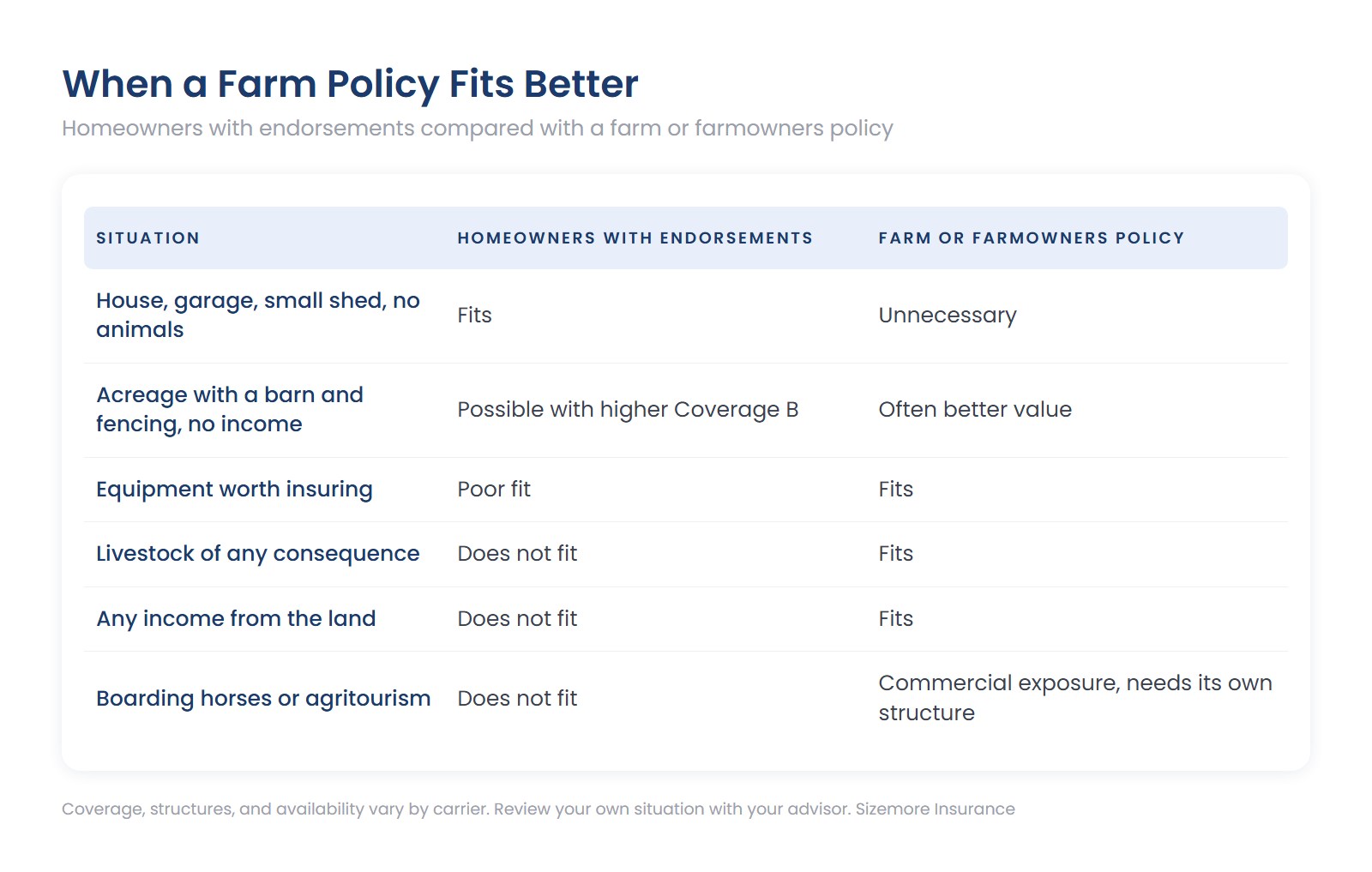
The takeaway: the line is not the acreage, it is the equipment, the animals, and whether anything generates income.
Coverage, structures, and availability vary by carrier. Review your own situation with your advisor.
A farmowners policy typically packages the home, the outbuildings, the equipment, the livestock, and farm liability into one program, and on a property with real barns and equipment it frequently costs less than a homeowners policy stretched with endorsements.
Incidental farming versus a business. Selling hay to a neighbor, a roadside stand, or a few beef cattle a year sits in an area where carriers draw the line differently. Describe the actual activity rather than guessing which label applies.
Boarding horses is a commercial activity with liability that a homeowners policy will not address. So is agritourism, a wedding venue, a corn maze, or a pumpkin patch.
Hunting leases create liability. If you lease the land for hunting, that arrangement needs its own attention.
Ponds and water features are an attractive nuisance. So are ATVs, which are also frequently excluded from homeowners liability off your own premises.
Protection class matters on rural property. Distance to a hydrant and a responding department drives the rate substantially, and it is worth confirming the classification is current.
Barn fires are severe and hard to fight. Distance from a station, no hydrant, and a large combustible structure with hay in it. Electrical condition in older barns is a recurring cause and worth an inspection.
Detached structures need to be listed accurately. An underwriter cannot cover a barn nobody mentioned, and a Coverage B percentage does not stretch to cover surprises.
Does homeowners insurance cover my barn?
Under other structures, up to a percentage of the dwelling limit shared with every other detached structure. On real acreage that is frequently short.
Is my tractor covered?
Generally not under a homeowners policy, or only at a low sublimit. Equipment belongs on a farm policy or a scheduled endorsement.
Are my horses covered?
Livestock is generally excluded from homeowners policies. A farm policy addresses it.
Do I need a farm policy if I do not farm commercially?
Frequently yes, and it is about the structures, equipment, and animals rather than about income. It also often costs less than the endorsed alternative.
What if I sell a little hay or a few cattle?
Describe the actual activity to your advisor. Carriers draw the incidental line differently.
Does my policy cover an ATV?
Frequently not off your own premises, and sometimes not on it. Ask specifically.
Sizemore Insurance is an independent insurance company founded in North Carolina in 1977, and we write a lot of land. Tell us what is on yours and we will price it both ways. Insurance made just for you.
Sources: North Carolina Department of Insurance, consumer guidance on homeowners coverage, other structures and policy exclusions (ncdoi.gov); North Carolina Rate Bureau, North Carolina homeowners policy forms and the role of protection class in homeowners rates (ncrb.org).
Coverage, exclusions, structures, and availability vary by carrier and form. Review your own policy or talk to your advisor.
Coverage details: North Carolina Home Insurance