Reviewed for insurance accuracy by Brad Sizemore, Owner and CEO, NPN 6595451 · November 12, 2026
View reviewer profileTwo nearly identical houses, one in town and one eleven miles up a gravel road, will not be quoted anywhere near the same. The reason is protection class, the rating for how far the house sits from a responding fire station and a water source.
The difference is not the house. It is how long it takes a fire truck to get there and whether there is water when it arrives. On mountain property that single factor can move a premium more than construction, square footage, and finish level combined.
It is also the factor owners understand least and can sometimes do something about.
Insurance carriers use a protection classification, generally a scale from 1 to 10, describing the fire protection available at a specific address. Lower is better.
Two measurements drive it.
Distance to a responding fire station, measured by road miles rather than as the crow flies. A house five miles out by road is treated very differently from one at four.
Distance to a water source, typically a hydrant within a defined distance. Beyond that, the department relies on tanker shuttle, and the classification reflects it.
Departments themselves are also rated on staffing, equipment, training, and water supply, so two homes the same distance from different departments can classify differently.
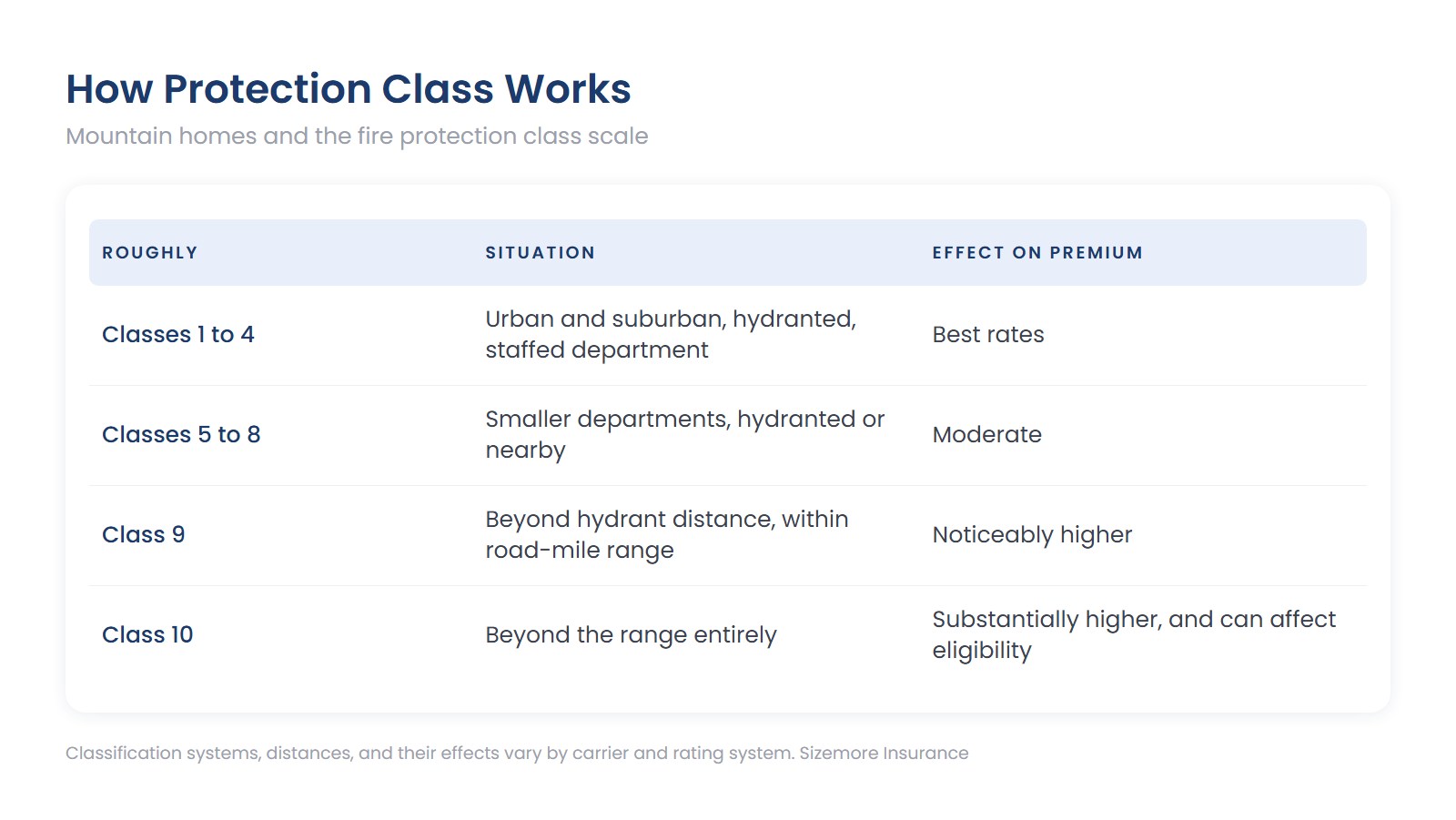
The takeaway: crossing from one class to the next can change a premium by more than most coverage decisions on the policy. It is worth knowing where your address sits and whether it is accurate.
Classification systems, distances, and their effects vary by carrier and rating system.
More than owners expect.
Verify the classification is correct. Departments open new stations, districts get redrawn, and carrier records lag. If a station opened closer to you, that is worth a phone call and it can be worth real money.
Ask about a dry hydrant or a nearby draft source. Some departments maintain drafting points at ponds and streams. Where one exists near your address, it may affect the classification.
Document your water supply. A pond, a cistern, or a large tank on the property is worth telling an underwriter about.
Address access. Driveway width and grade, turnaround space, bridge weight capacity, and clearance all determine whether equipment can actually reach the house. A private bridge that will not carry a loaded tanker is a real underwriting issue and a real safety one.
Post the address clearly and keep the driveway passable in winter. This is not a rating factor and it is the difference between a truck finding you and not.
Road miles, not straight lines. Mountain topography means a house half a mile from a station as the crow flies can be six miles by road. The measurement that counts is the drive.
A private bridge is a specific problem. Weight rating matters for fire equipment, and some carriers ask. If your only access crosses a bridge you maintain, know its capacity.
Winter access is part of the picture. A grade that is fine in July and impassable in ice affects both response and your own ability to get to the property.
Volunteer departments vary widely. Staffing and response times differ substantially, and that is reflected in the classification rather than being something to take personally.
Protection class interacts with wildfire scoring. They are separate assessments and they compound. A remote house in brushy terrain faces both.
Water supply on the property helps in a real fire, not just on paper. A pond with a draft point is worth having regardless of what it does to the classification.
What is a protection class and where do I find mine?
A rating describing fire protection at your address, generally 1 to 10. Your advisor can tell you what your carrier is using.
Why is my mountain home so much more expensive to insure?
Frequently protection class, followed by roof, access, and in some areas wildfire scoring.
Can my protection class improve?
Yes, if a station opens closer, a district changes, or a water source becomes available. Records also go stale, so verifying is worth doing.
Does a pond on my property help?
It can, particularly if the department can draft from it. Tell your advisor it is there.
Does my long driveway matter?
Yes. Width, grade, turnaround, and bridge capacity all affect whether equipment reaches the house, and carriers ask.
Is a class 10 home uninsurable?
No, and the market is narrower and the rate higher. It is placeable, and worth re-marketing periodically.
Sizemore Insurance is an independent insurance company founded in North Carolina in 1977. Send us the address and we will check the classification, look at the access, and tell you whether there is room to improve it. Insurance made just for you.
Sources: North Carolina Department of Insurance, Office of State Fire Marshal, fire district and fire protection ratings (ncdoi.gov); North Carolina Rate Bureau, homeowners rating by protection class (ncrb.org).
Classification systems, distances, rating effects, and availability vary by carrier and rating system. Review your own policy or talk to your advisor.
Coverage details: North Carolina Home Insurance