Reviewed for insurance accuracy by Brad Sizemore, Owner and CEO, NPN 6595451 · November 12, 2026
View reviewer profileFor most of my career, if you had asked a homeowner in Buncombe or Watauga County whether they needed flood insurance, they would have thought you had the wrong customer. Flood was a coastal problem. They lived in the mountains. After Helene, a western North Carolina home needs a flood policy, a current replacement cost valuation, and loss of use sized for a long rebuild.
Helene produced an estimated $6.4 billion in insured losses across this state, and a large share of it landed in the western counties, on properties whose owners had never priced a flood policy.
That storm changed three things about insuring a home out there: what owners need to carry, how carriers underwrite the region, and how long a rebuild takes. Here is where each of those stands.
Flood is now a mainstream question. Not for houses on a river. For houses near a creek, at the bottom of a slope, downhill from new development, or anywhere water concentrates. FEMA has long reported that a substantial share of flood claims come from outside mapped high-risk zones, and Helene demonstrated it at scale.
Loss of use limits proved short. After a regional event in a region with limited housing stock, alternate housing was scarce and expensive, and rebuilds ran long. A limit sized for an ordinary displacement did not cover a mountain rebuild in a market where every contractor was booked.
Ordinance or law mattered more than people expected. Older mountain housing stock rebuilt to current standards costs more than it did to build, and in flood-affected areas elevation requirements entered the conversation.
Documentation separated outcomes. The homeowners who had dated photographs and an inventory settled faster and more completely than the ones reconstructing from memory against an adjuster working enormous volume.
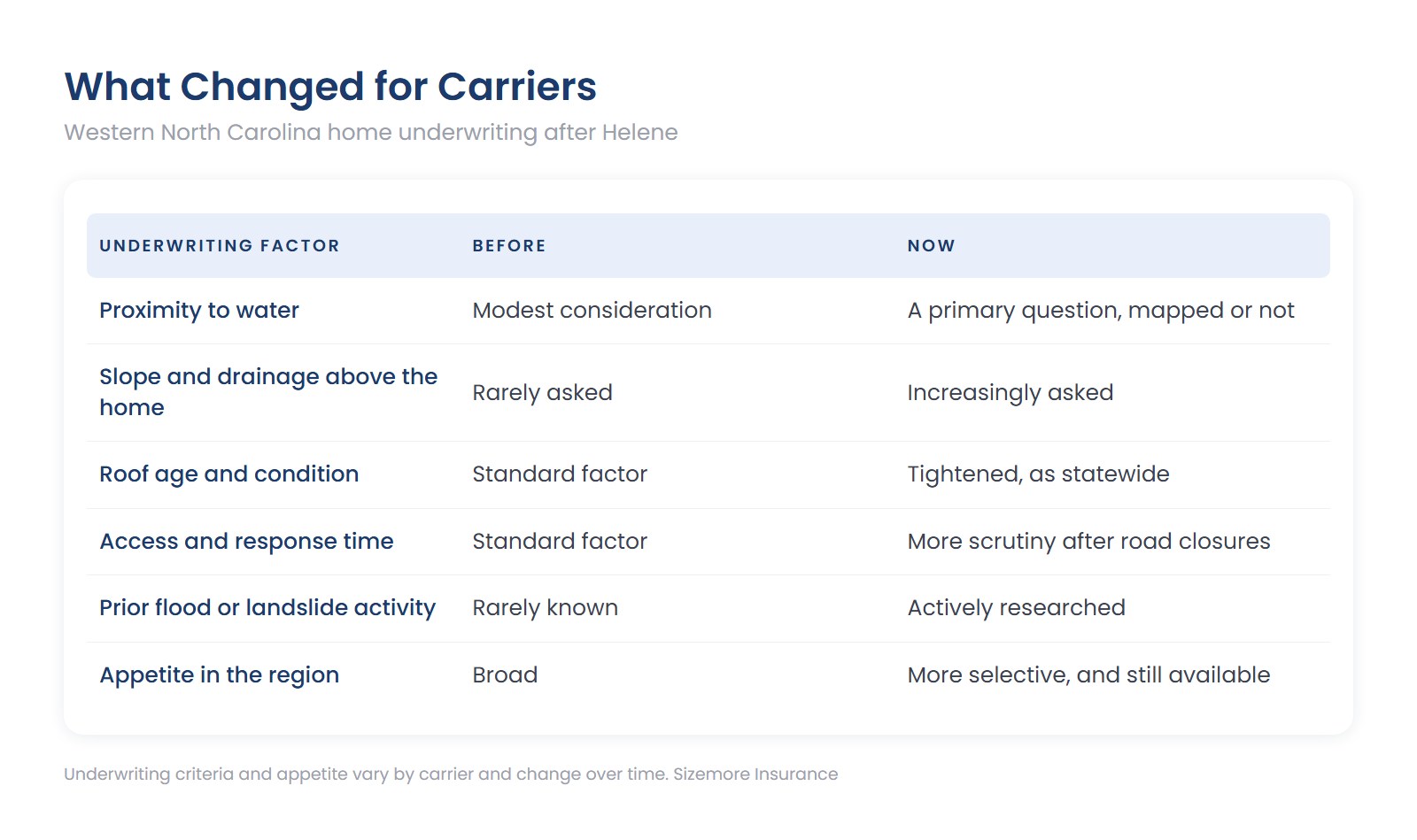
The takeaway: the region is placeable and the questions are harder than they used to be. A house that was quoted casually three years ago now gets a real underwriting look.
Underwriting criteria and appetite vary by carrier and change over time.
Flood coverage, regardless of zone. Outside a mapped high-risk area the premium is typically modest, and it is protecting against the loss that destroys an interior completely. The federal program carries a 30-day waiting period and caps residential building coverage at $250,000, so on a larger home an excess flood layer is where the actual protection sits.
Extended replacement cost, which addresses the construction cost surge that follows a regional event and that no accurate limit alone can anticipate.
Ordinance or law coverage, particularly on older homes and anything in a flood-affected area where elevation requirements now apply.
Loss of use sized for a long displacement, with attention to the duration and not just the limit.
A current dwelling limit, because construction costs in that region moved sharply and most policies escalate slower than the market did.
Landslide and debris flow are excluded everywhere. Earth movement is outside every homeowners policy, and a great deal of Helene's mountain damage came from slope failure and debris flow rather than from water alone. That is a coverage conversation with no good answer, and owners deserve to hear it plainly rather than discover it.
Flood and landslide can be hard to separate after the fact. Where a debris flow and rising water both reached a house, the causation question is genuine, and documentation is what resolves it.
Access affects the rebuild. Road and bridge closures extended timelines considerably, which is a loss of use question as well as a construction one.
Well and septic systems are their own exposure. Damage to them, and the cost of restoring water and wastewater service, is not always what owners assume.
Some carriers pulled back and others moved in. Appetite shifted rather than disappeared. That makes remarketing at renewal more valuable in this region than in most.
Rate relief is limited but real. North Carolina homeowners rates rose 7.5 percent on June 1, 2025 and again on June 1, 2026 under a negotiated settlement, and insurers cannot request another base rate increase before June 2027.
Do I need flood insurance in Asheville?
If there is any water above you, near you, or downhill of new development, get a quote. Outside a mapped high-risk zone the coverage is typically inexpensive.
Is my home harder to insure now?
The questions are harder. The region is placeable, and appetite varies by carrier more than it used to, which makes shopping worth more.
Does homeowners insurance cover landslides?
No. Earth movement is excluded on every homeowners policy.
Why did my premium go up when I had no damage?
Statewide rate changes and rebuild cost inflation. Neither is about your individual property.
How much loss of use should I carry?
Enough for a long displacement in a market with limited housing. Look at the duration as carefully as the limit.
What should I do first?
Get a flood quote and a current replacement cost valuation. Those two conversations cover most of the gap I saw after Helene.
Sizemore Insurance is an independent insurance company founded in North Carolina in 1977. Send us the address and we will tell you what your policy would have done in that storm and what it should do in the next one. Insurance made just for you.
Sources: FEMA and the National Flood Insurance Program, waiting period and building coverage limits (fema.gov, floodsmart.gov); North Carolina Department of Insurance, homeowners rate decisions (ncdoi.gov); North Carolina Rate Bureau, homeowners rate filings (ncrb.org).
Coverage, program terms, underwriting criteria, and appetite vary and change. Loss figures are estimates from published industry reporting. Review your own policy or talk to your advisor.
Coverage details: North Carolina Home Insurance