

Every August my phone rings with people asking about flood insurance, and by then the answer is already no.
Federal flood coverage generally does not take effect for 30 days after purchase. There are exceptions and they are narrow, and none of them help somebody watching a storm in the Atlantic.
This is the most important operational fact about flood insurance and it is why the whole conversation belongs in the spring.
Insurance works by pooling risk across people who do not know whether they will have a loss. If coverage took effect immediately, everyone would buy it when a storm was named and nobody would buy it otherwise.
The waiting period is what keeps the program from being a bet placed after the dice are already rolling. It is not an inconvenience the program could remove.
They exist and they are specific.
Loan-related purchases. Coverage purchased in connection with the making, increasing, extending, or renewing of a loan generally takes effect at closing rather than after a waiting period. This is why a buyer closing on a house in a flood zone is covered on day one.
Newly mapped properties. When a map revision places a property into a high-risk zone, there is generally a shorter waiting period for coverage purchased within a defined window after the map change.
Post-wildfire. Coverage purchased after a wildfire on federal land affecting the property has a modified waiting period, which matters more in western states and is worth knowing.
Requirements and exceptions are set federally and change. Confirm current rules with your advisor.
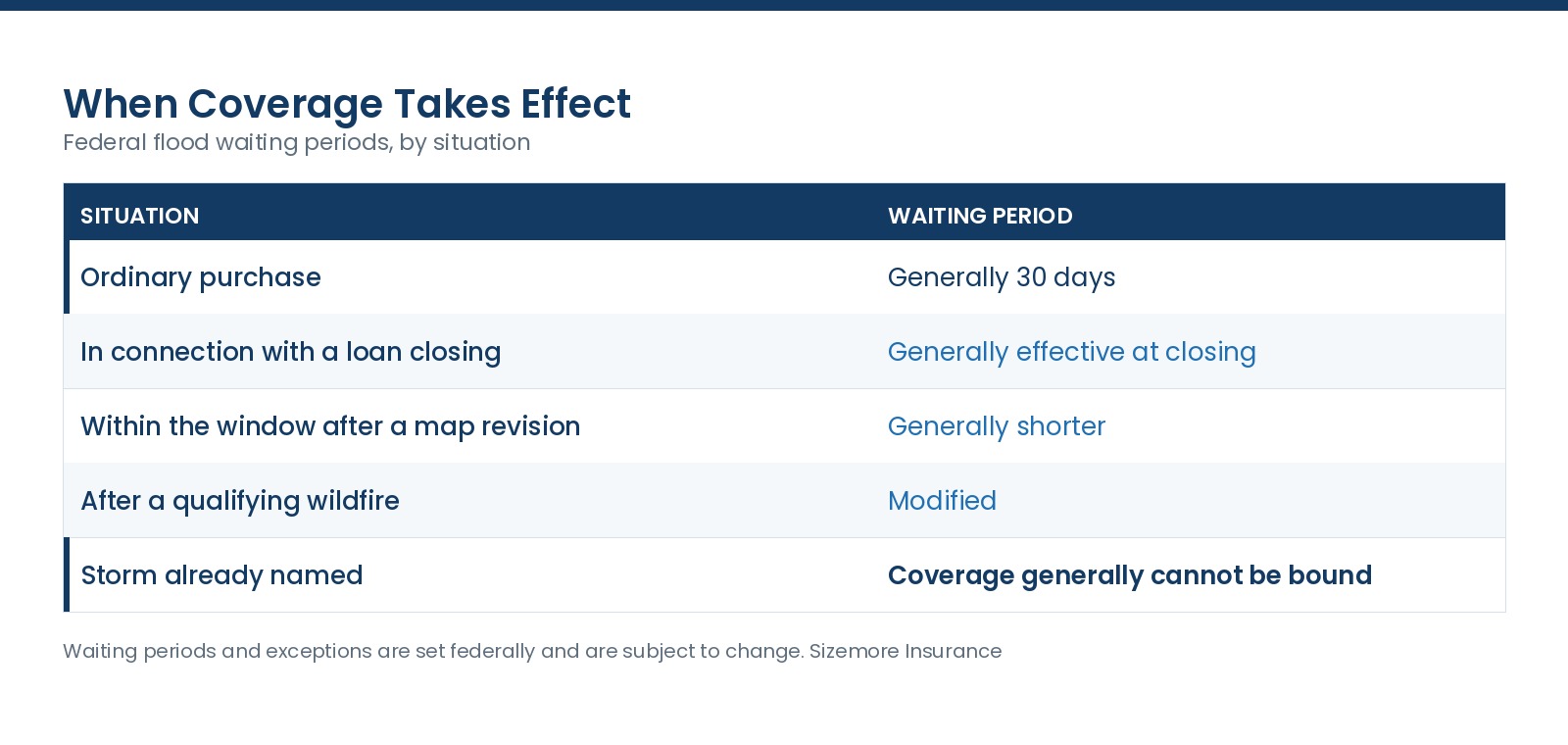
The takeaway: the exceptions are about transactions and map changes, not about weather. None of them help once a storm is approaching.
Private flood carriers set their own waiting periods, and they are frequently shorter than 30 days. Some are as short as a few days and some match the federal period.
That is a real advantage and it is not a solution to procrastination. Carriers also restrict binding once a storm is in a defined area, the same way property carriers do. A shorter waiting period does not help if nobody will bind the coverage.
Binding restrictions arrive before the waiting period matters. Once a storm is named and in a defined box, many carriers stop writing new coverage entirely. The practical deadline is earlier than the waiting period suggests.
A lapse restarts it. If a policy cancels for nonpayment and you reinstate late, a new waiting period can apply. That is an expensive way to save a payment.
Increasing coverage has its own timing. Adding limit mid-term can carry a waiting period on the increase.
A map change window is short, and the favorable treatment for buying within it goes away.
A property purchased without a loan does not get the closing exception. A cash buyer needs to plan for the waiting period.
Renewal is not a new purchase, so continuous coverage avoids the issue entirely. Do not let it lapse.
How long before flood insurance takes effect?
Generally 30 days under the federal program, with narrow exceptions.
Can I buy it when a storm is coming?
Generally not. Carriers restrict binding once a storm is named, and the waiting period applies on top of that.
Is there an exception for buying a house?
Coverage purchased in connection with a loan closing generally takes effect at closing.
What if I am paying cash?
The closing exception is tied to a loan. A cash buyer should plan for the waiting period.
Does private flood have a shorter wait?
Frequently, and carriers still restrict binding when a storm is approaching.
What if my policy lapsed?
Reinstating late can trigger a new waiting period. Do not let it lapse.
We have been an independent insurance company in North Carolina since 1977, and every year I take the same call in late August. Call in May instead. Insurance made just for you.
Waiting periods, exceptions, and binding restrictions are set federally and by private carriers and are subject to change. Review your own policy or talk to your advisor.