
The federal flood program caps residential building coverage at $250,000 and non-residential at $500,000.
Those are program maximums. They are not valuations, they do not adjust to what your property is worth, and on any building costing more than that to rebuild, the federal policy is a first layer rather than the coverage.
What sits above it has to be built, and built carefully.
The primary layer is the federal policy at maximum limits, or a private policy in its place.
The excess layer sits above it, typically placed in the surplus lines market, covering flood damage beyond the primary limit.
Or a single private policy replaces both, written at full value from the ground up.
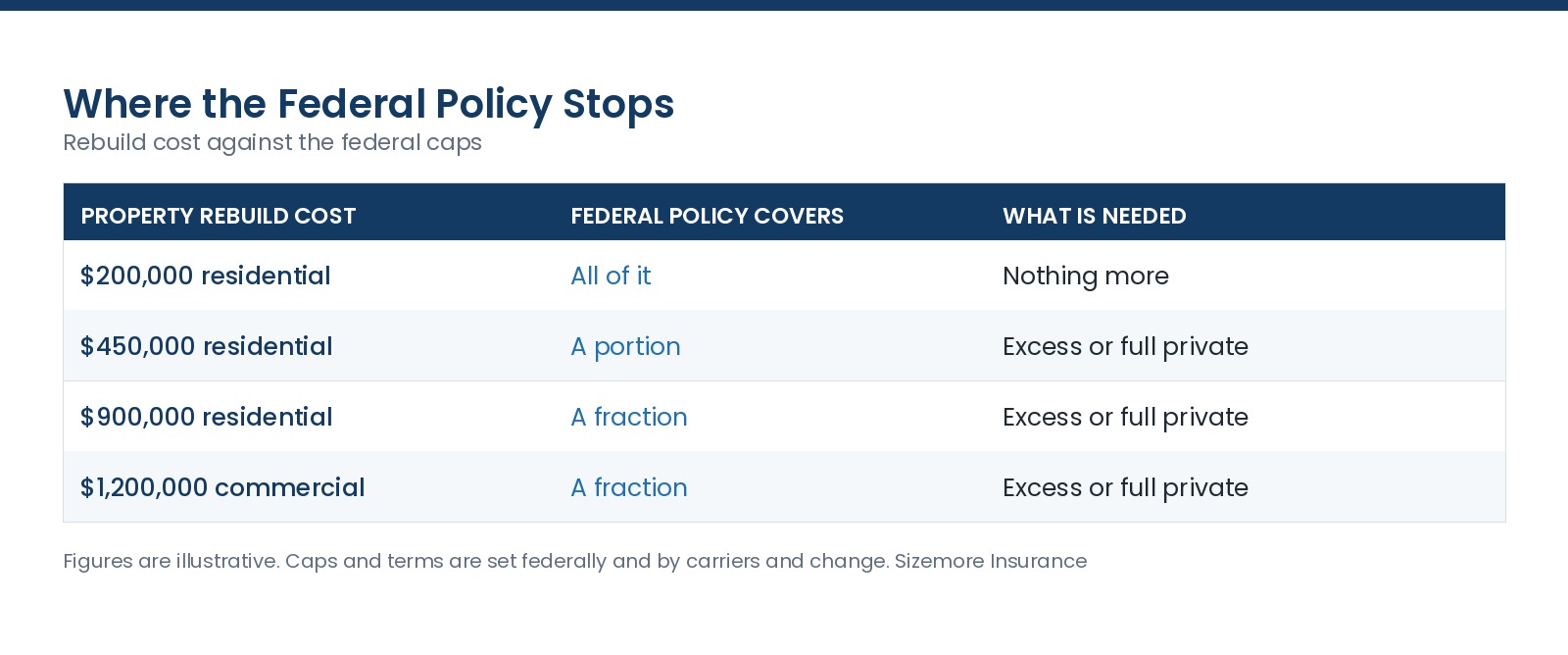
The takeaway: the gap is not subtle on anything above the cap, and many owners have never done this subtraction.
Figures are illustrative. Caps, availability, and terms are set federally and by carriers and change. Confirm current limits.
The attachment point has to match the primary limit exactly. If the excess attaches above where the primary exhausts, the difference is yours. This is a common structural error and it is entirely avoidable.
Most excess markets require the underlying at maximum limits. You generally cannot carry a partial federal policy and layer above it.
Contents have to be addressed at both levels, not just building. A primary with contents and an excess without leaves a gap on the contents side specifically.
Deductible treatment has to be settled and documented.
Definitions of flood have to align. An excess layer defining flood differently than the primary can decline something the primary covered, or the reverse.
Both policies need the lender named and both need to be maintained.
Rather than layering, a single private flood policy written at full value is frequently simpler and sometimes cheaper.
What it can add: replacement cost on contents, additional living expense or business income, higher limits, and a shorter waiting period.
What to consider before leaving the federal program: continuity treatment across map changes, lender acceptance, and whether returning later would be straightforward. Ask before switching entirely, and it is a real option worth pricing.
Commercial buildings need this most, because building values routinely exceed the cap and because business income exposure sits on top of the building loss.
Business income under flood is a specific gap. The federal program does not include it, so on a leased or operating building the income exposure needs a private or excess solution.
A difference in conditions policy can fill coverage gaps rather than only adding limit, which on a complex property is worth asking about.
Appetite tightens after regional events, so the window to place excess flood is between losses.
Portfolio owners face an allocation question, since a single event can touch several properties and how limits and deductibles apply across a schedule matters.
Increased cost of compliance sits on the federal side and is worth preserving when structuring the layers.
Loss of use and additional living expense are frequently absent on the federal side and available privately, which on a residential property with a long rebuild is a real consideration.
How much flood insurance can I buy?
The federal program caps at $250,000 building residential and $500,000 non-residential. Private and excess markets go higher.
What is excess flood?
A second layer above the primary flood policy, covering damage beyond the primary limit.
Do I need the federal policy at maximum limits first?
Most excess markets require it. Ask before assuming a partial primary works.
Should I just go fully private instead?
Frequently worth pricing. Consider continuity treatment, lender acceptance, and whether returning would be straightforward.
Does the federal program cover lost business income?
No. That needs a private or excess solution.
When should I place it?
Outside hurricane season and between regional events, because appetite tightens after losses.
Sizemore Insurance is an independent insurance company that has served North Carolina since 1977. Send us the property value and the current policy and we will show you exactly where the coverage stops. Insurance made just for you.
Caps, availability, attachment provisions, and terms are set federally and by carriers and are subject to change. Figures are illustrative. Review your own policies or talk to your advisor.