Reviewed for insurance accuracy by Brad Sizemore, Owner and CEO, NPN 6595451 · November 16, 2026
View reviewer profileA lake house sits between two categories. It is not coastal, so the named storm machinery does not apply. It is not an ordinary inland home either, because there is water at the bottom of the yard, structures in that water, and frequently a boat. A lake house needs a homeowners policy plus three things it usually lacks: enough other structures coverage for the dock, flood insurance, and a separate boat policy.
Owners on Norman, Wylie, Gaston, Hickory, Jordan, Keowee, and Murray tend to have a policy written as though the house were on a regular lot, and three specific things go missing.
The dock, boathouse, and lift. Usually the largest uninsured or underinsured asset on a lake property, and the one owners assume is covered.
Flood. A lake is a body of water with a managed level and a shoreline that rises. Lakeside homes flood, and many are outside mapped high-risk zones.
Watercraft. Homeowners policies cover boats in a very limited way and exclude liability for larger ones entirely.
Each gets its own treatment below and the dock question has its own article.
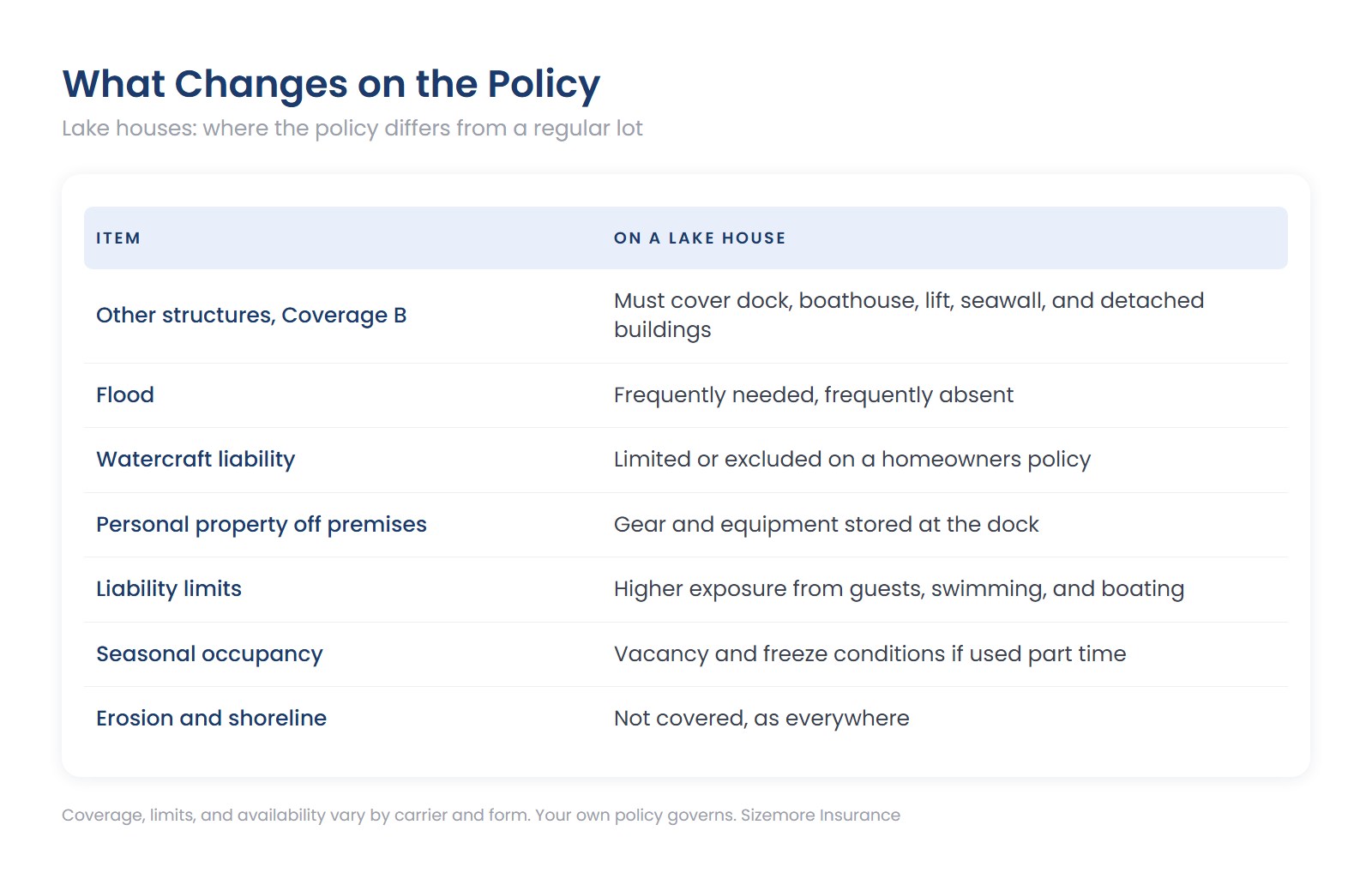
The takeaway: Coverage B and watercraft are where lake house policies fail, and both are fixable at a renewal.
Coverage, limits, and availability vary by carrier and form. Your own policy governs.
Most homeowners policies set other structures at a percentage of the dwelling limit, commonly 10 percent. On a $700,000 house that is $70,000.
Then add up what it has to cover: the dock, the boathouse, the lift, a seawall or riprap, the detached garage, the pump house, the fence, and the shed.
On many lake properties that total exceeds the limit before you get to the dock. And the limit is shared, so a storm that damages the dock and the detached garage draws from one pool.
Increasing Coverage B is inexpensive. Doing it after you add up the structures is the point.
A homeowners policy treats boats narrowly.
Physical damage to a boat under a homeowners policy is typically capped at a low sublimit, frequently in the range of a thousand dollars or so, covering the boat, motor, and trailer together.
Liability for watercraft is generally excluded above defined thresholds of size and horsepower. A small trolling motor on a jon boat may be within the policy. A twenty-four foot pontoon with a two hundred horsepower outboard is not.
Personal watercraft are generally excluded from liability entirely on most homeowners forms.
A separate boat policy handles hull damage, liability, medical payments, uninsured boater coverage, towing, and wreck removal. On a lake with heavy summer traffic, the liability piece is the part that matters most, and a personal umbrella can sit above it if the boat is scheduled.
Shoreline is frequently managed by a utility. On several Carolina lakes the shoreline and lake bed are under a utility’s management, and dock construction and modification require a permit. Nonpermitted structures can be a coverage and a compliance problem. Confirm with the lake manager before building or modifying.
Seasonal use brings the freeze condition. If the house sits empty in winter, the same provisions that govern mountain second homes apply here: heat maintained, or water shut off and drained.
Guest liability is real. Swimming, diving, and boating with visitors are the highest liability exposures on a lake property, and an umbrella is inexpensive relative to them.
Erosion and shoreline loss are not covered, the same as on the coast.
Renting it out changes the form. Lake houses are commonly rented, and even a few weeks a year can move the property outside a standard policy.
Flood is not automatic. Many lakeside homes sit outside mapped zones and still flood. Coverage there is typically inexpensive.
Is my dock covered by homeowners insurance?
Sometimes, under other structures, and frequently at a limit that does not reflect its value. Some forms restrict or exclude structures in or over water.
Does my homeowners policy cover my boat?
Physical damage is capped at a low sublimit and liability is generally excluded above modest size and horsepower thresholds. A boat policy is the answer.
Do I need flood insurance on a lake house?
Get a quote. Many lakeside homes are outside mapped zones and still flood, and coverage there is inexpensive.
How much other structures coverage do I need?
Add up the dock, boathouse, lift, seawall, and every detached building, then compare that to your current limit. Most owners find they are short.
Does my umbrella cover boating?
Only if the watercraft is scheduled and the underlying liability requirement is satisfied. Confirm it.
What if I rent the house out in the summer?
Tell your advisor. Even occasional rental can move the property outside a standard homeowners form.
Sizemore Insurance is an independent insurance company founded in North Carolina in 1977. Tell us what is on the property and in the water and we will find what the policy is missing. Insurance made just for you.
Sources: North Carolina Rate Bureau, North Carolina homeowners policy forms, including other structures and the watercraft provisions (ncrb.org); FEMA and the National Flood Insurance Program, flood zones and flood coverage (fema.gov, floodsmart.gov); North Carolina Department of Insurance (ncdoi.gov) and South Carolina Department of Insurance (doi.sc.gov), consumer guidance on homeowners coverage.
Coverage, limits, sublimits, thresholds, and availability vary by carrier and form. Shoreline management requirements vary by lake and utility. Review your own policy or talk to your advisor.
Coverage details: North Carolina Home Insurance