

People buy a flood policy and assume it works like a homeowners policy. It does not, and the differences are specific enough to list.
Start with the most important one. Building coverage and contents coverage are two separate purchases. A building-only policy covers the structure and nothing inside it. That is one of the most common gaps in a flood program and it is entirely a purchasing decision.
Contents under the federal program are settled at actual cash value, meaning depreciation is applied. That is different from most homeowners policies and it surprises people.
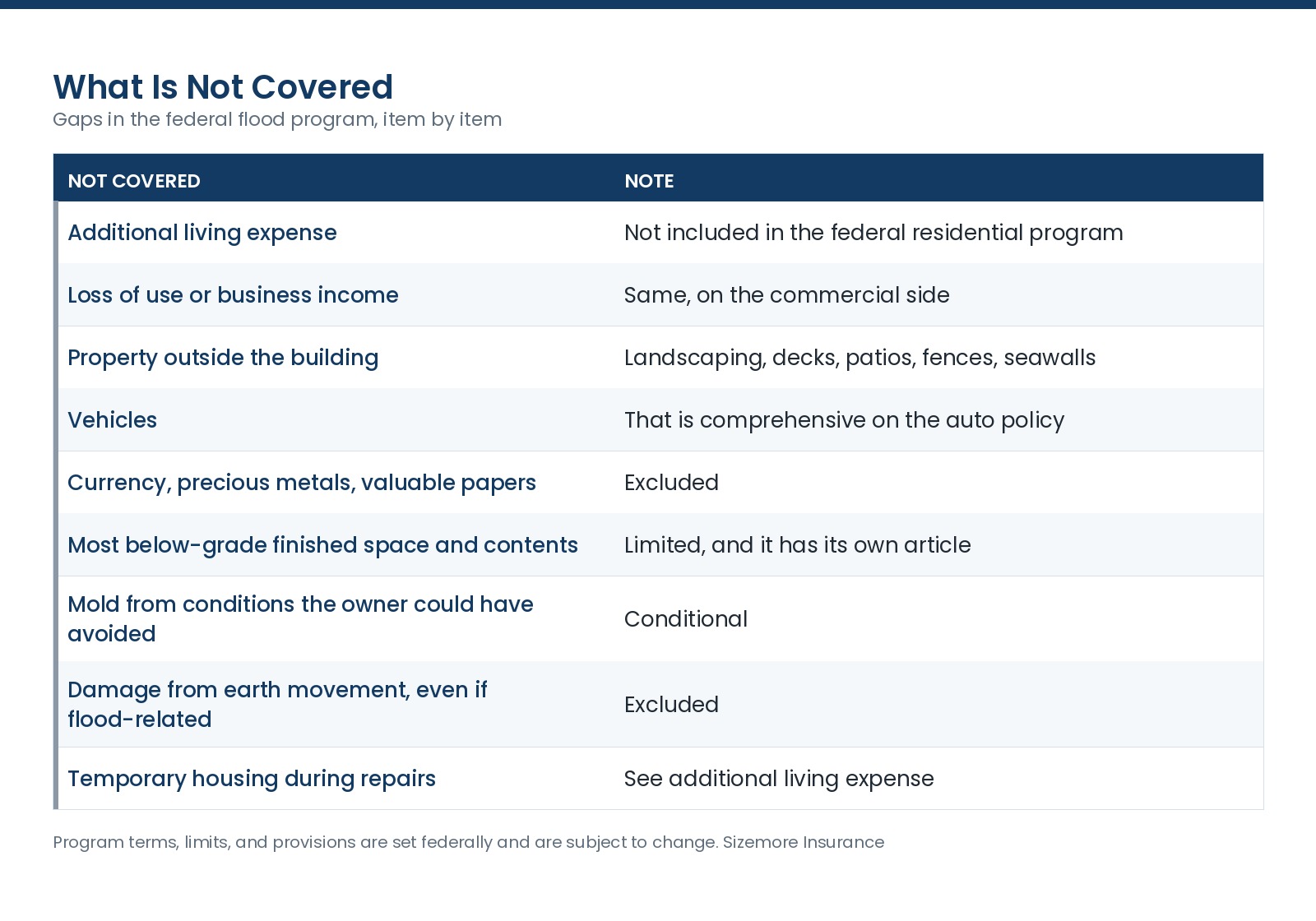
The takeaway: the two largest surprises are that contents are a separate purchase settled at actual cash value, and that the federal program does not pay for you to live somewhere else.
Program terms, limits, and provisions are set federally and are subject to change. Confirm current terms.
This deserves its own emphasis because it is among the least understood things about flood coverage.
If wind makes your house uninhabitable, your homeowners loss of use pays for you to live elsewhere. If rising water makes it uninhabitable, the federal flood program generally does not.
After Helene and after Florence, families were displaced for months by water rather than wind, and that cost fell where it fell.
Many private flood policies include it. On a household that could not absorb months of rent on top of a mortgage, that is one of the strongest reasons to look beyond the federal program.
Residential: $250,000 building and $100,000 contents.
Non-residential: $500,000 building and $500,000 contents.
Those are program maximums rather than valuations. On any property costing more than that to rebuild, the federal policy is a layer and private or excess flood is what actually covers it.
Building settlement basis varies. Replacement cost under the federal program is generally reserved for a single-family primary residence meeting coverage requirements. Other structures, including rentals, second homes, and commercial buildings, are generally settled at actual cash value.
Detached structures get a portion, not a separate limit.
A finished basement is largely outside the coverage, which has its own article in this section.
Private flood frequently offers replacement cost contents, living expense, and higher limits, which is the comparison worth running.
Increased cost of compliance is a separate benefit helping bring a substantially damaged building into floodplain compliance.
Contents must be purchased. I have said it twice because it is the gap I see most.
Are my belongings covered by flood insurance?
Only if you purchased contents coverage. It is a separate purchase from building coverage.
Are contents replacement cost?
Under the federal program, generally no. Contents are settled at actual cash value.
Does flood insurance pay for a hotel?
The federal residential program generally does not include additional living expense. Many private policies do.
Is my deck or fence covered?
Generally not. Property outside the building, including landscaping, decks, and fences, is excluded.
Is my car covered?
Not by a flood policy. Vehicle flood damage is comprehensive coverage on your auto policy.
How much can I buy?
Federal caps are $250,000 building and $100,000 contents residential, and $500,000 each non-residential. Private goes higher.
We have been an independent insurance company in North Carolina since 1977. Send us the address and we will quote both markets and show you exactly what each one reaches. Insurance made just for you.
Program terms, limits, settlement provisions, and exclusions are set federally and by private carriers and are subject to change. Review your own policy or talk to your advisor.