Reviewed for insurance accuracy by Victoria Konczynski, Personal Lines Account Manager, NPN 16516709 · November 12, 2026
View reviewer profileAn empty house is a different risk and most policies say so, in a provision almost nobody reads until a claim. The fix is to tell your advisor before the house goes empty, so an unoccupied or vacancy endorsement, or a vacant property policy, is in place for the period.
The reason owners miss it is that the situations that produce an empty house are all ordinary. A seasonal property between visits. A house on the market. An estate being settled. A renovation. A move where the new place closed before the old one sold.
None of those feel like a coverage event. All of them can be one.
This distinction matters and it is not intuitive.
Unoccupied generally means nobody is living there but the furnishings and personal property remain. A seasonal home between visits is unoccupied.
Vacant generally means empty of both people and contents. A house that has been cleaned out for sale, or an estate property after the furniture is gone, is vacant.
Forms treat them differently, and vacancy is the more restrictive of the two. Definitions and periods vary by carrier, and some forms use only one of the terms. Read yours rather than assuming.
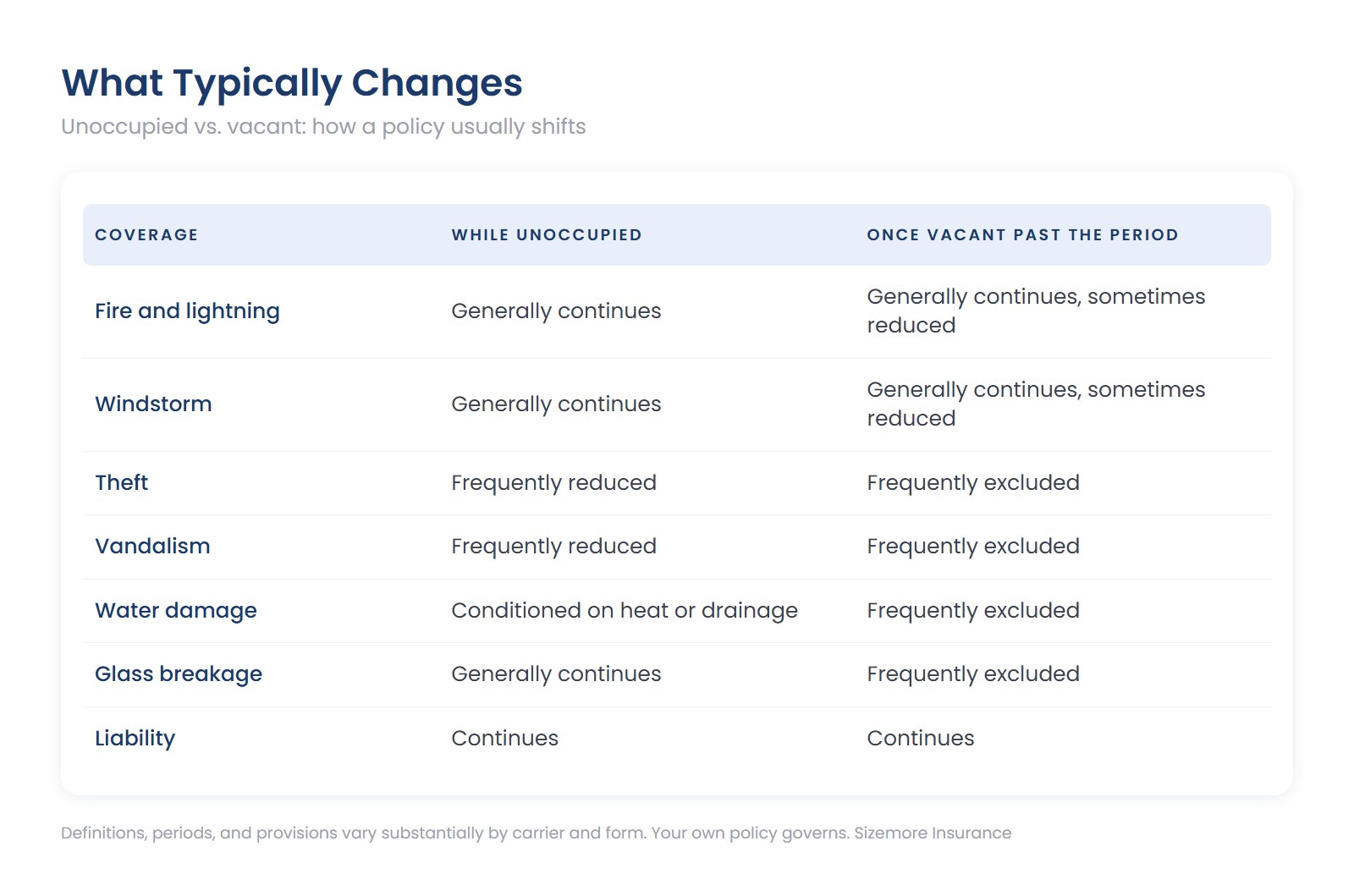
The takeaway: the perils that drop out are precisely the perils an empty house faces. Vandalism, theft, and undiscovered water are the empty-house losses, and they are the ones the provision removes.
Definitions, periods, and provisions vary substantially by carrier and form. Your own policy governs.
A seasonal home. Coastal or mountain, occupied a few weeks or months a year. Usually unoccupied rather than vacant, and the water damage condition is the live issue.
A house on the market. Once it is staged or emptied, the clock may be running. Long listing periods are common right now.
An inherited or estate property. Often the worst case, because it sits empty for months while an estate is settled, frequently with the contents removed and frequently with nobody checking on it.
A renovation. Many forms except property under construction or renovation, and a builders risk policy is often the better structure for significant work.
A gap between homes. Closed on the new house, old one not sold. Ordinary, and the old house is now unoccupied.
Tell your advisor before the house goes empty. A vacancy permit endorsement or an unoccupied endorsement preserves coverage during a known period. It has to be arranged in advance, and no carrier adds it retroactively after a loss.
On a longer vacancy, consider a policy written for it. Vacant property forms exist. They are narrower and cost more, and both are preferable to a provision that has removed the coverages you need.
Maintain heat or shut off and drain the water. This is the condition most forms impose and it is the one most commonly failed. Decide which and be able to prove it.
Install monitoring. Low-temperature alerts, water leak sensors, and an automatic shutoff valve. Inexpensive, credited by several carriers, and they turn a catastrophic water loss into a small one.
Arrange documented checks. Someone walking the property on a schedule, with a log. It helps with underwriting, with the policy conditions, and with catching a loss in week one instead of week six.
Keep the utilities on. Turning off the power to save money disables the systems that would have limited the loss.
The clock runs quietly. Nothing in your policy notifies you that day 61 has arrived, and the provision applies whether or not the carrier knows the house is empty.
Mail and appearance matter. A house that visibly looks empty attracts the losses the provision excludes. Stopping accumulation and keeping the exterior maintained is genuine risk control.
An estate property has an ownership question too. Who is the named insured after a death, and whether the policy still responds, is a question to resolve with the estate's attorney and the carrier promptly rather than months later.
Renovation is usually a builders risk conversation. Significant work changes the risk enough that a form written for it is the right answer.
Lenders may care. A vacancy that impairs coverage can breach a loan's insurance requirement independent of the coverage consequence.
Coming back is a phone call too. When the house is occupied again, the coverage should return to a standard form.
How long can a house sit empty before coverage changes?
It varies by carrier and form, commonly 30 or 60 days. Read your own provision.
What is the difference between vacant and unoccupied?
Unoccupied generally means nobody living there with contents remaining. Vacant generally means empty of both. Vacant is more restrictive.
Is my seasonal home covered while I am away?
Generally yes, subject to unoccupancy provisions and the condition around heat or drained plumbing.
Can I add a vacancy endorsement after the house is already empty?
Sometimes before a loss, never after. Arrange it in advance.
What is the most common empty-house claim?
Water, from a failed supply line or a freeze, discovered days or weeks later.
Does my liability coverage continue?
Generally yes, and the premises exposure on an empty house is real. Trespass, attractive nuisances, and deteriorating conditions all continue.
Sizemore Insurance is an independent insurance company founded in North Carolina in 1977. Tell us how long the house will be empty and why, and we will structure the coverage to survive it. Insurance made just for you.
Sources: North Carolina Rate Bureau, homeowners and dwelling policy forms, including vacancy and unoccupancy provisions (ncrb.org); North Carolina Department of Insurance, consumer guidance on homeowners and dwelling policies (ncdoi.gov).
Definitions, periods, conditions, endorsement availability, and credits vary by carrier and form. Review your own policy or talk to your advisor.
Coverage details: North Carolina Home Insurance