

People call us about a house on the Outer Banks and ask what homeowners insurance costs out there.
The honest answer is that homeowners insurance is usually the smallest of the three policies they are going to need, and quoting it alone tells them almost nothing about what the house costs to insure.
On most of that coastline you are buying a homeowners policy with wind excluded, a separate windstorm policy, and a flood policy. Three carriers, three deductibles, three renewal dates. Understanding that structure is more useful than any single number.
The Three Policies
The homeowners policy. Fire, theft, liability, loss of use, personal property, and water damage from inside the house. In most of the beach area it excludes windstorm and hail.
The wind policy. Windstorm and hail, frequently through the North Carolina Insurance Underwriting Association, which everyone calls the Beach Plan. This is usually the largest of the three premiums and it carries a percentage deductible.
The flood policy. Rising water and storm surge, which nothing else covers. On a barrier island this is not optional in any practical sense, and if there is a mortgage it will be required.
Some owners add a fourth, an excess flood policy above the federal limits, because the National Flood Insurance Program caps residential building coverage at $250,000 and contents at $100,000. On a $900,000 beach house that leaves a very large gap.
What Drives the Number
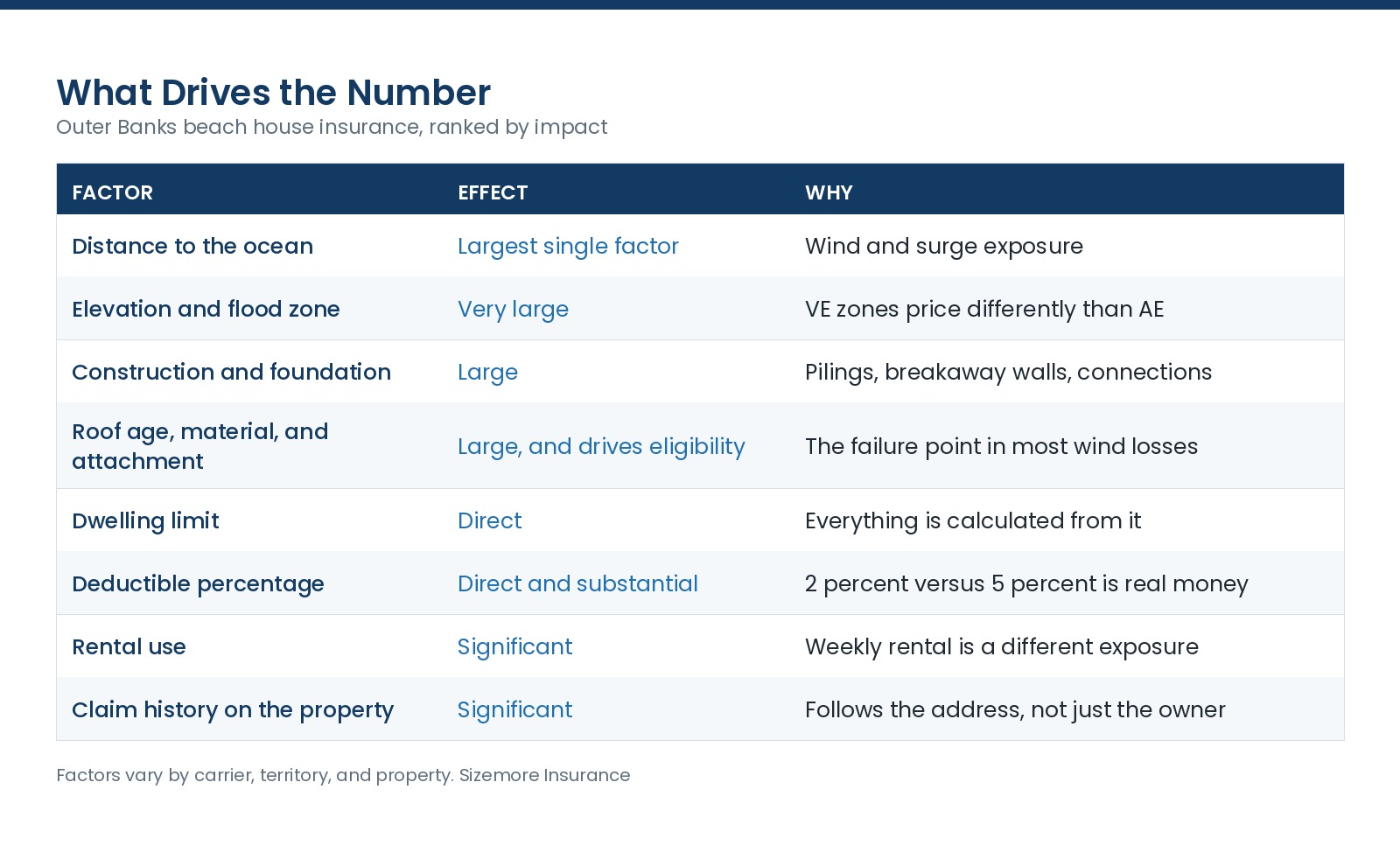
The takeaway: two houses on the same street can differ by a factor of two or more, and elevation, roof, and foundation explain most of it. Square footage matters far less than people assume.
Figures and factors vary by carrier, territory, and property. Review your own situation with your advisor.
The Deductible Is the Number to Know
On the wind policy, the deductible is almost always a percentage of the dwelling limit rather than a flat amount.
Five percent of a $700,000 dwelling limit is $35,000. That is the money you need available before the wind policy pays anything, and it applies per named storm rather than per year. Two storms in one season means two deductibles.
Calculate yours in dollars and write it down. In almost fifty years of doing this, that number is the one homeowners are most consistently surprised by, and it is printed on page one of a policy they have had for six years.
Where This Gets Complicated
Rental use changes the policy, not just the price. If the house is rented weekly through a platform, a standard homeowners policy is generally not written for that use. Carriers do investigate occupancy after a loss. A house that rents twelve weeks a summer needs a form built for it, and the good news is those forms exist and are not exotic.
Flood does not cover what people think it covers. The federal program pays non-elevated enclosed areas below the flood elevation very little, and on a piling home the ground level is usually one of those areas. Contents down there are largely uncovered, and enclosing that space for living use can jeopardize the whole policy.
Erosion is not insurable. Shoreline movement, loss of land, and a house becoming unsafe as the beach retreats are not covered by any policy. That is a real Outer Banks risk and it is a purchase decision rather than an insurance one.
Wind-driven rain is the recurring claim dispute. Rain entering through an opening the wind created is generally covered. Rain entering through failed flashing or an aging roof is generally not. Dated photographs of your roof and openings, taken on a clear day, are worth more than any argument after a storm.
Roof age determines whether you have options. In the beach area, roof age and attachment method determine which carriers will write the house at all, not just what they charge. A roof replacement built to enhanced wind standards is the single strongest thing an owner can do.
Three policies means three adjusters. After a hurricane that takes part of a roof and pushes water into the ground floor, you will have a wind claim and a flood claim running at the same time, with an argument about which damage belongs to which. Documentation is what settles it.
Common Questions
How much is homeowners insurance on the Outer Banks?There is no single answer, and the more useful question is what all three policies cost together. Elevation, flood zone, roof, foundation, and distance to the water drive it far more than square footage.
Is wind covered by my homeowners policy out there?Frequently not. Check for a windstorm and hail exclusion, and check whether you have a separate wind policy.
Do I have to buy flood insurance?If there is a mortgage and the house is in a mapped high-risk zone, yes. Without a mortgage it is still the coverage most likely to matter on a barrier island.
Why is my neighbor's premium so different from mine?Elevation, flood zone, foundation type, and roof age. Two houses on one street are not the same risk.
Can I lower the deductible on the wind policy?Sometimes, and it is worth asking. Trading a higher everyday deductible on the homeowners side to fund a lower percentage on the wind side is a move most owners have never been offered.
Does insurance cover erosion?No. Shoreline loss and the land itself are outside every policy.
The Bottom Line
We have been an independent insurance company in North Carolina since 1977 and we have worked a lot of storms on that coast. Send us the address and we will tell you what all three policies cost and which markets will write the house. Insurance made just for you.
Coverage, availability, deductible structures, and pricing vary by carrier, territory, and property. Figures are illustrative. Review your own declarations page or talk to your advisor.