
Reviewed for insurance accuracy by Victoria Konczynski, Personal Lines Account Manager, NPN 16516709 · November 11, 2026
View reviewer profileTwo owners each rent out a house they do not live in. One has a tenant on a twelve-month lease. The other takes nightly bookings. The lease needs a dwelling policy, typically DP-3, and the nightly rental needs a short-term rental form or endorsement.
Those are not variations of the same policy. They are different products, priced by different logic, and switching from one use to the other without telling anyone is one of the more common coverage failures in personal lines.
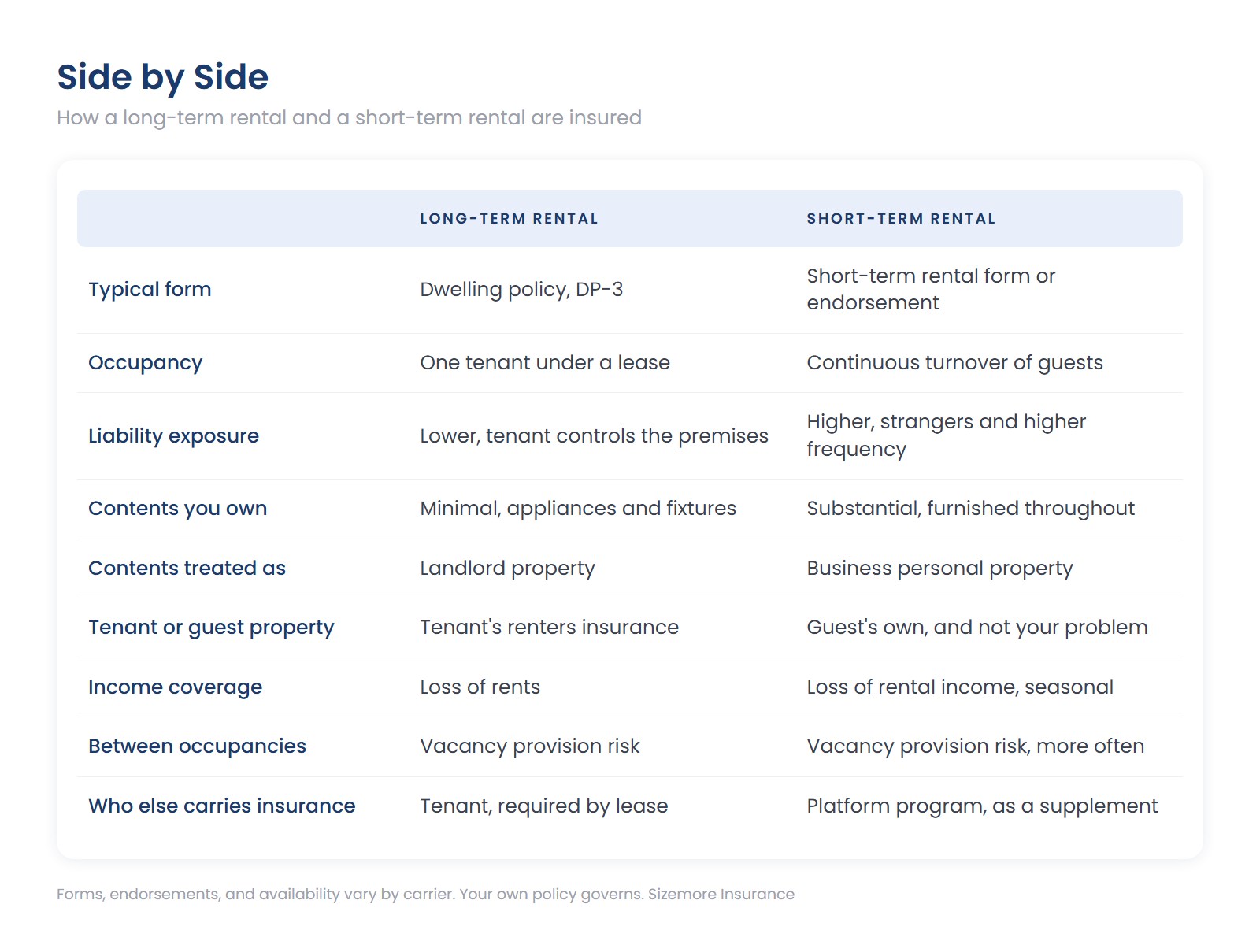
The takeaway: the short-term version carries more liability, more of your own contents, and more seasonal income at risk. It is not a small adjustment to a landlord policy.
Forms, endorsements, and availability vary by carrier. Your own policy governs.
A dwelling policy, written for non-owner-occupied residential property.
Liability added, since many dwelling forms do not include it automatically.
Loss of rents, sized to the actual current rent rather than the rent when you bought the property.
Theft coverage endorsed on, because dwelling forms frequently limit or exclude it, and appliances and HVAC equipment do walk off a vacant unit.
Ordinance and law if the house predates current code.
A lease that requires tenant renters insurance with liability, which resolves a large share of small claims without touching your policy.
Guest liability at a higher limit, with an umbrella above it. Strangers in the house at a higher frequency is a materially different exposure.
Contents as business personal property, covering the furnishings, linens, appliances, and equipment you bought to operate it.
Guest damage coverage, which standard forms handle poorly.
Seasonal income coverage, sized to a peak-season outage rather than an annual average.
Coverage between bookings, confirmed rather than assumed, because that is when fire and freeze losses happen and when platform protection does not apply.
This is where owners get into trouble, and it happens in both directions.
Long-term tenant leaves, owner starts listing nightly. The dwelling policy is now covering a use it was not written for. Call before the first booking.
Short-term rental converts to a lease. The specialty form may no longer fit and the coverage should move to a dwelling policy, usually at a lower cost.
Owner moves back in. A dwelling policy on a house you now occupy is the wrong form, and a homeowners policy is both broader and typically cheaper.
Property sits empty during the transition. Between a lease ending and the first booking, or between seasons, the vacancy provision applies. Most forms restrict coverage past a set period, and the perils that drop out are exactly the ones an empty house faces.
Every one of those is a five-minute call. All four are expensive if the call does not happen.
Mid-term rentals sit between the two. Thirty-day corporate or traveling professional stays are neither a nightly rental nor a standard lease. Carriers treat them differently and it is worth naming the actual arrangement rather than picking the closest label.
Occupancy is a material fact in both directions. A homeowners policy on a house you rent out, or a dwelling policy on a house you occupy, are both misstatements that can affect a claim.
Your mortgage may care. Some loan documents restrict rental use, particularly on a property financed as a primary residence.
Local ordinances usually distinguish the two. Many jurisdictions regulate short-term rental and say nothing about a twelve-month lease. Permitted use is a local question worth resolving first.
A tenant's renters policy does nothing for a guest. Risk transfer works on a lease. It does not exist in a nightly booking.
Past two or three properties, the structure changes. A scheduled or commercial program usually prices better than separate specialty policies and consolidates the renewals.
Can I use my landlord policy for Airbnb?
Generally not. A dwelling policy written for a leased property is not written for nightly guest occupancy.
Is short-term rental insurance more expensive?
Usually, reflecting higher liability, more owner-owned contents, and greater turnover. It is also usually a fraction of the revenue.
What form do I need for a twelve-month lease?
A dwelling policy, typically DP-3, with liability added and loss of rents sized to current rent.
What about a thirty-day corporate stay?
That is a mid-term rental and carriers treat it differently from both. Describe the actual arrangement to your advisor.
Do I still need coverage between tenants or bookings?
Yes, and the vacancy provision is what to watch. Most forms restrict coverage past a set empty period.
What happens if I switch uses and do not tell anyone?
The carrier finds out at the claim. Occupancy and use are material facts.
Sizemore Insurance is an independent insurance company founded in North Carolina in 1977. Tell us how the property is actually rented and we will place the form that fits it. Insurance made just for you.
Sources: North Carolina Rate Bureau, dwelling policy forms (ncrb.org); North Carolina Department of Insurance, consumer guidance on dwelling and homeowners policies (ncdoi.gov).
Forms, exclusions, endorsements, and availability vary by carrier. Local rental regulation varies by jurisdiction. Review your own policy or talk to your advisor.
Coverage details: North Carolina Home Insurance