Two investors own identical rentals with identical limits and identical deductibles. One collects fifty-eight thousand on a roof claim and the other collects nineteen.
The difference is one line on the declarations page, and most investors have never looked at it.
The Two Forms
Rental dwellings are generally written on a dwelling policy form. The two you will encounter are the basic form and the special form, commonly called DP1 and DP3.
DP1, the basic form. Covers a limited list of named perils. Settles losses on an actual cash value basis in most cases, meaning depreciation is subtracted.
DP3, the special form. Covers all causes of loss except those excluded. Settles on a replacement cost basis in most cases.
Two differences, and each one is substantial on its own.
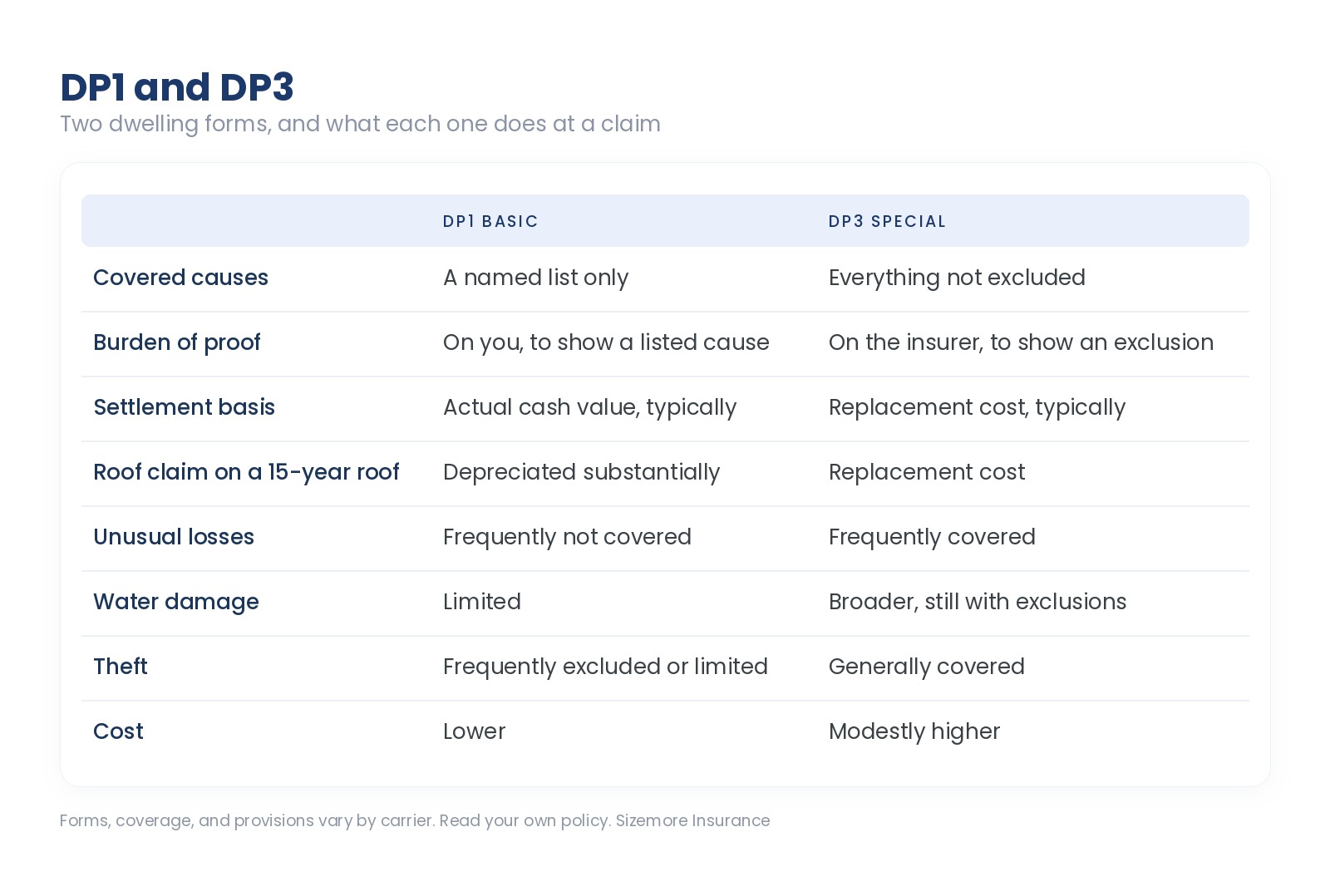
The takeaway: the settlement basis is what produces the dramatic difference on a real claim, and the peril list is what produces the surprises.
Forms, coverage, and provisions vary by carrier. Read your own policy.
Why the ACV Difference Is So Large
Actual cash value subtracts depreciation from the cost to replace.
On a roof, that is severe. A fifteen-year-old architectural shingle roof has consumed most of its service life, and an actual cash value settlement reflects that. A replacement cost settlement pays to put a new roof on.
The same logic applies to siding, HVAC, flooring, and water heaters. On an older rental, which describes a great deal of the Piedmont housing stock, that gap runs through every partial claim rather than only a total loss.
Partial claims are most claims.
How to Tell Which You Have
Look at the declarations page for a form number or a description. It frequently says basic, broad, or special, or references a DP form number.
Look at the settlement basis, which is generally stated. Replacement cost or actual cash value.
Look for a roof settlement schedule in the endorsements, because a DP3 with an age-based roof schedule settles the roof at actual cash value even though the dwelling is replacement cost.
Ask us. It takes about ten seconds with a declarations page in front of us.
Where This Gets Complicated
A DP2 broad form exists between the two, covering a longer named-peril list, and it appears less often.
A DP3 with a roof schedule is not the same as a full replacement cost policy, and on an older roof that endorsement matters more than the form.
Coinsurance applies to both and it reduces claims proportionally when the limit is short.
A cheap quote is frequently a DP1, and that is a common reason a landlord property quote comes in noticeably lower than the others.
Your lender may require replacement cost, which effectively requires a DP3 or equivalent, and a DP1 can be rejected at closing.
Some hard-to-place properties are only available on a basic form, which is a real constraint rather than a choice, and it argues for fixing the insurability issue.
A commercial form applies at five units and up in most cases, which is a different comparison entirely.
Common Questions
What is the difference between a DP1 and a DP3?
A DP1 covers named perils, generally at actual cash value. A DP3 covers everything not excluded, generally at replacement cost.
Which should I have?
A DP3 in nearly every case. The premium difference is modest and the claim difference is not.
Why is one quote so much cheaper?
Frequently because it is a DP1. Check the form before comparing on price.
Does a DP3 always mean replacement cost on the roof?
Not if a roof settlement schedule is attached. Check the endorsements.
Will my lender accept a DP1?
Frequently not, because lenders commonly require replacement cost.
What if a DP1 is all I can get?
That is an insurability constraint worth fixing, usually through the roof and the systems.
The Bottom Line
- Find the form on your declarations page for every property you own.
- Move to a DP3 unless there is a specific reason you cannot.
- Check the endorsements for a roof settlement schedule, because it overrides the form on the roof.
- Compare quotes on form, not premium, because a cheap quote is frequently a basic form.
- Confirm your lender’s requirement, because a DP1 can stall a closing.
- Fix the insurability issue if a basic form is all the market will offer.
Sizemore Insurance is an independent insurance company founded in North Carolina in 1977, writing in both North Carolina and South Carolina. Send us your declarations pages and we will tell you which form each property is on. Insurance made just for you.
Forms, coverage, settlement provisions, and requirements vary by carrier and lender and are subject to change. Figures above are illustrative. Nothing here is a coverage determination. Review your own policy or talk to your advisor.