One of the most common ways a landlord claim gets denied is that the property was rented on a homeowners policy.
It happens innocently. Someone moves, keeps the old house, rents it to cover the mortgage, and never calls their insurance company because the house did not change. The house did not change. The occupancy did, and occupancy is a material fact on a property policy.
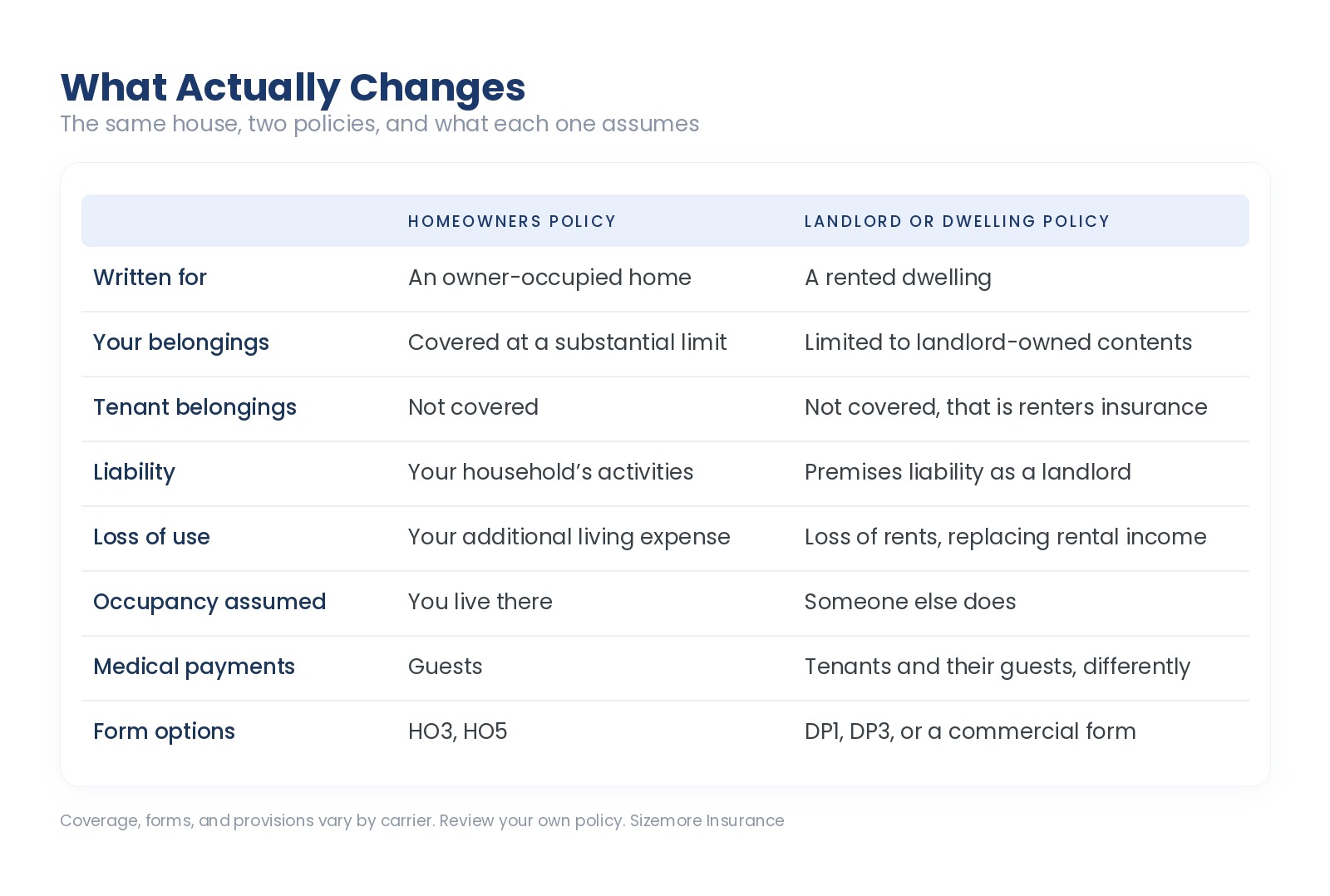
The takeaway: the two policies swap two whole coverages. Your contents shrink and your loss of use becomes loss of rents, which is income rather than expense.
Coverage, forms, and provisions vary by carrier. Review your own policy.
The Two Coverages That Swap
Contents. A homeowners policy covers your belongings at a percentage of the dwelling limit. A landlord policy covers only property you own that services the rental, which is the appliances, window treatments, and maybe a lawnmower. That reduction is appropriate and it surprises people.
Loss of use becomes loss of rents. A homeowners policy pays your additional cost of living elsewhere. A landlord policy pays the rental income you lost. Those are different calculations and the second one has to be sized to your actual rent.
What Gets Denied
The whole claim, in some cases. A carrier discovering at a fire that the property has been rented for three years on a homeowners policy has a material misrepresentation question, not a coverage question.
Loss of rents, always, because a homeowners policy does not include it. Even if the property damage is paid, the income is not.
Liability, potentially, because the exposure the policy contemplated was your household rather than a tenant’s.
This is not a technicality applied harshly. The policy priced an owner-occupied risk and the risk was not owner-occupied.
How to Switch Without a Gap
Call before the tenant moves in, ideally before you sign a lease.
The dwelling policy starts and the homeowners policy ends on the same day. Not a week apart in either direction.
Confirm the named insured matches the deed, including an LLC or trust if title moved.
Notify the lender, because the mortgagee clause has to appear on the new policy.
Get renters insurance requirements into the lease while you are drafting it.
Set loss of rents to the actual rent, with a realistic repair period.
Where This Gets Complicated
Owner-occupied multifamily is genuinely mixed. Living in one unit of a duplex and renting the other is a specific situation, and which form applies depends on the carrier. It has its own article.
A temporary rental, including renting a house while it is listed for sale, is still rental occupancy.
A family member paying rent is still a tenant for most policy purposes. Disclose it.
Short-term rental is a third category, neither owner-occupied nor a standard long-term rental.
Your own umbrella may not reach the rental, particularly if an LLC owns it, and that has its own article.
Coming back the other way matters too. If you move back in, the policy should change again.
Common Questions
Can I rent my house on my homeowners policy?
Generally not. Occupancy is a material fact and a rented property needs a landlord or dwelling form.
What is the biggest difference?
Contents shrink to landlord-owned property, and loss of use becomes loss of rents.
Will a claim be denied if I did not switch?
It can be, and a carrier discovering undisclosed rental occupancy at a claim has a misrepresentation question rather than a coverage question.
Does a landlord policy cover my tenant’s belongings?
No. That is renters insurance, which you can require.
What if I only rent it for a season?
Rental occupancy is rental occupancy. Disclose it.
Is a landlord policy more expensive?
Frequently somewhat, and it covers the things a rental actually needs.
The Bottom Line
- Switch before the tenant moves in, not after.
- Line the effective dates up exactly, with no gap in either direction.
- Confirm the named insured matches the deed.
- Size loss of rents to your actual rent.
- Notify the lender so the mortgagee clause carries over.
- Call us if you moved back in, because it changes again.
Sizemore Insurance is an independent insurance company founded in North Carolina in 1977, writing in both North Carolina and South Carolina. Tell us when the tenant moves in and we will set the dates so nothing falls between them. Insurance made just for you.
Coverage, forms, and provisions vary by carrier and are subject to change. Nothing here is a coverage determination. Review your own policy or talk to your advisor.