

Neither state generally requires you to insure a boat. Lenders and marinas frequently do, and that is not the reason to carry it.
The reason is that a boat is a heavy object moving among people in the water, with no lanes, no brakes, and no traffic control. The liability exposure is real and it is the part most owners think about least.
Very little, and it is worth being specific.
Physical damage to a boat under a homeowners policy is typically capped at a low sublimit, frequently around a thousand dollars or so, covering the boat, motor, and trailer together. That is written for a canoe.
Liability is generally excluded above defined thresholds of length and horsepower. The specific numbers vary by form, and the practical result is that anything with a meaningful outboard sits outside it.
Personal watercraft are generally excluded from liability entirely on most homeowners forms.
Being at your own dock does not change it. A boating liability claim is not a homeowners claim because the boat happened to be at your house.
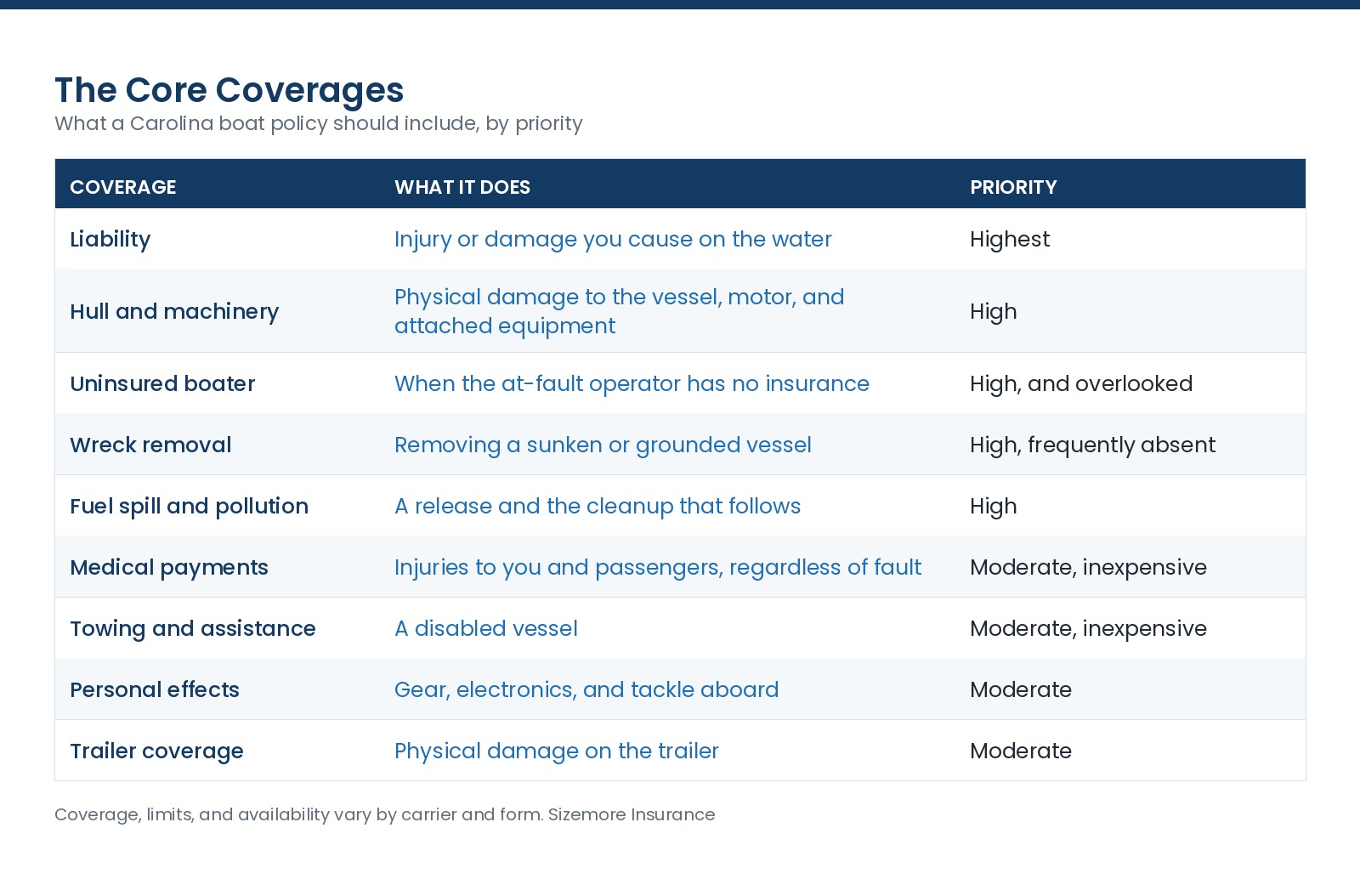
The takeaway: liability, wreck removal, and pollution are the three that produce numbers most owners could not absorb, and the last two are frequently missing.
Coverage, limits, and availability vary by carrier and form. Review your own policy.
Neither Carolina generally requires boat insurance.
On the road, every driver around you is legally required to carry liability. On the water, many of the operators around you carry nothing at all.
If one of them injures you or a passenger, uninsured boater coverage on your own policy is what responds. It is generally inexpensive and it is a coverage many owners have never been offered.
These two are the ones I most want owners to check for.
Wreck removal. If your vessel sinks or grounds, removing it can be legally required, and the cost is not related to what the boat was worth. A sunken boat in a channel or a marina slip has to come out regardless of whether it is a total loss.
Fuel spill and pollution liability. A release triggers cleanup obligations under federal law, and those costs are not small. This coverage exists because the exposure does.
Neither is automatic on every policy, and both should be.
Navigation limits define where you are covered. A policy written for inland and coastal waters may not cover a run well offshore or a trip to another region. Read them before you plan the trip, not after.
Lay-up periods reduce coverage during a defined off season. Know the dates before taking the boat out on a warm February day.
Agreed value and actual cash value are different worlds. Boats depreciate, and which basis your policy uses decides what a total loss pays. That gets its own article.
Named storm deductibles apply on the coast, frequently as a percentage of insured value, and some carriers require a written haul-out plan.
Personal watercraft need their own coverage and are frequently listed separately even on a boat policy.
Chartering or renting the boat out is a commercial use and it is outside a personal policy.
A survey may be required on an older or larger vessel, by the carrier or the lender.
Is boat insurance required in North Carolina?
The state does not generally require it. Lenders and marinas frequently do, and liability is the reason to carry it regardless.
Does my homeowners policy cover my boat?
Physical damage at a low sublimit, and liability generally only for small low-horsepower craft.
What limits should I carry on liability?
As much as you reasonably can. This is the coverage protecting everything you own.
Do I need uninsured boater coverage?
Yes, arguably more than on the road, because boat insurance is not generally required and many operators carry none.
Is wreck removal included?
Not always. Check for it specifically, because the cost is unrelated to the boat's value.
Can my umbrella sit over my boat policy?
Generally, if the watercraft is scheduled and the underlying limit requirement is met. Confirm it.
We have been an independent insurance company in North Carolina since 1977, on a coast where a lot of families keep a boat. Send us your declarations page and we will tell you what is actually on it. Insurance made just for you.
Coverage, limits, thresholds, and availability vary by carrier and form. Registration and operating requirements are set by the North Carolina Wildlife Resources Commission and the South Carolina Department of Natural Resources. Review your own policy or talk to your advisor.