
Reviewed for insurance accuracy by Brad Sizemore, Owner and CEO, NPN 6595451 · November 18, 2026
The first question after a fire is not about the house. It is where the family sleeps tonight, and then where they sleep for the next eight months. Loss of use, Coverage D on most policies, pays the additional cost of living somewhere else while your home is being repaired after a covered loss.
Loss of use is the coverage that answers it, and it is the one clients ask me about least before a claim and most during one. Through 15 private flood insurance markets we can also offer flood policies where some carriers include additional living expense, which a standard NFIP policy does not.
Loss of use, Coverage D on most policies, pays the additional cost of living somewhere else while your home is being repaired after a covered loss.
The word additional is doing real work. It pays the difference between what you normally spend and what you now spend, not your total living costs.
Covered, generally: a rental home or apartment, hotel, the increase in your food costs from eating out, storage for belongings, pet boarding, laundry, and additional commuting if you are living farther from work.
Not covered: your mortgage, which you were paying anyway. Utilities to the extent you were paying them before. Ordinary groceries at your normal level.
The mortgage question is the one that surprises people most. It continues, and it is not an additional cost, so it comes from your own pocket while you also pay rent somewhere.
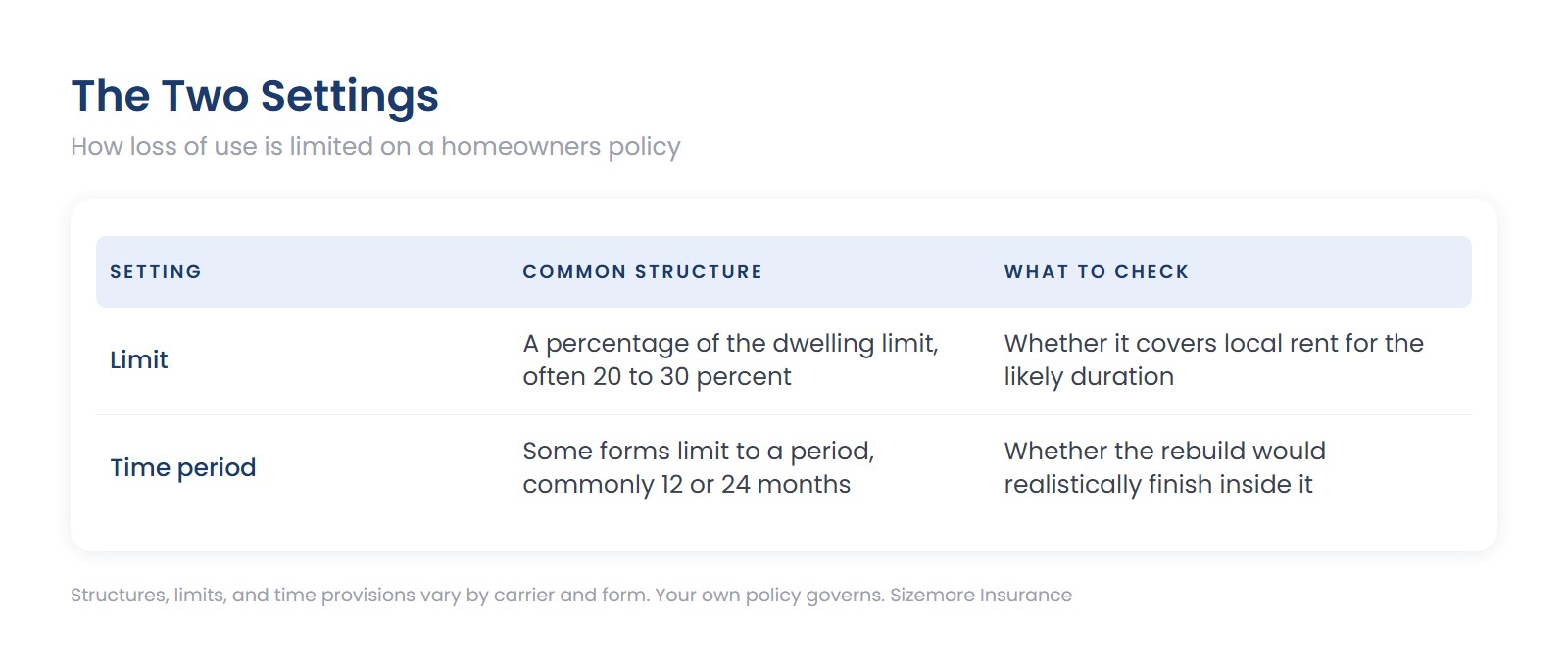
The takeaway: the time period matters as much as the dollar limit, and after a regional storm both run short.
Structures, limits, and time provisions vary by carrier and form. Your own policy governs.
Some policies carry no time limit and pay until the home is repaired within a reasonable time. Some carry both a percentage limit and a months limit, and whichever runs out first ends the coverage.
The first thing I check when a client asks about this is what comparable housing actually costs where they live.
Find a real number. What does a rental of similar size and location cost per month in your area right now? Multiply by twelve.
Then add the extras. Storage, higher food costs, pet boarding, and the deposit and moving costs that come with a temporary move twice.
Compare that to your Coverage D limit. Most clients find it is close on a small loss and short on a total one.
Think about the duration. Permitting, contractor availability, and material lead times all extend a rebuild, and a total loss in this state routinely takes a year or more. After a regional event it takes longer.
Housing is scarce after a widespread storm. Everyone in the county is looking for a rental at once, and prices reflect it. That is exactly when the coverage is needed and when the market makes it most expensive.
Coastal and mountain rebuilds run longest, because of access, permitting, and elevation or code requirements.
Flood is different. The federal flood program generally does not include additional living expense on a residential policy. If your home is unlivable because of rising water rather than wind or fire, this coverage may not respond at all. Some private flood policies include it, which is a genuinely good reason to look beyond the federal program.
Prohibited use is a related coverage. Some forms pay loss of use when a civil authority prevents you from occupying the home even without direct damage to it, subject to conditions and usually a short duration.
Pets and larger households cost more. A family with animals or several children has fewer rental options and pays more for them.
Keep receipts for everything. The claim is reimbursed against documented additional expense, and reconstructing three months of restaurant receipts from memory is not fun.
What does loss of use cover?
The additional cost of living elsewhere after a covered loss, including rent, hotel, increased food costs, storage, and pet boarding.
Does it pay my mortgage?
No. Your mortgage is an existing expense, not an additional one.
How much loss of use do I have?
Usually a percentage of your dwelling limit, commonly 20 to 30 percent. It is on your declarations page as Coverage D.
Is there a time limit?
Some policies have one, commonly 12 or 24 months, and some pay until the repair is complete within a reasonable time. Check yours.
Does flood insurance cover living expenses?
The federal residential program generally does not. Some private flood policies do.
Can I increase it?
Usually yes, and it is inexpensive. Call us and we will price it.
Sizemore Insurance is an independent insurance company founded in North Carolina in 1977. Send me your declarations page and I will tell you how long your loss of use coverage would actually last. Insurance made just for you.
Sources: North Carolina Department of Insurance, consumer guidance on homeowners coverage in North Carolina (ncdoi.gov); South Carolina Department of Insurance, consumer guidance on homeowners coverage in South Carolina (doi.sc.gov); FEMA and the National Flood Insurance Program, what a federal flood policy does and does not cover, including living expenses (fema.gov, floodsmart.gov).
Coverage, limits, time provisions, and program terms vary by carrier and form. Review your own declarations page or talk to your advisor.
Coverage details: North Carolina Home Insurance