Everyone thinks about their belongings. Far fewer think about where they will sleep.
Additional living expense is the coverage that answers the second question, and after a real loss it is frequently the part people are most grateful for.
If a covered loss makes your place unlivable, it pays the additional costs of living somewhere else.
Additional is the key word. It pays the difference between what you normally spend and what you now have to spend.
A hotel or a short-term rental, while your place is repaired or while you find something else.
Extra food costs, because a hotel room without a kitchen means eating out.
Storage for belongings that survived.
Extra commuting costs if you are temporarily living farther from work.
Laundry, pet boarding, and other costs you did not have before.
What it does not pay: your normal rent, which you may or may not still owe depending on your lease. That is a lease question rather than an insurance one.
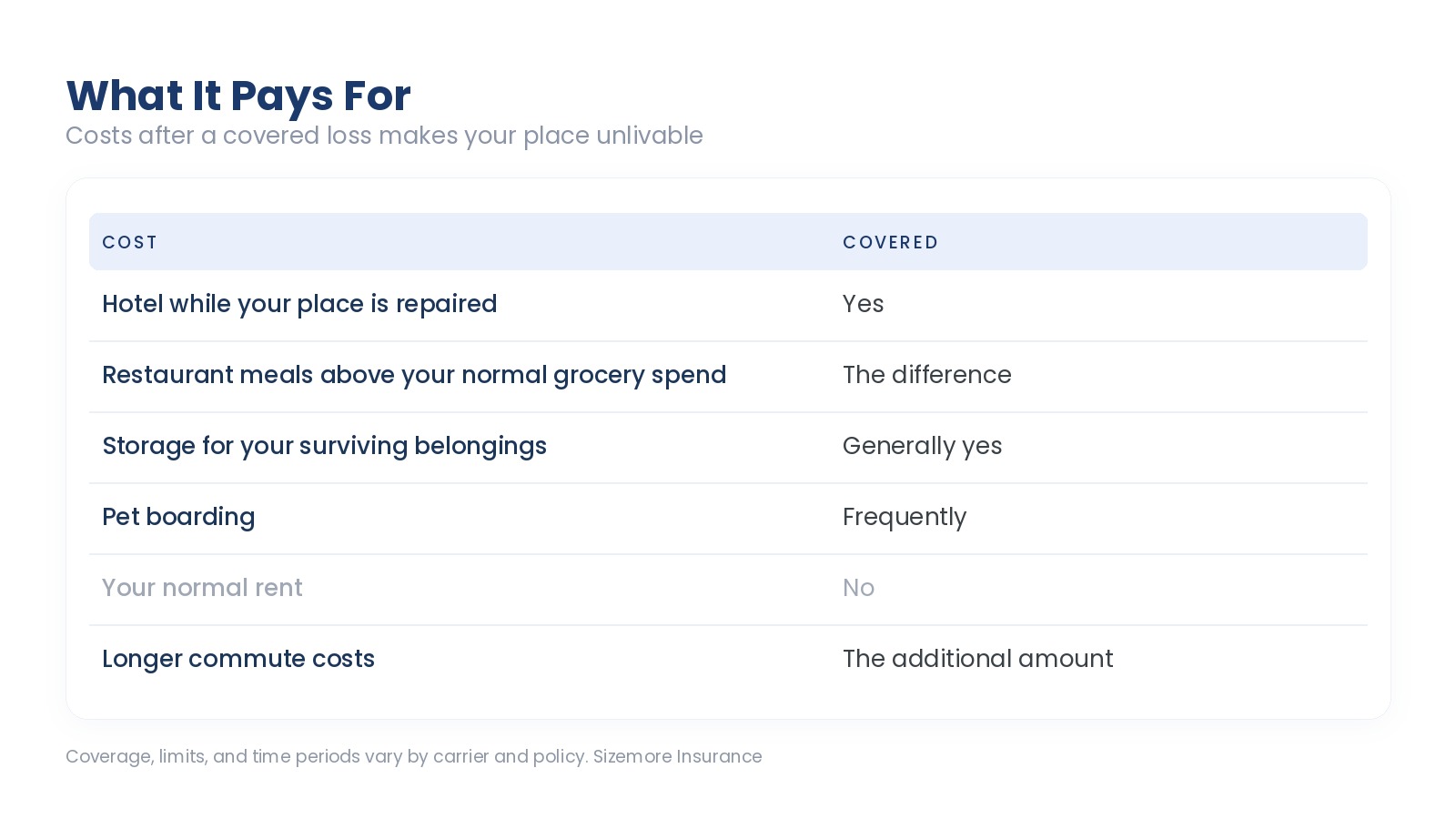
The takeaway: it covers the gap between your normal life and your temporary one, which after a fire is a substantial number.
Coverage, limits, and time periods vary by carrier and policy.
The limit, frequently a percentage of your personal property coverage.
The time period, frequently stated as a maximum number of months or as the time reasonably required to repair or relocate.
Both matter and many people have never looked at either.
Ask anyone in western North Carolina who rented in September 2024.
When a whole area is affected, there is nowhere to go. After a regional event, hotels fill, short-term rentals fill, and available apartments disappear. What housing exists is expensive.
Repairs take longer because contractors are booked.
Which means the coverage runs longer and costs more per night exactly when it is hardest to find anything at all.
A limit and a time period sized for a single apartment fire in an ordinary month is not sized for that.
And there is a second lesson. After a regional event, a renter without this coverage may not be able to stay in the area at all, which means leaving a job and a community, not just a building.
It requires a covered loss. A landlord deciding to renovate, or selling the building, is not a covered loss.
Evacuation without damage may or may not trigger it depending on the form and the circumstances. Ask.
Your lease still governs the rent question, and whether you owe rent on an unlivable unit is a lease and state law matter rather than an insurance one.
Documentation matters. Keep receipts for everything, because the claim is reimbursement of additional costs and receipts are the proof.
It is not unlimited, and knowing the limit and the period in advance is worth two minutes.
What is additional living expense?
Coverage for the extra costs of living somewhere else when a covered loss makes your place unlivable.
Does it pay my rent?
No. It pays additional costs above your normal spending. Whether you still owe rent is a lease question.
How long does it last?
There is a limit and a time period. Ask what yours are.
Does it cover a hotel?
Yes, along with extra food, storage, and other additional costs.
What if my landlord just decides to renovate?
That is not a covered loss.
Why does a regional event change things?
Housing disappears and costs more, and repairs take longer. The coverage runs longer at a higher rate.
Sizemore Insurance is an independent insurance company founded in North Carolina in 1977, writing in both North Carolina and South Carolina. Send us your declarations page and we will tell you what your limit and period are. Insurance made just for you.
Coverage, limits, time periods, and provisions vary by carrier and policy and are subject to change. Nothing here is legal advice or a coverage determination. Review your own lease and policy or talk to your advisor.