Reviewed for insurance accuracy by Brad Sizemore, Owner and CEO, NPN 6595451 · November 25, 2026
A homeowners policy pays to rebuild what you had. A building inspector requires what code says you should have now. Ordinance or law coverage pays the added cost of rebuilding to current building code after a covered loss.
On a house built in 1974, those are two different houses, and the difference is a number nobody discusses until a permit gets pulled after a fire.
The added cost of complying with current building codes when you repair or rebuild after a covered loss.
Increased cost of construction. Bringing the rebuilt portion up to today's standards. Electrical service and grounding, insulation and energy requirements, hurricane connections and fastening in wind-exposed areas, egress, and in flood zones elevation.
Demolition of the undamaged portion, where code will not permit tying new compliant work into old noncompliant structure.
The value of that undamaged portion you are required to tear down.
Most standard policies include a small amount, frequently 10 percent of the dwelling limit. Higher options are commonly available at 25 percent, 50 percent, or more.
This is the part that surprises people.
On a total loss you are building a new house, everything is to code, and the question is whether your dwelling limit plus the ordinance coverage is enough.
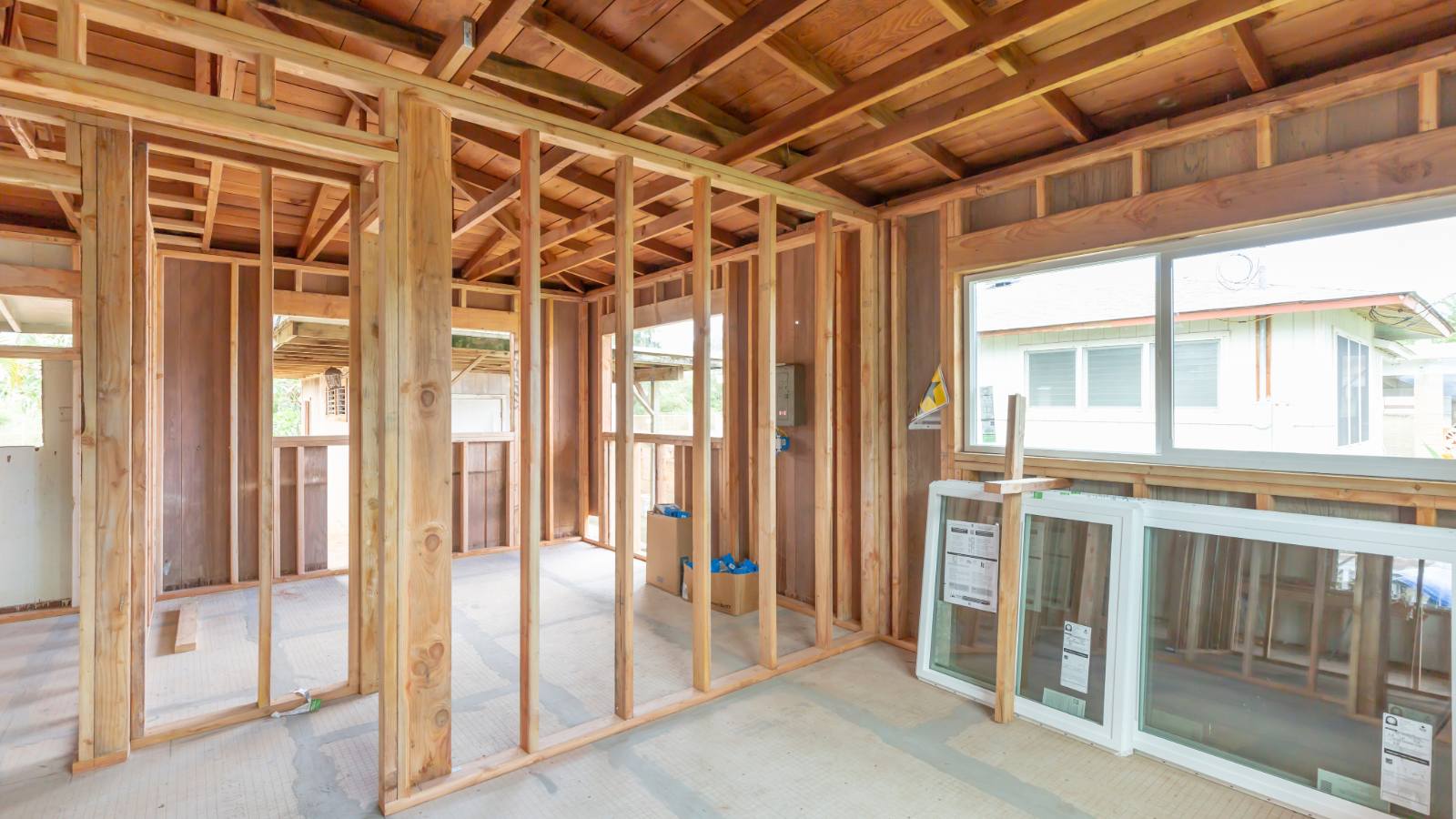
On a partial loss you are tying new work into an old house that does not comply. That is where the expensive conflicts live: transitions between compliant and noncompliant construction, thresholds that trigger requirements across a whole system once work exceeds a percentage, and demolition of sound structure to make the connection legal.
Partial losses are the overwhelming majority of homeowners claims.
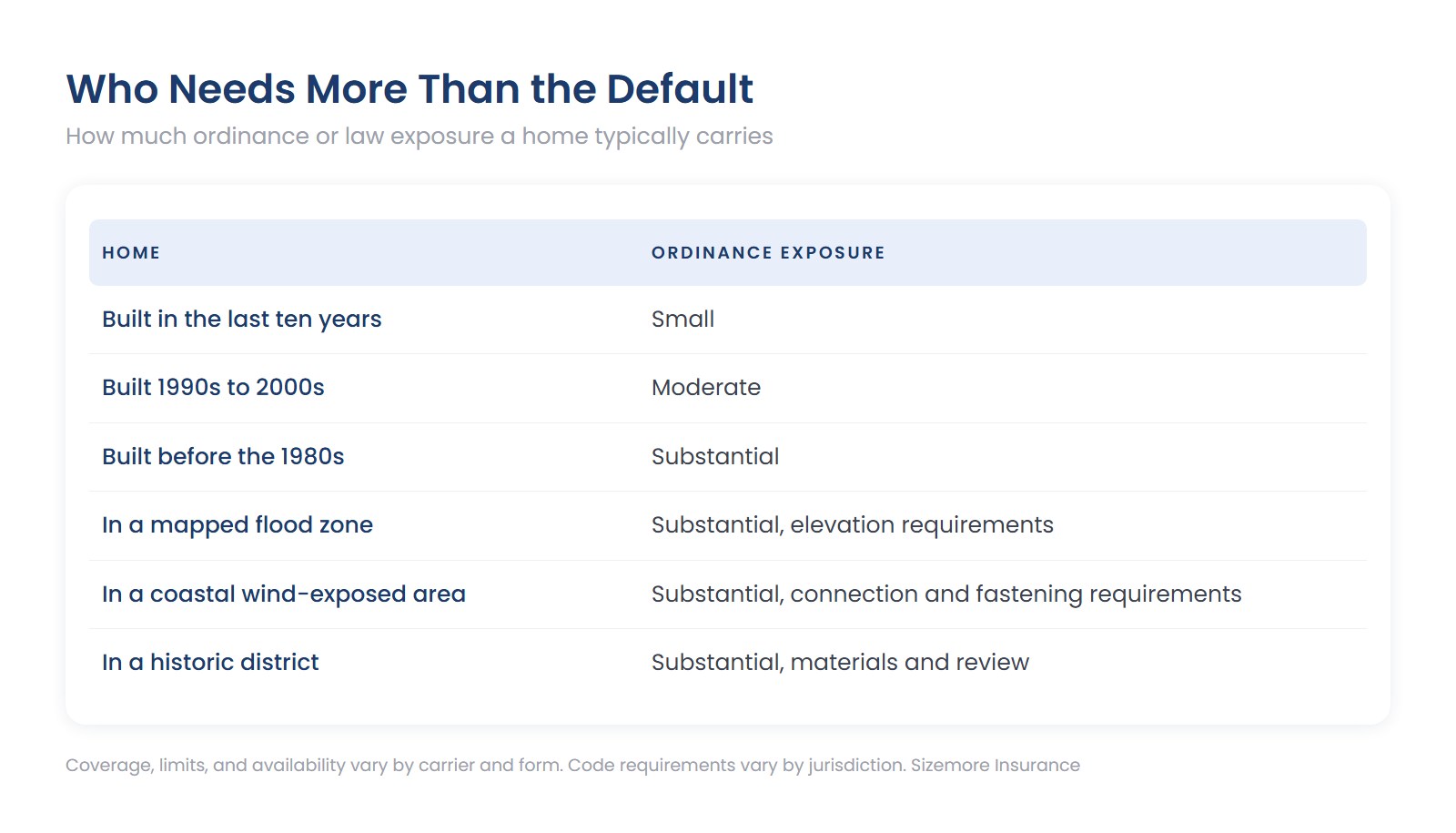
The takeaway: the exposure scales with the gap between how the house was built and what code now requires, and in most Carolina downtowns that gap is decades wide.
Coverage, limits, and availability vary by carrier and form. Code requirements vary by jurisdiction.
The limit is a percentage of Coverage A. If your dwelling limit is short, the ordinance coverage is short by the same proportion. Fix the dwelling limit first.
Flood zone substantial damage rules are the largest version. Damage exceeding a defined percentage of the structure's value can require the house to be brought into compliance with current floodplain standards, including elevation. That is a very large number and this coverage addresses part of it.
Increased cost of compliance under a flood policy is a separate provision addressing part of the same problem from the flood side. Neither covers all of it.
It is inexpensive. Increasing from the default 10 percent to 25 or 50 percent is typically a small premium change relative to the exposure it closes.
Historic districts add materials and review requirements that affect both cost and timeline.
Solar, well, and septic can bring their own current-code requirements at rebuild.
Loss of use interacts with it. Code-driven scope and permitting extend a rebuild, and your loss of use duration has to survive it.
What is ordinance or law coverage?
Coverage for the added cost of rebuilding to current building code after a covered loss.
Does my policy already have it?
Most include a small amount, frequently 10 percent of the dwelling limit. That is rarely enough on an older home.
How much should I carry?
More on older homes, coastal homes, and homes in flood zones or historic districts. Twenty-five to 50 percent is a reasonable range to price.
Does it apply to partial losses?
Yes, and that is where it matters most, because tying new work into old construction is where the code conflicts arise.
Is it expensive?
No. It is one of the least expensive meaningful additions to a homeowners policy.
Does it cover elevation requirements in a flood zone?
It addresses part of the code-driven cost. Increased cost of compliance under the flood policy addresses another part. Neither covers all of it.
Sizemore Insurance is an independent insurance company founded in North Carolina in 1977. Tell us when your house was built and where it sits and we will price the right ordinance limit against the exposure. Insurance made just for you.
Sources: North Carolina Department of Insurance, consumer guidance on homeowners coverage in North Carolina (ncdoi.gov); North Carolina Rate Bureau, the standard North Carolina homeowners forms, including the ordinance or law provision (ncrb.org); FEMA and the National Flood Insurance Program, the substantial damage rule and increased cost of compliance coverage (fema.gov, floodsmart.gov).
Coverage, limits, and availability vary by carrier and form. Code requirements vary by jurisdiction and change. Nothing here is code or legal advice. Review your own policy or talk to your advisor.
Coverage details: North Carolina Home Insurance