Reviewed for insurance accuracy by Brad Sizemore, Owner and CEO, NPN 6595451 · November 17, 2026
View reviewer profileNorth Carolina has a great deal of factory-built housing, and the insurance conversation around it starts with a distinction most owners have never had explained to them. A modular home is generally written on a standard homeowners form, while a manufactured home is typically written on a specialized manufactured home form.
Manufactured and modular are not two words for the same thing. They are built to different standards, they are insured on different forms, and one of them prices like an ordinary house while the other does not.
Modular homes are built in sections in a factory and assembled on a permanent foundation, and they are constructed to the same state and local building codes as a site-built house. For insurance purposes a modular home is generally treated like any other home and written on a standard homeowners form.
Manufactured homes are built to a federal construction standard administered by HUD rather than to the state building code, are built on a permanent chassis, and are transported to the site. They are typically written on a specialized manufactured home form rather than a standard homeowners policy.
If you are unsure which you have, the data plate and the certification label tell you. Modular homes carry a state or third-party inspection label. Manufactured homes carry a HUD certification label on the exterior of each section.
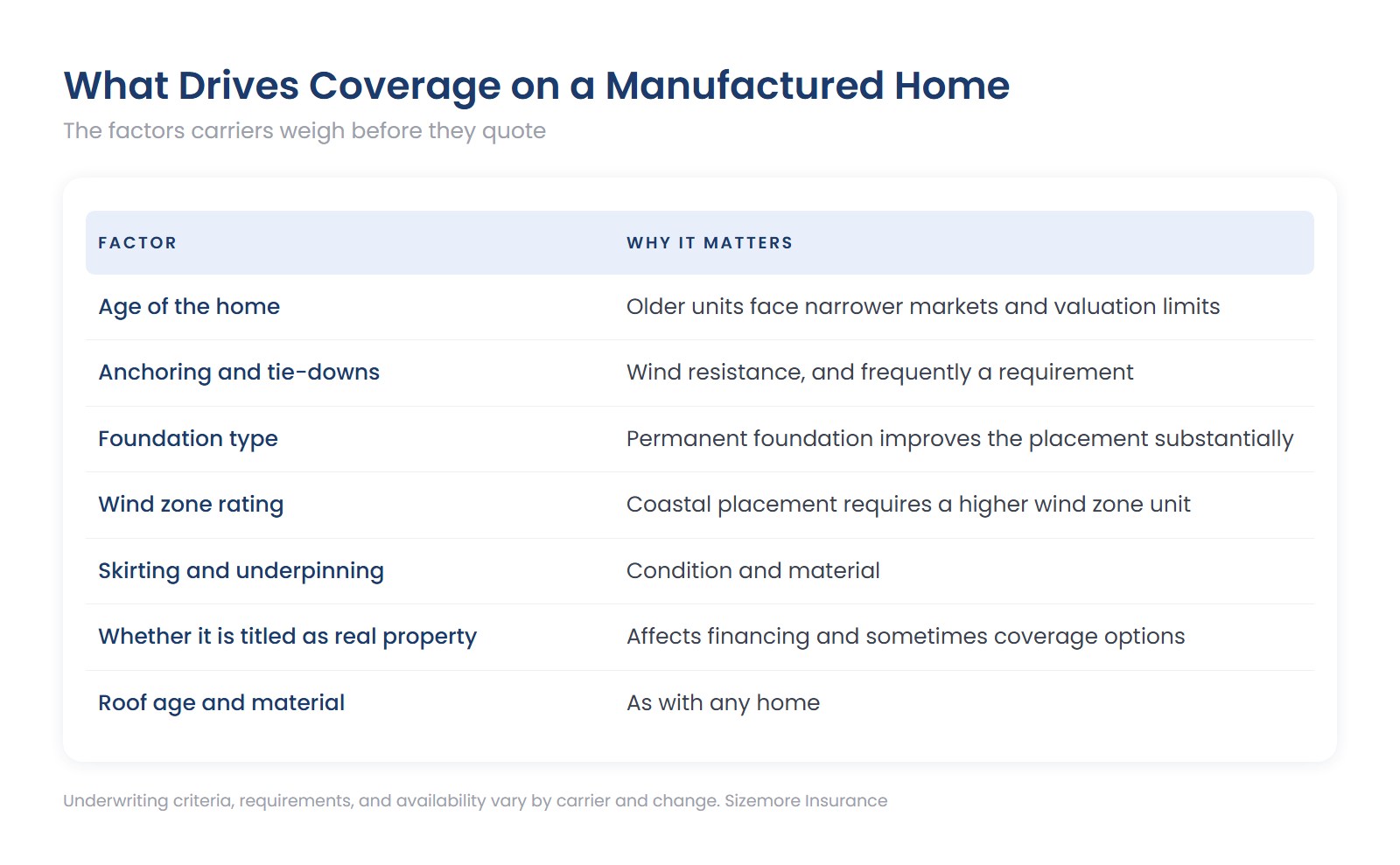
The takeaway: anchoring, foundation, and wind zone are what determine whether a manufactured home is a routine placement or a difficult one.
Underwriting criteria, requirements, and availability vary by carrier and change.
This is where manufactured home coverage differs most from a standard homeowners policy.
Actual cash value is common on manufactured home forms, particularly on older units. Depreciation is applied, and on a home that has depreciated substantially the payout after a total loss can be well below what it costs to replace.
Replacement cost is available from some carriers on newer units and it is worth asking for specifically.
Stated value or agreed value approaches exist and behave differently again.
Ask which one you have. On a manufactured home this single setting decides more than any other, and owners frequently assume replacement cost because that is what they had on a previous house.
Wind zone matters on the coast. Manufactured homes are built to different wind zone standards, and placing a unit rated for one zone in a higher-exposure area creates both a compliance and an insurance problem.
Anchoring is frequently a coverage condition and it is also the thing that keeps the home in place. Documentation of a proper installation is worth having.
Older units face age limits. Many carriers will not write manufactured homes past a certain age, and the ones that will may offer actual cash value only.
Land ownership affects the picture. Owning the land, being in a leased-lot community, or being on family property all change the placement and sometimes the available forms.
Flood applies the same way it does everywhere. No property policy covers rising water, and manufactured homes in flood-prone areas face elevation requirements the same as any structure.
Modular homes should not be quoted as manufactured. If you have a modular home and someone quoted a manufactured form, you may be paying more for narrower coverage. Show them the label.
Additions and attached structures built on site, like a carport, deck, or sunroom, may be treated differently from the home itself.
What is the difference between manufactured and modular?
Modular homes are built to state and local building codes and insured like a site-built home. Manufactured homes are built to a federal HUD standard on a permanent chassis and typically use a specialized form.
How do I tell which I have?
Look for the label. Manufactured homes carry a HUD certification label. Modular homes carry a state or third-party inspection label.
Can I get replacement cost on a manufactured home?
Some carriers offer it, more commonly on newer units. Ask specifically, because actual cash value is common.
Does anchoring affect my insurance?
Yes. Proper anchoring and tie-downs affect eligibility, pricing, and how the home performs in wind.
Can I insure an older manufactured home?
Frequently yes, with narrower options and often on an actual cash value basis.
Is a modular home harder to insure?
No. It is generally treated like any other home built to code.
Sizemore Insurance is an independent insurance company founded in North Carolina in 1977, and we write a lot of factory-built housing. Tell us which label is on your home and we will place it correctly. Insurance made just for you.
Sources: U.S. Department of Housing and Urban Development, the federal manufactured home construction standard, certification labels and wind zones (hud.gov); North Carolina Department of Insurance, modular and manufactured home construction, labels and installation in North Carolina (ncdoi.gov); South Carolina Department of Insurance, consumer guidance on homeowners and manufactured home coverage (doi.sc.gov); FEMA and the National Flood Insurance Program, flood coverage and elevation requirements (fema.gov, floodsmart.gov).
Construction standards, underwriting criteria, valuation options, and availability vary by carrier and change. Review your own policy or talk to your advisor.
Coverage details: North Carolina Home Insurance