Reviewed for insurance accuracy by Brad Sizemore, Owner and CEO, NPN 6595451 · November 16, 2026
View reviewer profileThe storm that makes the news is not the event that produces most mountain home claims. Ice and snow damage to the house is generally covered, and a frozen pipe claim on an empty house usually turns on whether the heat was on or the water was off and drained.
January does. An ice storm takes the power out for four days, the house cools, a supply line in an exterior wall lets go, and water runs for however long it takes somebody to notice. On a house nobody is living in, that can be a week.
Winter losses are also the most preventable losses in this whole section, and the coverage turns on conditions rather than on perils.
Weight of ice, snow, or sleet causing damage to the building. Roof damage and collapse under load are generally covered perils on a standard form.
A tree falling under ice load onto the house or a covered structure.
Sudden discharge from a burst pipe, including the resulting water damage, subject to the freezing conditions below.
Damage from a covered peril generally, including fire from a supplemental heat source used during an outage.
Freeze damage while the dwelling is unoccupied, unless you maintained heat in the building or shut off the water supply and drained the system. This is the condition that decides the claim.
Gradual seepage, including slow leaks that ran for weeks before discovery.
Wear and deterioration, including a roof that failed under normal load because it was at the end of its life.
Food spoilage and losses from a power outage, unless an endorsement addresses it. Some carriers offer one and the limits are modest.
Damage to the pipe itself in some forms, distinct from the resulting water damage.
Ice dam repair on the roof, in some circumstances, even where the resulting interior water damage is covered.
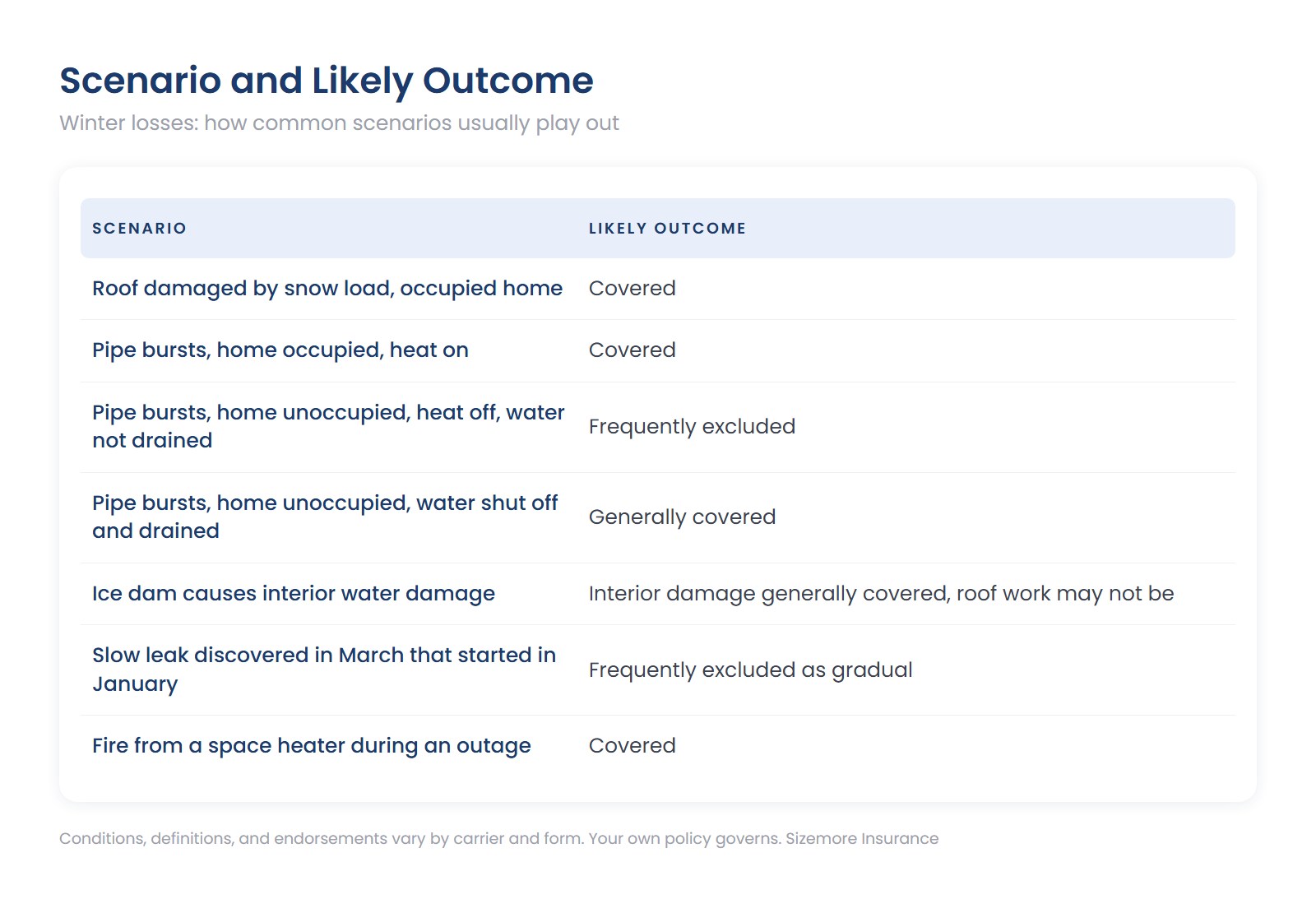
The takeaway: the difference between a covered freeze claim and an excluded one is usually whether the heat was on or the water was off, and whether you can prove it.
Conditions, definitions, and endorsements vary by carrier and form. Your own policy governs.
Standard forms commonly exclude loss caused by water freezing in a plumbing, heating, or air conditioning system while the dwelling is unoccupied, unless you used reasonable care either to maintain heat in the building or to shut off the water supply and drain the system.
Two ways to satisfy it. Heat maintained, or water off and drained.
The word doing the work is unoccupied, which on a mountain second home or a rental between guests is most of the winter.
Proof matters. A thermostat that says the heat was set is one thing. A monitored low-temperature sensor with a logged history is considerably better, and it is inexpensive.
A low-temperature alert. A monitored sensor that texts you when the house drops below a threshold. The cheapest meaningful risk control in this article.
An automatic water shutoff with leak detection. Senses flow anomalies and closes the main. Several carriers offer credits for them, and they turn a catastrophic loss into a small one.
Pipe insulation and sealing air leaks in crawlspaces and exterior walls, which is where the failures concentrate.
A standby generator on a house that loses power regularly. It protects the heat, which protects the plumbing.
Someone checking the house on a schedule during winter, with a log.
Draining the system properly if you choose that route rather than maintaining heat. Partial draining is how people end up with the worst of both.
Roof snow load and ice dams are different problems. Load is a structural question. Ice dams are a ventilation and insulation question, and the fix is attic work rather than roof work.
Removing snow from a roof causes damage. Aggressive removal damages shingles and flashing and creates a maintenance argument later. Roof rakes used from the ground, carefully, are the safer approach.
Access complicates everything. A house at the top of an icy grade delays discovery, delays mitigation, and delays repair.
Outages and supplemental heat interact. People run stoves and space heaters hardest during exactly the conditions when clearances and maintenance matter most.
Mitigation speed decides mold. Water damage coverage frequently comes with restricted mold provisions conditioned on prompt drying. Days matter.
On a rental property, the income side matters too. A February freeze that takes a mountain rental offline into spring is a loss of rental income question as well as a property one.
Are frozen pipes covered by homeowners insurance?
Generally yes when the home is occupied. When it is unoccupied, coverage typically requires that you maintained heat or shut off and drained the water.
Is roof damage from snow covered?
Weight of ice, snow, and sleet is generally a covered peril on a standard form.
Are ice dams covered?
The resulting interior water damage is generally covered. Work on the roof itself may not be, depending on the form.
What if the power went out and I could not maintain heat?
The condition asks whether you used reasonable care. This is exactly why a monitored low-temperature alert and a generator matter, both as prevention and as evidence.
Does my policy cover spoiled food after an outage?
Only with an endorsement in most cases, and the limits are modest.
What should I install first?
A monitored low-temperature alert, then an automatic water shutoff with leak detection.
Sizemore Insurance is an independent insurance company founded in North Carolina in 1977. Tell us how the house is used in the winter and we will tell you which condition applies to your policy and what would satisfy it. Insurance made just for you.
Sources: North Carolina Rate Bureau, North Carolina homeowners policy forms, including the freezing and unoccupancy conditions (ncrb.org); North Carolina Department of Insurance, consumer guidance on homeowners coverage (ncdoi.gov).
Coverage, conditions, endorsements, credits, and availability vary by carrier and form. Nothing here is a coverage determination. Review your own policy or talk to your advisor.
Coverage details: North Carolina Home Insurance