Reviewed for insurance accuracy by Victoria Konczynski, Personal Lines Account Manager, NPN 16516709 · November 18, 2026
A standard homeowners form is a well-built product designed for the middle of the market. Above a certain point it stops fitting, and the mismatch shows up in valuation, in sublimits, and in how a claim settles. A standard policy usually stops fitting somewhere above roughly $750,000 to $1,000,000 in rebuild cost, or wherever custom construction, valuable contents, above-ordinary liability or multiple properties are present.
The threshold is not a single number. It is a set of conditions, and most owners who have crossed it are still on a standard form.
Sizemore Insurance works with carriers that insure homes valued up to $25 million, wind included, on one policy.
The dwelling limit is high enough that a valuation error is expensive. Above roughly $750,000 to $1,000,000 in rebuild cost, small percentage errors become large dollar figures.
The house has custom or irreplaceable elements. Millwork, stonework, imported materials, unusual roof geometry, or period construction that a square footage calculation will not capture.
Personal property exceeds the category sublimits meaningfully. Jewelry, art, wine, firearms, collections, or high-end electronics.
Liability exposure is above ordinary. Household staff, board service, significant assets, a pool, a dock, or teenage drivers.
There are multiple properties. A primary residence, a coastal or mountain second home, and possibly a rental, ideally coordinated rather than placed separately.
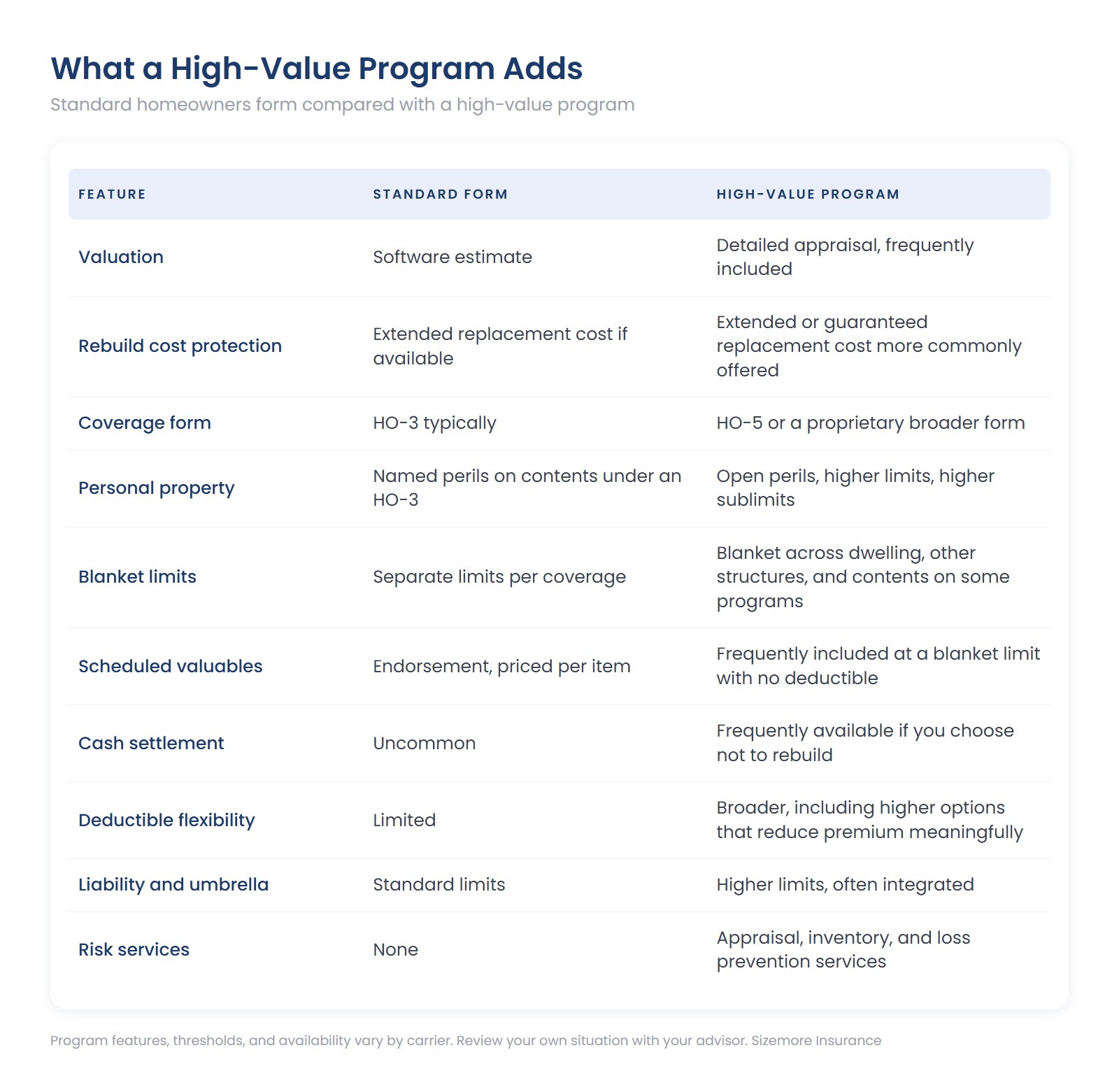
The takeaway: the two features that matter most are the valuation work and the blanket limit. Together they largely eliminate the underinsurance problem that a standard form leaves to the owner.
Program features, thresholds, and availability vary by carrier. Review your own situation with your advisor.
Eligibility is not only about value. Coastal exposure, roof age, claim history, and construction all affect whether a high-value carrier will write the house. Some of these programs are more selective than the standard market, not less.
Premium is not automatically higher. Broader coverage at a higher deductible frequently prices competitively against a standard form at a low deductible. Compare the total structure rather than the headline.
Blanket limits are the feature to ask about specifically. A single limit spanning dwelling, other structures, and contents removes the problem of one coverage running short while another has surplus.
Cash settlement changes the decision after a total loss. On a standard form, replacement cost generally requires you to rebuild. Some high-value programs pay the dwelling limit in cash without requiring reconstruction, which matters if you would relocate instead.
Coordination across properties is the real value. One program covering the primary residence, the coastal house, the mountain house, the vehicles, the boat, the valuables, and an umbrella above all of it is simpler at renewal and far simpler at a claim.
These programs still exclude flood and earth movement. Coastal and mountain exposures need the same separate policies as anywhere.
Scheduling is easier and frequently unnecessary. Many programs offer a blanket valuables limit rather than item-by-item scheduling, though genuinely high-value single items still warrant scheduling with appraisals.
At what home value should I move to a high-value program?
There is no fixed threshold. Somewhere above roughly $750,000 to $1,000,000 in rebuild cost, or wherever custom construction, valuable contents, or multiple properties are present.
Is high-value insurance more expensive?
Not necessarily. Broader coverage paired with a higher deductible often competes well against a standard form.
What is a blanket limit?
A single limit spanning dwelling, other structures, and personal property rather than separate limits for each.
Do I still need to schedule jewelry?
Many programs offer a blanket valuables limit. Genuinely high-value individual items still warrant scheduling with an appraisal.
Does this cover flood?
No. Flood and earth movement are excluded on these programs as on any other.
Can one program cover all my properties?
That is the main structural advantage, and it is worth asking for explicitly.
Sizemore Insurance is an independent insurance company founded in North Carolina in 1977. Send us the whole picture, every property and every schedule, and we will tell you whether a high-value program fits better than what you have. Insurance made just for you.
Sources: North Carolina Department of Insurance, consumer guidance on homeowners coverage, valuation and replacement cost (ncdoi.gov); South Carolina Department of Insurance, consumer guidance on homeowners coverage (doi.sc.gov); North Carolina Rate Bureau, the standard homeowners forms including the HO-3 and HO-5 and replacement cost loss settlement (ncrb.org); FEMA and the National Flood Insurance Program, flood excluded from homeowners policies and sold separately (fema.gov, floodsmart.gov).
Program features, eligibility, thresholds, and availability vary by carrier. Review your own policy or talk to your advisor.
Coverage details: North Carolina Home Insurance