

In both North Carolina and South Carolina, residual market wind coverage is capped. That is a design feature rather than a defect, and it creates a specific structural problem on any property worth more than the cap.
The problem is not that the residual market is inadequate. It is that a single layer sized to a cap and a property sized to a replacement cost are two different numbers, and the space between them is uninsured unless somebody builds a second layer.
The primary layer is the residual market wind policy, up to its maximum available limit.
The excess layer sits above it, typically placed in the surplus lines market, covering wind damage beyond the primary limit up to the property’s actual replacement cost.
The companion policy covers everything that is not wind.
Three policies on one property, and the excess layer is the one many owners do not know exists.
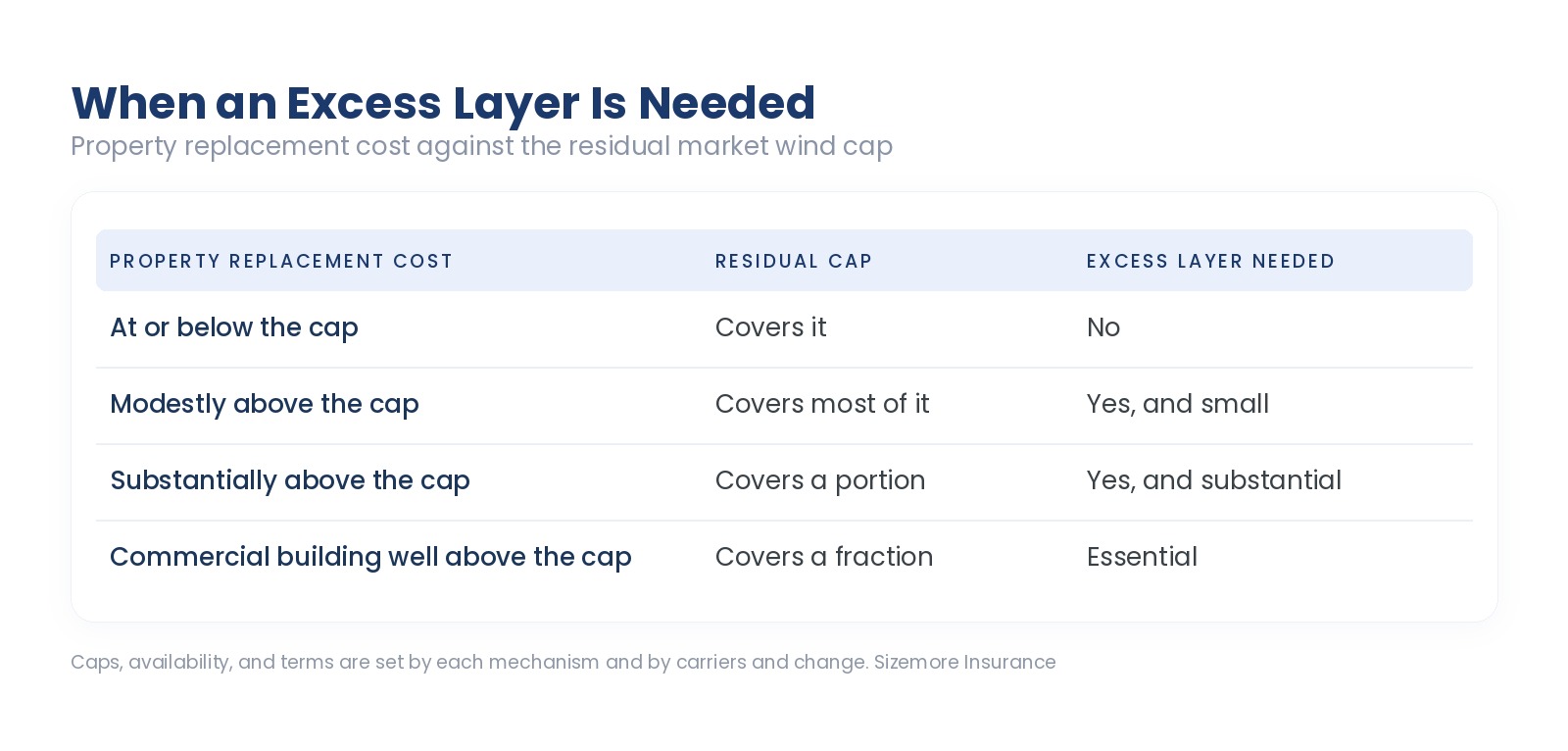
The takeaway: the cap is a limit, not a valuation. It does not adjust to what your property is worth.
Caps, availability, and terms are set by each mechanism and by carriers and change. Confirm current limits.
This is where the work is, and getting it wrong means you paid for coverage that does not connect.
The attachment point has to match the primary limit exactly. If the excess policy attaches at a figure above where the primary exhausts, the difference is yours.
The deductible has to be coordinated. The primary carries a percentage deductible. How the excess layer treats that deductible, and whether it applies again, needs to be settled in writing.
The covered perils have to align. An excess layer written on different trigger language than the primary can respond to different events, which can produce a gap at exactly the wrong moment.
Both policies need the same insured value. If they disagree on what the property is worth, the layers disagree on where one ends and the other begins.
Both need the lender named correctly, and both need to be maintained.
Difference in conditions is a related but distinct product. A difference in conditions policy can fill coverage gaps rather than only adding limit above a primary. On a complex property it is worth asking about, and it is a different structure than a straightforward excess layer.
Loss of use and business income sit awkwardly. They are frequently limited on the primary and may or may not be picked up by the excess layer. Address them specifically.
Commercial properties need this more often, because building values more commonly exceed the caps and because business income exposure compounds the gap.
Renewal coordination matters. Three policies with three dates is three chances for something to lapse or change without the others adjusting.
Getting out of the structure entirely is sometimes possible with roof work, and a single standard market policy is simpler and generally cheaper than three layers. Ask us to re-market annually.
The excess market is not always available, and appetite tends to tighten after regional losses. The window to place it is between events.
Why is my wind coverage capped?
Residual market mechanisms, the Beach Plan in North Carolina and the South Carolina Wind and Hail Underwriting Association, have maximum available limits set by statute or by the association. They do not adjust to property value.
What is excess wind coverage?
A second layer above the primary wind policy, covering damage beyond the primary limit, typically placed in the surplus lines market.
How do I know if I need it?
Compare your property’s replacement cost to the primary wind limit. The difference is your exposure.
What happens if the layers do not connect?
The gap between them is uninsured. Attachment point, deductible treatment, and trigger language all have to align.
Is this common on homes or only commercial?
Both, and more common on commercial because building values more often exceed the caps.
Can I avoid the whole structure?
Sometimes, with roof work that reopens the standard market. Ask us to re-market at every renewal.
Sizemore Insurance is an independent insurance company founded in North Carolina in 1977, writing in both North Carolina and South Carolina. Send us your policies and your replacement cost and we will show you where the layers connect and where they do not. Insurance made just for you.
Caps, availability, attachment provisions, and terms vary by mechanism, carrier, and form and are subject to change. Review your own policies or talk to your advisor.