

Many coastal owners treat their storm deductible as a fixed feature of living here. It frequently is not.
There is usually more room to change it than people realize, and the trade that funds it is one many owners have never been offered.
Multiply the percentage by the insured value and write it down.
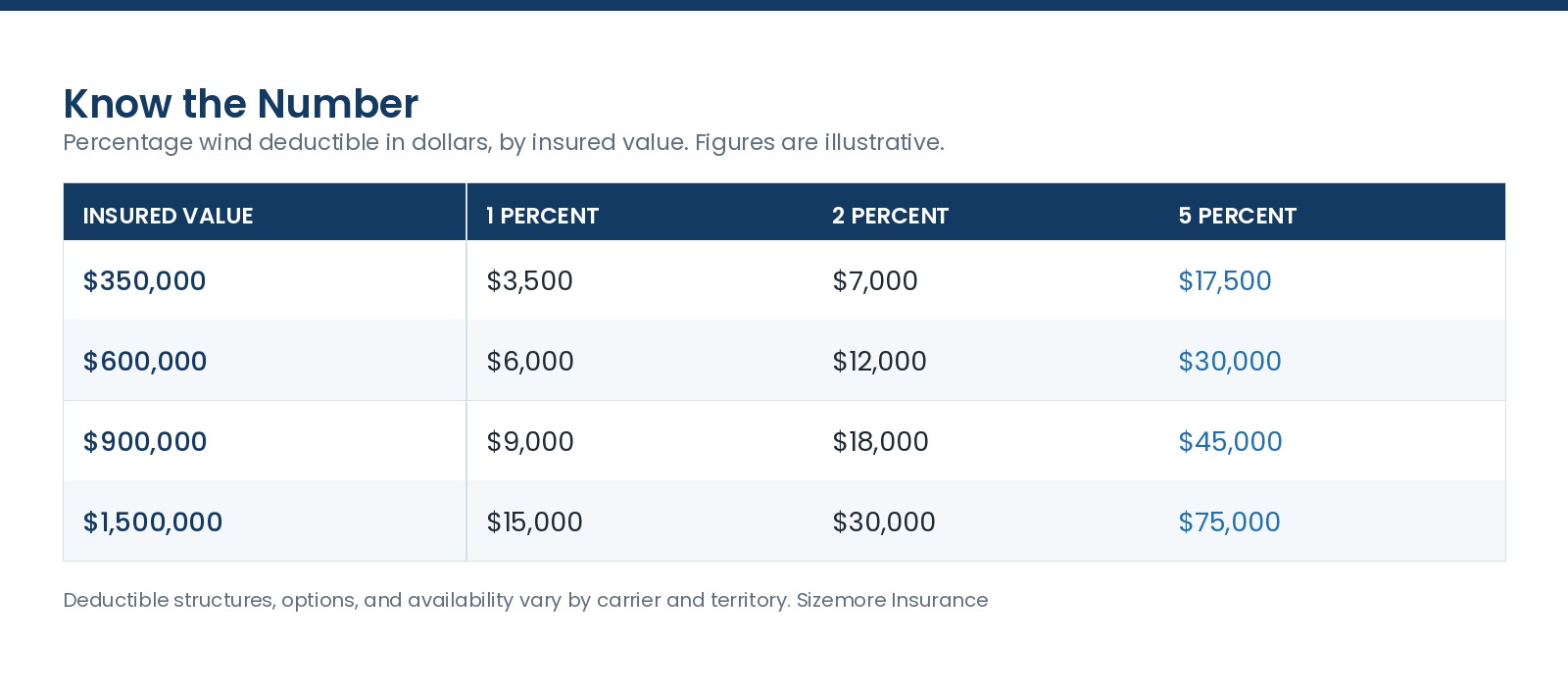
The takeaway: the difference between five percent and two percent on a $900,000 property is $27,000, which is a larger number than nearly anything else you could change on the policy.
Deductible structures, options, and availability vary by carrier and territory. Figures are illustrative.
Note also that the dollar figure climbs every year as your limit adjusts for construction cost inflation, while the percentage stays the same and nobody notifies you.
Ask for lower percentages priced. Two percent, one percent, and sometimes a flat option depending on the territory. Many owners have never been shown the alternatives because nobody offered them.
Trade the all other perils deductible. This is the move that rarely gets offered. Raising your everyday deductible from $1,000 to $2,500 is a manageable exposure and it can help fund a move from five percent to two percent on the storm side, where the dollars are far larger. Ask for both priced together.
Improve the roof. Enhanced wind construction affects eligibility, and better eligibility opens access to carriers and structures that a declined property does not have. Sometimes the deductible option follows the market position rather than the other way around.
Re-market the property. Deductible structures vary between carriers and between the standard, surplus, and residual markets. The structure you have reflects the market you are in as much as anything.
Ask about a flat option. Farther from the water a flat deductible is sometimes available and it is generally better for the owner where it exists.
The trigger matters as much as the percentage. Named storm, hurricane, and wind and hail are three different triggers, and a two percent named storm deductible and a two percent wind and hail deductible do not respond to the same weather. Read the language, not just the number.
It applies per storm. Two named storms in one season means the deductible twice, which argues for a percentage you could absorb twice rather than once.
It may apply to more than the dwelling. Depending on the form the same percentage can reach other structures and personal property.
A minimum dollar deductible frequently applies on percentage structures.
Loan documents may cap it. Many mortgages specify a maximum deductible, and a five percent structure on a coastal property can exceed it. That is worth checking before you assume the higher percentage is acceptable.
Lowering it costs premium. This is a real trade rather than a free improvement, and the question is whether the annual difference is worth the reduction in what you would fund after a storm.
Insurance to value affects it. Since the deductible is a percentage of the limit, an inflated limit inflates the deductible too. A correct valuation helps in both directions.
Can I lower my percentage wind deductible?
Frequently there are lower options available, and whether they are offered depends on the territory and the market. Ask for them priced.
What is the trade?
Premium. Lower deductible, higher premium. The useful comparison is the annual difference against the reduction in what you would fund after a storm.
Can I raise my other deductible to fund it?
That is the underused move. Ask for both priced together.
Why did my deductible go up when nothing changed?
Because it is a percentage of the limit and the limit rose with inflation adjustment.
Does the trigger matter?
Substantially. Named storm applies more often than hurricane, and the same percentage can respond differently.
Does my mortgage limit my deductible?
Many loan documents cap it. Check before you assume a higher percentage is acceptable.
We have been an independent insurance company in North Carolina since 1977. Send us your declarations page and we will convert every deductible to dollars and price the alternatives side by side. Insurance made just for you.
Deductible structures, options, triggers, minimums, and availability vary by carrier, territory, and form. Figures are illustrative. Review your own policy or talk to your advisor.