Reviewed for insurance accuracy by Brad Sizemore, Owner and CEO, NPN 6595451 · November 25, 2026
Every dwelling limit is an estimate made before the loss. The rebuild happens after it, under conditions nobody predicted. Extended replacement cost pays a stated percentage above your dwelling limit, and guaranteed replacement cost pays the full rebuild cost without a stated ceiling.
That is the gap these two options exist to close, and after a regional storm it is not a small one. When hundreds of houses in a county need rebuilding at the same time, local labor and material costs rise sharply. An accurate limit set in a normal year is not an accurate limit in that market.
Extended replacement cost adds a stated percentage above your dwelling limit, commonly 25 percent and sometimes 50 percent, available when the actual rebuild cost exceeds the limit. On a $500,000 limit, a 25 percent extension provides up to $625,000.
Guaranteed replacement cost pays the full cost to rebuild regardless of the dwelling limit. It is the stronger of the two and it has become difficult to obtain, particularly on the coast and on older homes.
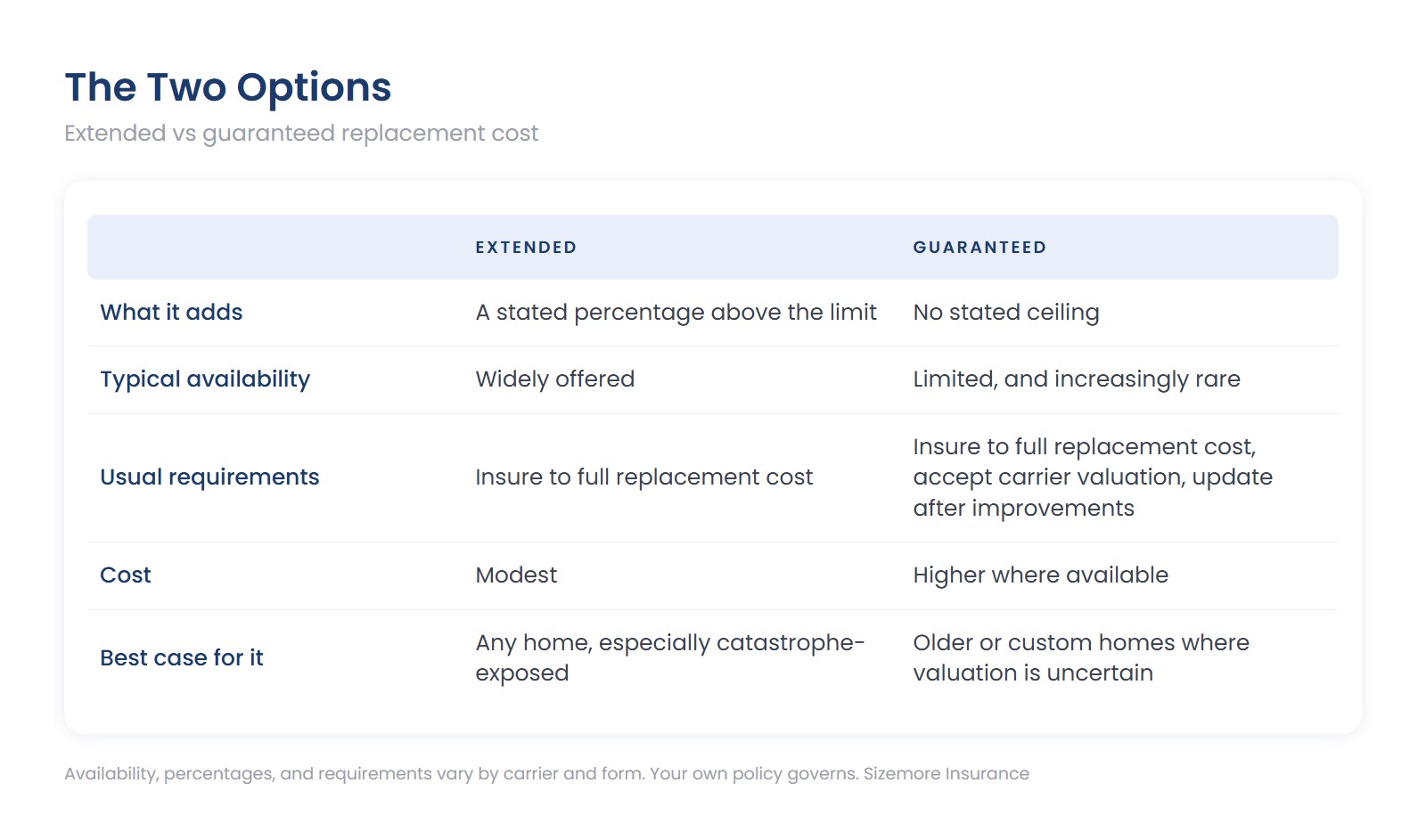
The takeaway: extended replacement cost is the practical choice for most homeowners and it should be on nearly every policy.
Availability, percentages, and requirements vary by carrier and form. Your own policy governs.
Neither one is a substitute for an accurate dwelling limit. Both are conditioned on it.
Insure to full replacement cost. Carriers require the base limit to reflect a current valuation. If you have deliberately underinsured to save premium, the extension may not apply.
Accept the carrier's valuation in many cases, or provide one they accept.
Report improvements. An addition, a finished basement, or a major renovation changes the rebuild cost, and failing to report it can affect the extension.
Keep the limit current at renewal. Most policies escalate automatically, and automatic escalation frequently lags actual construction cost movement.
Ordinance or law is separate. These options address the cost of rebuilding what you had. Code upgrades are a different limit. On an older home you need both.
Demand surge is exactly the scenario they cover. After Helene, after Florence, and after any regional event, local rebuild costs spike. That is when a limit set in an ordinary year proves short, and it is when this coverage earns its premium.
Guaranteed replacement cost is disappearing on the coast. If you have it, understand what you have and what maintaining it requires.
Neither one increases loss of use. A longer, more expensive rebuild also means a longer displacement, and that limit is separate.
They do not apply to other structures or contents on most forms. Those carry their own limits.
An inaccurate base limit undermines both. If your Coverage A is 30 percent below rebuild cost, a 25 percent extension does not get you there.
What is extended replacement cost?
Additional dwelling coverage above your limit, commonly 25 percent, available when the rebuild costs more than the limit.
What is guaranteed replacement cost?
Coverage paying the full rebuild cost without a stated ceiling. Increasingly hard to obtain.
Do I have either one?
Check your declarations page. If it is not listed, ask what adding it costs.
Is it expensive?
Extended replacement cost is typically a modest addition relative to what it covers.
Does it replace an accurate dwelling limit?
No. Both are conditioned on insuring to full replacement cost.
Does it cover code upgrades?
No. That is ordinance or law coverage, and it is separate.
Sizemore Insurance is an independent insurance company founded in North Carolina in 1977. Send us your declarations page and we will tell you whether either option is on it and what the other would cost. Insurance made just for you.
Sources: North Carolina Department of Insurance, consumer guidance on homeowners coverage in North Carolina (ncdoi.gov); North Carolina Rate Bureau, the standard North Carolina homeowners forms, including dwelling coverage (Coverage A) and replacement cost loss settlement (ncrb.org).
Availability, percentages, requirements, and pricing vary by carrier and form. Review your own declarations page or talk to your advisor.
Coverage details: North Carolina Home Insurance