
Reviewed for insurance accuracy by Brad Sizemore, Owner and CEO, NPN 6595451 · November 16, 2026
View reviewer profileCharleston is the most complicated residential insurance market in either Carolina, because it stacks three difficult things in one property. A Charleston home needs three layers built together: a separate wind policy, flood and excess flood sized to the rebuild, and a property policy valued for historic construction.
Coastal wind exposure. Tidal and stormwater flooding that reaches streets on sunny days. And historic construction with review requirements that govern how anything gets rebuilt.
Each one is manageable. Together they require a program rather than a policy.
Wind. Frequently excluded from the property policy in the coastal zone and written separately, often through the South Carolina Wind and Hail Underwriting Association. Percentage hurricane deductible.
Flood. Not optional in practical terms. Tidal flooding in downtown Charleston is a routine occurrence rather than a storm event, and the federal caps of $250,000 building and $100,000 contents do not reach most Lowcountry homes. Excess flood is where the actual coverage sits.
The property policy itself, which on a historic home has to contend with construction that costs more to reproduce than to build new.
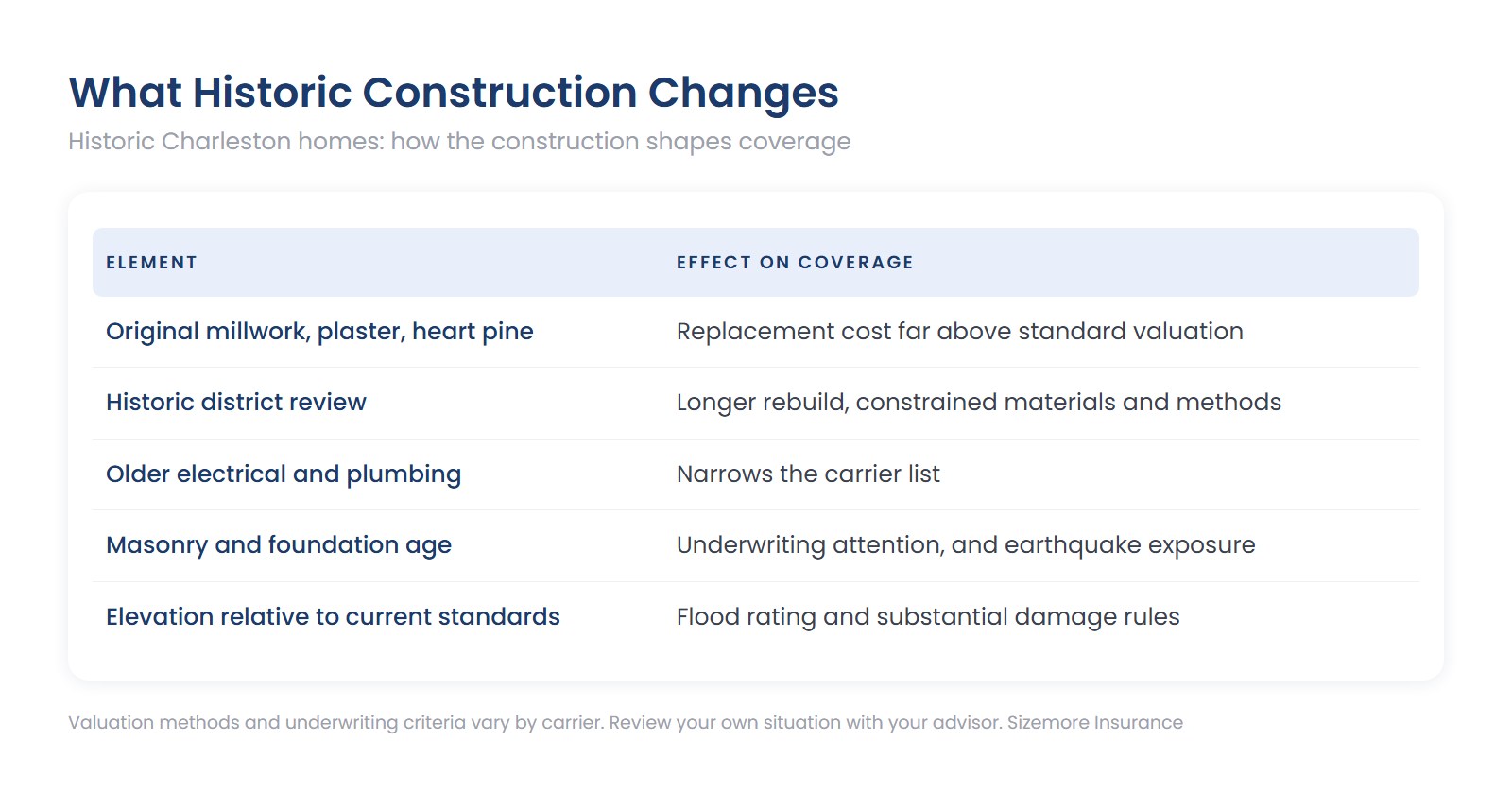
The takeaway: a standard replacement cost estimate will undershoot a historic Charleston home, sometimes substantially. Valuation on these properties deserves more than software.
Valuation methods and underwriting criteria vary by carrier. Review your own situation with your advisor.
A real valuation. On a historic property with genuine craftsmanship, a professional insurance replacement cost appraisal is frequently worth the cost. Plaster, millwork, and period materials are not what a square footage calculation contemplates.
Extended replacement cost, because a regional event drives local construction costs up and Charleston already has a constrained skilled trades market for period work.
Ordinance or law coverage, which on a historic home in a review district is one of the highest-value endorsements available. Rebuilding to current code, under review, with constrained materials, costs more than the original construction did.
Flood and excess flood, sized to the actual rebuild rather than to the federal caps.
Loss of use with real duration, because a historic rebuild under review takes longer than an ordinary one.
Earthquake, worth discussing. The Lowcountry has a documented seismic history and earthquake is excluded from every homeowners policy. Coverage is available separately and it is a conversation more Charleston owners should be having than are.
Tidal flooding is not a storm. It is a recurring condition, and it affects both the risk picture and how often a property is exposed. Being outside a mapped high-risk zone means less here than almost anywhere.
Historic review governs the rebuild, not the policy. Your dwelling limit assumes you rebuild what you had. The review board may require specific materials and methods, which is a cost and a timeline issue that ordinance or law coverage addresses in part.
Older systems narrow the market. Knob and tube, aluminum branch wiring, fuse panels, and galvanized or polybutylene plumbing all matter here as much as anywhere, and they are common in this housing stock.
Surplus lines is frequently the answer on a high-value historic coastal home, and that is a legitimate placement rather than a fallback.
High-value forms fit better than standard ones. On a substantial Charleston property, a high-value homeowners program typically offers broader coverage, better valuation treatment, and more flexible deductibles than a standard form.
Short-term rental is regulated locally and Charleston’s rules are among the stricter ones in the region. Resolve permitted use before building a rental business around a property.
Do I need flood insurance in downtown Charleston?
In practical terms yes, whatever the zone map says. Tidal flooding is a recurring condition.
Is wind included in my Charleston policy?
Frequently not in the coastal zone. Look for a windstorm and hail exclusion and confirm you have a separate wind policy.
How do I insure a historic home properly?
Start with a real valuation, add extended replacement cost and ordinance or law, and look at a high-value program rather than a standard form.
Does insurance cover historic review requirements?
Ordinance or law coverage addresses code-driven cost. Review requirements are a local process and they affect timeline and materials, which is why loss of use duration matters.
Should I carry earthquake coverage?
It is excluded from every homeowners policy and available separately. Given the Lowcountry’s seismic history it is worth a conversation.
Can I rent it short term?
That depends entirely on local rules, which are strict in Charleston. Resolve that first.
Sizemore Insurance is an independent insurance company founded in North Carolina in 1977, and we write in South Carolina as well. Send us the address and the age of the house and we will build the layers a Lowcountry property actually needs. Insurance made just for you.
Sources: South Carolina Wind and Hail Underwriting Association, wind coverage in the coastal zone (scwind.com); FEMA and the National Flood Insurance Program, federal flood limits and flood zones (fema.gov, floodsmart.gov); South Carolina Department of Insurance, consumer guidance on homeowners, ordinance or law and earthquake coverage (doi.sc.gov); City of Charleston, historic district review and short-term rental rules (charleston-sc.gov).
Coverage, valuation methods, program terms, and local regulation vary and change. Nothing here is legal advice. Review your own policy or talk to your advisor.
Coverage details: South Carolina Home Insurance