

Three state-created mechanisms serve property owners in the Carolinas, and people mix them up constantly, including people who are in one of them.
They exist for the same reason: legislatures decided that property owners who cannot obtain coverage in the standard market should have somewhere to go. What each one covers, and where, is different.
The North Carolina Insurance Underwriting Association, universally called the Beach Plan. Provides windstorm and hail coverage in the beach and coastal areas of North Carolina, where the standard market is thinnest. Wind-focused, and on the barrier islands and immediate coast it is frequently the only wind market available.
The North Carolina Joint Underwriting Association, called the FAIR Plan. Serves property elsewhere in North Carolina that cannot obtain standard market coverage for reasons other than coastal wind exposure. Roof condition, claim history, vacancy, and older construction are the usual reasons.
The South Carolina Wind and Hail Underwriting Association, the wind pool. Provides windstorm and hail coverage in designated coastal areas of South Carolina.
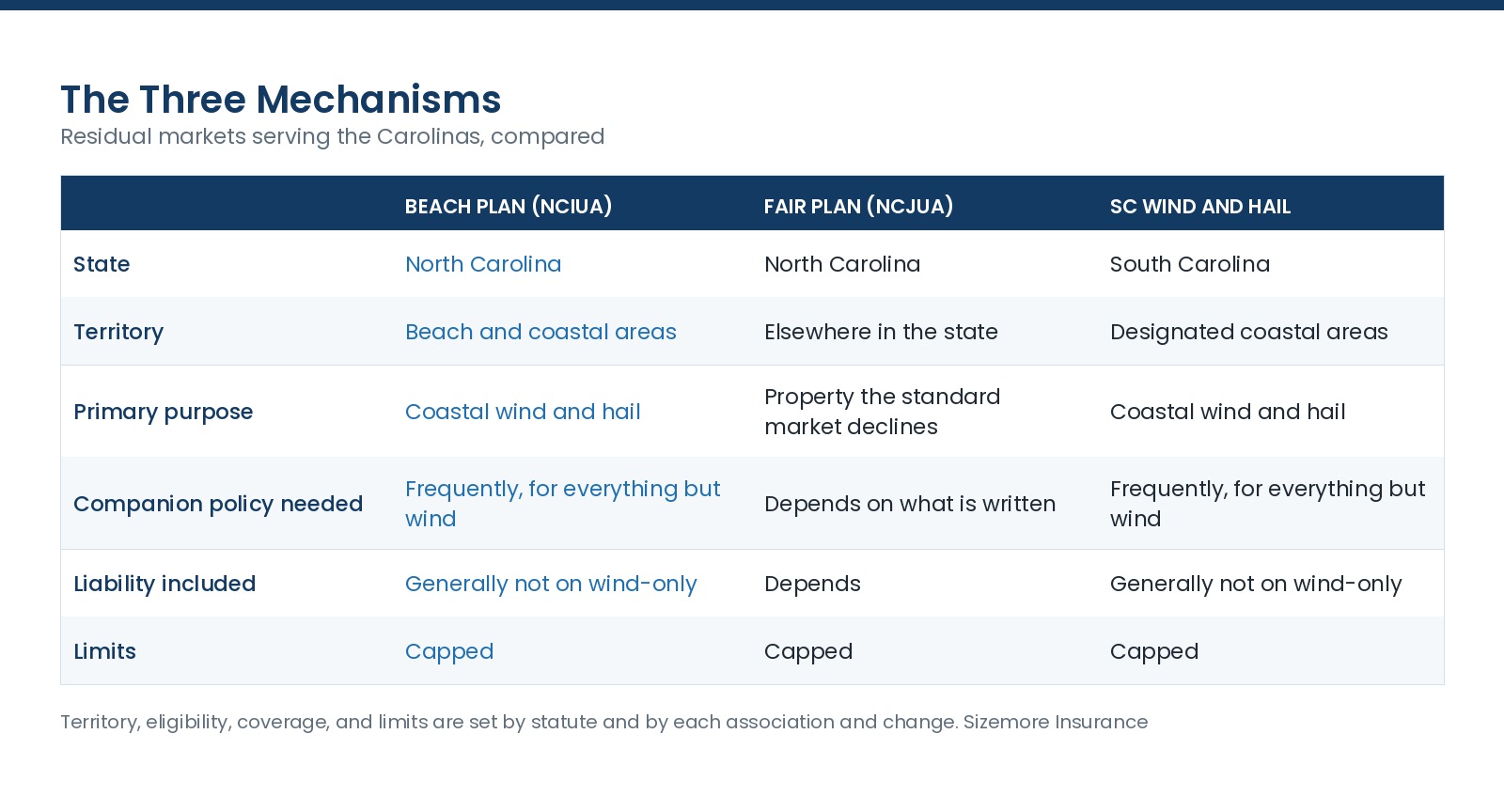
The takeaway: two of the three are wind mechanisms in different states, and the third is a different thing entirely.
Territory definitions, eligibility, coverage, and limits are set by statute and by each association and change. Confirm current terms with the association or the applicable Department of Insurance.
They are backstops, not first choices. Every property should be marketed to the standard market first and re-marketed every year.
They pay claims. These are functioning mechanisms and after the storms I have worked they did what they were built to do.
They are narrower by design. Coverage is not as broad as a well-written standard policy, and the limits are capped.
They frequently need a companion policy. A wind-only policy covers wind and hail. Fire, theft, water from inside, liability, and loss of use come from somewhere else.
Getting out is usually about the roof. Roof condition and age are dominant eligibility factors in the standard market, and replacing one to enhanced wind standards is the most reliable path back.
The cap matters on a higher-value property. Residual market limits are capped, and on a home or building worth more than that cap, an excess wind layer above it is what actually covers the property. That structure has to be built deliberately so there is no gap between the layers.
Liability falls through the crack constantly. A wind-only policy plus a narrow companion policy can leave you with no personal or premises liability. Confirm it exists somewhere.
Loss of use and business income are narrower in the residual markets than in a standard policy, and on a leased building or a home that would take a year to rebuild, that matters.
Two policies means two adjusters after a storm that produces both wind damage and interior water damage.
Surplus lines sits between the residual market and the standard market. Non-admitted carriers write risks the admitted market declines and frequently offer broader terms than a residual mechanism. It belongs in the search.
Flood is none of these. No residual property mechanism covers rising water.
What is the difference between the Beach Plan and the FAIR Plan?
The Beach Plan serves the North Carolina beach and coastal areas with wind and hail coverage. The FAIR Plan serves property elsewhere in the state that cannot get standard coverage for other reasons.
Does South Carolina have a Beach Plan?
It has its own mechanism, the South Carolina Wind and Hail Underwriting Association, serving designated coastal areas.
Is residual market coverage bad?
Narrower by design and capped, and it pays claims. A standard market policy is broader where it is available.
Do I still need another policy?
Frequently yes. A wind-only policy covers wind and hail and nothing else, including liability.
What if my property is worth more than the cap?
You layer excess wind coverage above it, and the layers have to be structured so there is no gap.
How do I get out?
Usually the roof, plus asking us to re-market at every renewal.
We have been an independent insurance company in North Carolina since 1977 and we place in all three of these markets. Send us your policies and we will tell you which mechanism you are in and whether the structure around it is complete. Insurance made just for you.
Territory definitions, eligibility, coverage, limits, and terms are set by statute and by each association and are subject to change. Confirm current terms with the applicable association or Department of Insurance. Review your own policy or talk to your advisor.