Reviewed for insurance accuracy by Brad Sizemore, Owner and CEO, NPN 6595451 · November 16, 2026
View reviewer profilePlenty of families own on both sides of that line. A house in Charlotte and a place at Cherry Grove. A home in Wilmington and a lake house on Murray. The main differences are how rates are set, which coastal mechanism writes the wind coverage, and the negligence rule that decides a liability claim.
They assume the two policies work the same way. Several things do not, and one of them changes how a liability claim resolves.
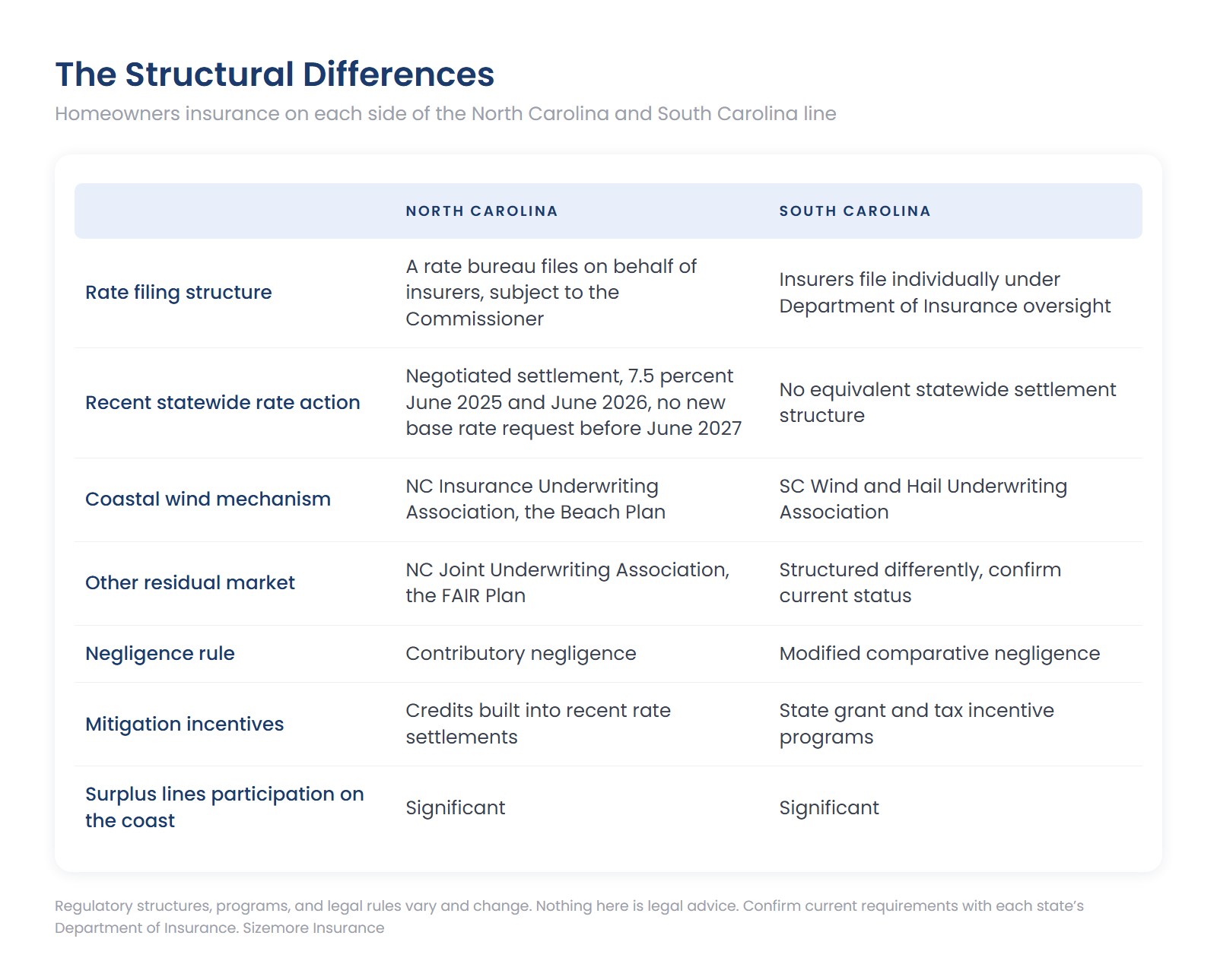
The takeaway: North Carolina’s statewide rate machinery has no South Carolina equivalent, and the negligence rule is the difference most likely to affect an actual claim.
Regulatory structures, programs, and legal rules vary and change. Nothing here is legal advice. Confirm current requirements with each state’s Department of Insurance.
This one is worth understanding because it affects liability claims on your property.
North Carolina applies contributory negligence. A claimant who contributed to their own injury, even slightly, may be barred from recovering. That is a favorable environment for a premises owner and it makes the specific facts decisive, which is why maintenance logs and incident records matter so much in this state.
South Carolina applies a modified comparative rule, where recovery is reduced by the claimant’s share of fault and barred once that share exceeds a threshold. That is a more forgiving environment for a claimant.
Practically, the same slip on the same set of steps can resolve differently depending on which side of the line the property sits. It is an argument for carrying meaningful liability limits and an umbrella on a South Carolina property, and for keeping good records in both states.
More than owners expect.
Flood is excluded on every homeowners policy in both states, and the federal program’s caps and 30-day waiting period apply identically.
Wind may be excluded on the coast in both states, with the coverage written separately through the respective mechanism.
Percentage hurricane and named storm deductibles are the norm on both coasts. Calculate them in dollars in either state.
Roof age drives eligibility in both, and enhanced roof construction is rewarded in both.
Erosion and earth movement are uninsurable in both.
A policy cannot be transferred across the line. Property policies are written for a specific location, and moving means a new policy rather than a change of address.
Mitigation incentives are stronger in South Carolina. The state has operated grant programs and tax incentives connected to windstorm retrofitting. North Carolina has built mitigation credits into recent rate settlements. Both reward the work and the mechanisms differ, so check what applies where the property sits.
Rate movement will not track between the states. North Carolina’s recent settlement locked base rates from further increases until at least June 2027. That has no South Carolina counterpart, so a family with property in both states should expect the two renewals to behave independently.
Carrier appetite differs by state. A carrier writing your North Carolina home may not want your South Carolina one, and the reverse. Two states frequently means two carriers and it is not a failure of coordination.
Umbrella coverage should reach both properties. Confirm each is scheduled. This gets missed on multi-state households constantly.
Renting either one changes the form and the local regulation differs by jurisdiction in both states.
Can I put my South Carolina house on my North Carolina policy?
No. Property policies are location-specific.
Why is my South Carolina renewal moving differently?
The states use different rate regulation structures, and North Carolina’s recent statewide settlement has no South Carolina equivalent.
What is the practical difference in a liability claim?
North Carolina applies contributory negligence, which is favorable to a premises owner. South Carolina applies a modified comparative rule. The same incident can resolve differently.
Do both states have a wind pool?
Both have coastal wind mechanisms, structured differently. North Carolina’s is the Beach Plan through the NCIUA. South Carolina’s is the Wind and Hail Underwriting Association.
Are mitigation credits available in both?
Both reward mitigation. South Carolina has operated grant and tax incentive programs, and North Carolina has built credits into recent rate settlements.
Do I need two agents?
No. An independent company licensed in both can handle both, which also means one person seeing your whole position.
Sizemore Insurance is an independent insurance company founded in North Carolina in 1977, and we write in South Carolina as well. Send us both declarations pages and we will look at the whole position rather than one house at a time. Insurance made just for you.
Sources: North Carolina Rate Bureau (ncrb.org) and North Carolina Department of Insurance (ncdoi.gov), homeowners rate filing and the statewide rate settlement; North Carolina Insurance Underwriting Association and North Carolina Joint Underwriting Association (ncjua-nciua.org), the Beach Plan and the FAIR Plan; South Carolina Department of Insurance (doi.sc.gov), rate filing and windstorm mitigation programs; South Carolina Wind and Hail Underwriting Association (scwind.com), coastal wind coverage; FEMA and the National Flood Insurance Program (fema.gov, floodsmart.gov), flood coverage limits and the 30-day waiting period.
Regulatory structures, programs, legal rules, and availability vary by state and change. Nothing here is legal advice. Review your own policies or talk to your advisor.
Coverage details: South Carolina Home Insurance