

Being in the Beach Plan is not a judgment about your house. Plenty of well-built, well-maintained coastal homes are there for no reason other than where they sit.
It is also not permanent. Markets move, appetite shifts, and the specific things that keep a house in the residual market are frequently things an owner can change.
Here is what actually moves a house back, in order of how much it matters.
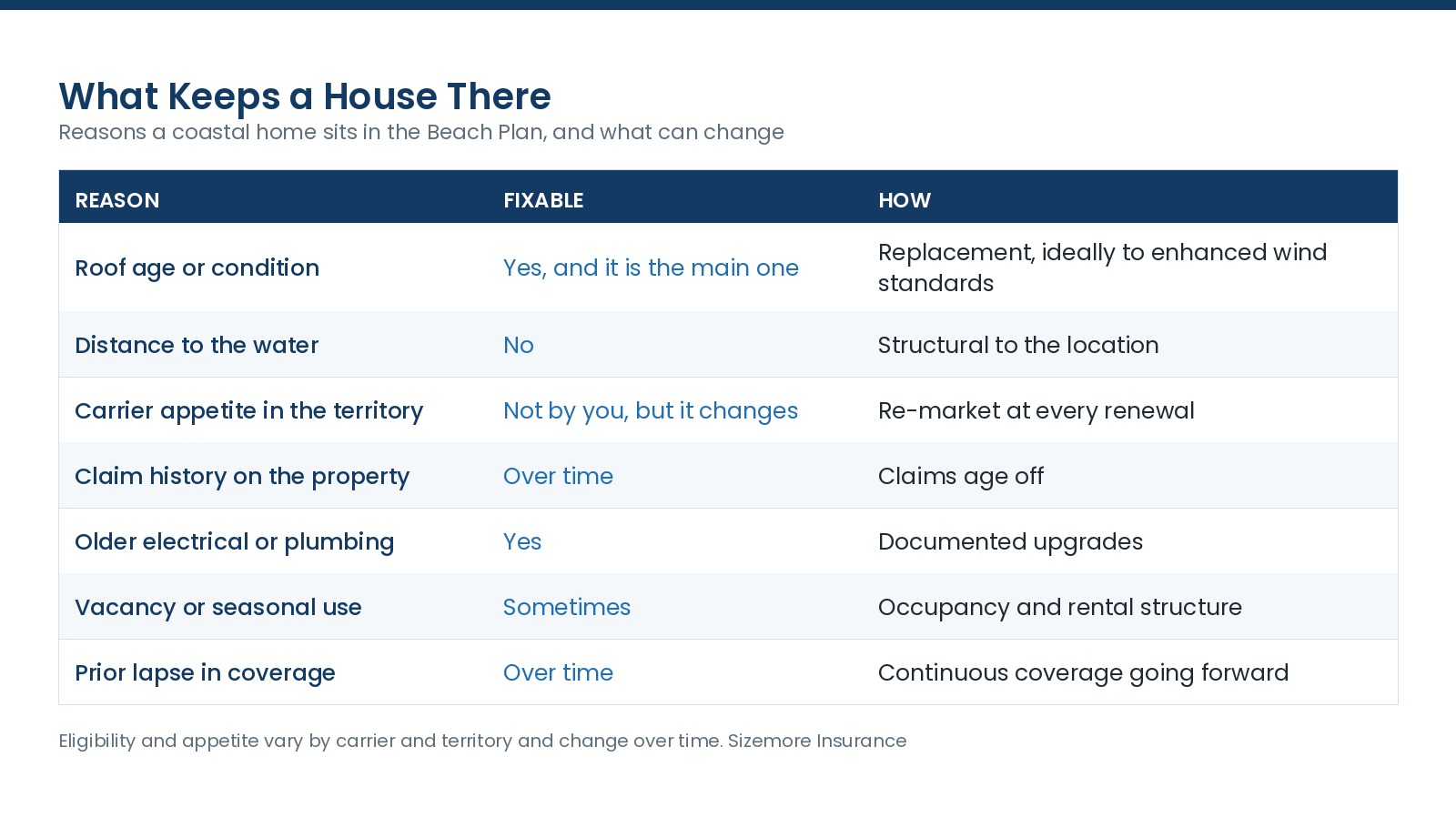
The takeaway: the roof is the lever that works, and the second one is simply asking every year. Appetite in a territory can change without anything about your house changing.
Eligibility and appetite vary by carrier and territory and change over time.
The Beach Plan is real coverage that pays real claims, and I place clients there without apology when it is the right answer. But a standard market policy is generally better in three ways that matter.
Breadth. A standard homeowners policy is written broader than a residual market wind policy, and it includes coverages the wind policy does not, particularly around loss of use and personal property.
One carrier, one claim. When wind and the rest of the policy sit with one company, a storm that damages the roof and then the interior produces one claim and one adjuster instead of two and an argument about which policy owns what.
Limits. Residual market coverage is capped. On a larger coastal home that cap can leave a layer that has to be filled separately.
None of that means the Beach Plan is a bad outcome. It means the standard market is a better one where it is available.
Ask every renewal. This is the step owners skip. Appetite changes, new carriers enter territories, and a house that was declined two years ago may be quotable today with nothing having changed.
Document what improved. Roof replacement with invoice and permit, electrical panel upgrade, plumbing replacement, tree removal, new windows or shutters. Underwriters price what they can verify.
Provide loss runs. Five years of claim history. If it is clean, that is your strongest argument. If there was a claim, explain the cause and what was done about it.
Include photographs. Roof, all four elevations, and the interior. Underwriters who can see a house price it better than underwriters who cannot.
Time it around the roof. If a replacement is planned, do the marketing after the work is complete and certified rather than before.
Do not cancel anything before the replacement is bound. A gap in coverage on a coastal home is expensive and it makes you a worse risk to the next carrier. Bind first, then cancel.
A standard policy may still exclude wind. Moving out of the Beach Plan for the property coverage does not always mean wind comes with it. Confirm what you are actually getting.
Compare the deductible structure, not just the premium. A standard market policy with, for example, a 5 percent named storm deductible is not obviously better than a Beach Plan policy at 2 percent. Run both in dollars before you decide.
Watch the minimum earned premium and cancellation terms on anything placed in the surplus lines market as an intermediate step.
Surplus lines is a legitimate middle ground. Between the residual market and the standard market sits the non-admitted market, which can offer broader terms than the Beach Plan on a house the standard carriers will not take. It is worth including in the search.
Certificates expire. If a fortified designation is part of what got you back into the standard market, the certificate has a term and re-evaluation is required.
Is the Beach Plan bad coverage?
No. It is narrower by design and capped, and it pays claims. A standard market policy is generally broader where it is available.
How do I get out of the Beach Plan?
Most often through the roof. A replacement built to enhanced wind standards, documented and certified, is what reopens the standard market on many coastal homes.
Can I be forced to stay?
No. You can be quoted by any carrier willing to write the house. The constraint is appetite, not a rule.
How often should I try?
Every renewal. It costs you a conversation and appetite changes without notice.
Will my premium definitely go down?
Not necessarily. Compare the deductible structure and the coverage breadth, not just the number. Sometimes the better policy costs more and is still the better policy.
What if nothing works?
Then the Beach Plan is doing what it was built to do, and the work shifts to structuring it properly: adequate limits, excess wind where the cap falls short, liability in the companion policy, and flood alongside it.
We have been an independent insurance company in North Carolina since 1977. We market coastal homes to the standard carriers first, every year, and we structure the residual market properly when that is where the house belongs. Insurance made just for you.
Eligibility, appetite, coverage, limits, and availability vary and change. Review your own policy or talk to your advisor.