Reviewed for insurance accuracy by Victoria Konczynski, Personal Lines Account Manager, NPN 16516709 · November 11, 2026
View reviewer profileThe two most active short-term rental markets in this state are also the two hardest property markets in it. You need a policy written for the rental use, plus separate coverage for the local peril: wind and flood on the coast, flood in the mountains.
An Outer Banks rental carries named storm exposure, a percentage wind deductible, and flood risk. An Asheville rental sits in a market that tightened considerably after Helene, with flood, access, and wildfire questions attached.
Layer a nightly rental business on top of either one and you have two distinct exposures that have to be covered by one program. Owners frequently solve for one and leave the other open.
The peril exposure is what the geography brings. Wind, surge, and flood on the coast. Flood, landslide, wildfire, ice, and access in the mountains. This is a property question and it is the same whether you rent the house or not.
The business exposure is what the rental activity brings. Guest liability, guest damage, turnover, contents used commercially, and revenue that stops when the property goes offline. This is what a standard homeowners policy is not written for.
A specialty short-term rental policy addresses the second. It does not automatically solve the first, and on the coast it frequently cannot include wind at all.
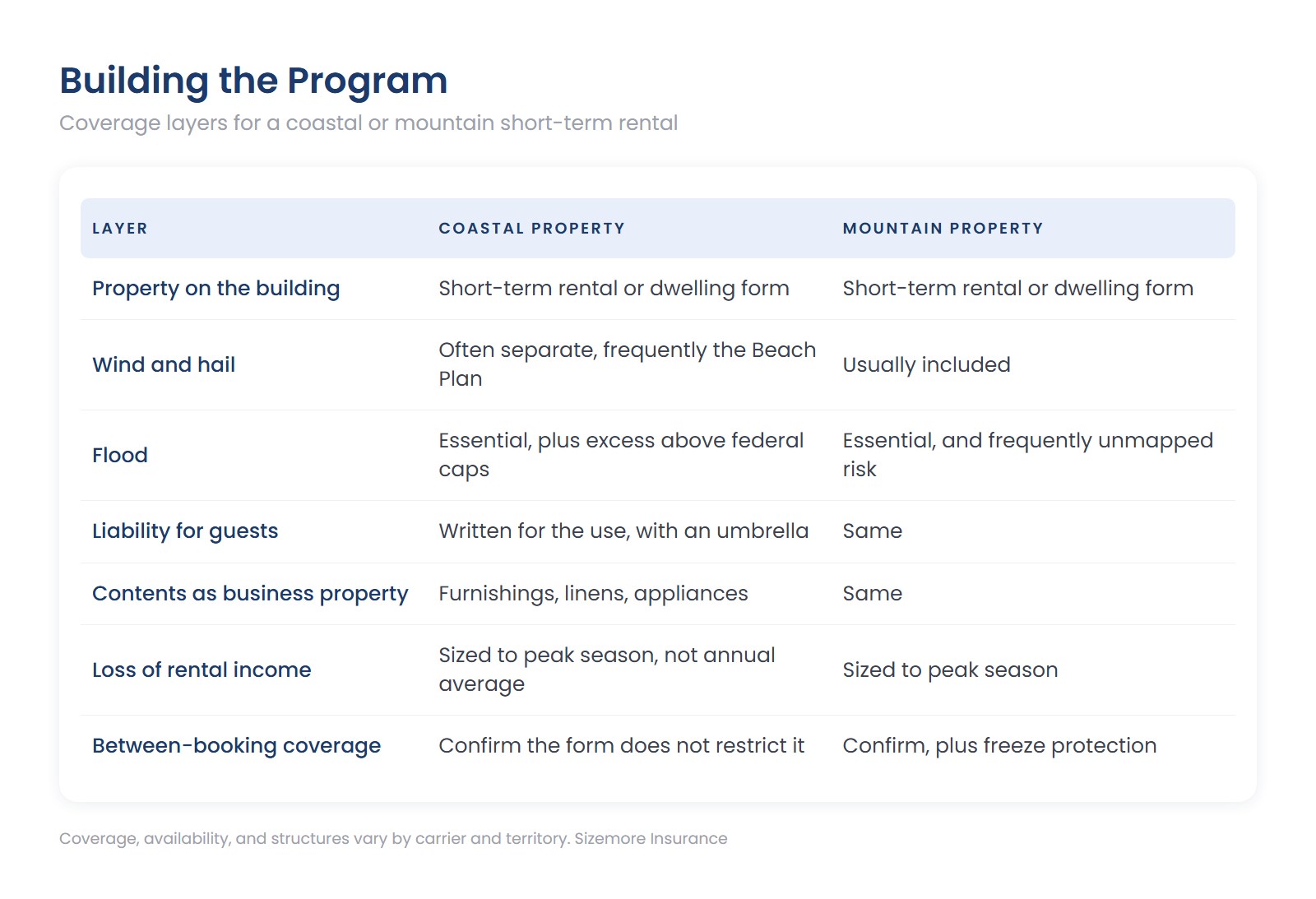
The takeaway: on a coastal rental you may need four policies, and on a mountain rental the flood exposure is the one nobody quotes. Neither is solved by a specialty rental form alone.
Coverage, availability, and structures vary by carrier and territory. Review your own situation with your advisor.
This is where the money is on a short-term rental and where the coverage is most often sized wrong.
Both of these markets are seasonal. An Outer Banks property earns a disproportionate share of its revenue between Memorial Day and Labor Day. An Asheville property peaks in October.
A loss in February costs you a shoulder season. A loss in June costs you the year.
Size the coverage to what a peak-season outage actually costs, not to an annual average divided by twelve. And check the period, because a rebuild on a barrier island or a mountain lot runs long, and after a regional event it runs much longer.
Off-season freeze losses are the mountain claim. A property sitting empty in January with the heat off produces a burst line and days of water before anyone notices. Most forms restrict water damage after a vacancy period, and remote monitoring with a low-temperature alert is one of the cheapest risk controls available.
The coastal wind deductible applies to a business asset. Five percent of a $700,000 dwelling limit is $35,000 you fund before the wind policy responds, and the property is generating revenue you are also losing.
Flood in Asheville is not a hypothetical anymore. Helene produced an estimated $6.4 billion in insured losses in this state, much of it far from the coast, on properties outside mapped zones. Coverage there is typically inexpensive.
Cleaning crews, maintenance staff, and managers create their own questions. Whether they are employees or contractors affects workers compensation exposure, and a management agreement should address insurance on both sides.
Hot tubs, docks, and fire pits raise the liability conversation. All three are common in these markets and all three attract underwriting attention. Some carriers require fencing, covers, or written rules.
Local ordinance compliance varies significantly. Asheville and several coastal jurisdictions regulate short-term rentals differently. Resolve the permitted use question before you build a program around the property.
Multiple properties change the structure. Past two or three units, a scheduled or commercial program usually prices better and produces one renewal instead of several.
Can I insure a short-term rental on the Outer Banks?
Yes. Expect a property form written for rental use, wind frequently written separately, and flood as its own policy, with excess flood above the federal caps.
Is Asheville harder to insure after Helene?
The market tightened and it is placeable. Flood is the coverage most owners in that area now need and previously never considered.
How much loss of rental income should I carry?
Enough to cover a peak-season outage through a realistic repair timeline, which in both markets runs longer than owners assume.
Do I need workers compensation for a cleaning crew?
It depends on whether they are employees or contractors and on how the arrangement is structured. It is worth asking rather than assuming.
Does a hot tub affect my coverage?
It can affect eligibility and pricing, and some carriers impose requirements. Disclose it.
What if I rent through more than one platform?
That is fine, and it makes your own policy more important, because coverage has to be consistent across bookings rather than dependent on any one platform's program.
Sizemore Insurance is an independent insurance company founded in North Carolina in 1977. Tell us where the property is and how it operates and we will build the layers in the right order. Insurance made just for you.
Sources: North Carolina Insurance Underwriting Association, the Beach Plan (ncjua-nciua.org); FEMA and the National Flood Insurance Program, federal flood coverage limits (fema.gov, floodsmart.gov); North Carolina Department of Insurance (ncdoi.gov).
Coverage, availability, program terms, and local regulation vary and change. Loss figures are estimates from published industry reporting. Review your own policy or talk to your advisor.
Coverage details: North Carolina Home Insurance