Reviewed for insurance accuracy by Brad Sizemore, Owner and CEO, NPN 6595451 · November 16, 2026
View reviewer profileThe Grand Strand is a coastal insurance market with the same three-policy structure you find on the Outer Banks and a different set of rules behind it. A home in Myrtle Beach or on the Grand Strand is usually insured with three policies: a property policy, a wind policy, and a flood policy.
South Carolina regulates insurance its own way, has its own coastal wind mechanism, and offers a mitigation program North Carolina does not. Owners who moved down from North Carolina, or who own on both sides of the line, frequently carry assumptions that do not transfer.
The property policy. Fire, theft, liability, loss of use, personal property, and water from inside the house. Along much of the Strand it excludes windstorm and hail.
The wind policy. Windstorm and hail, frequently through the South Carolina Wind and Hail Underwriting Association, the state’s coastal wind mechanism. Usually the largest of the three premiums and it carries a percentage deductible.
The flood policy. Rising water and surge, which nothing else covers. Federal residential limits cap at $250,000 building and $100,000 contents, so on most Strand properties excess flood is where the real coverage sits.
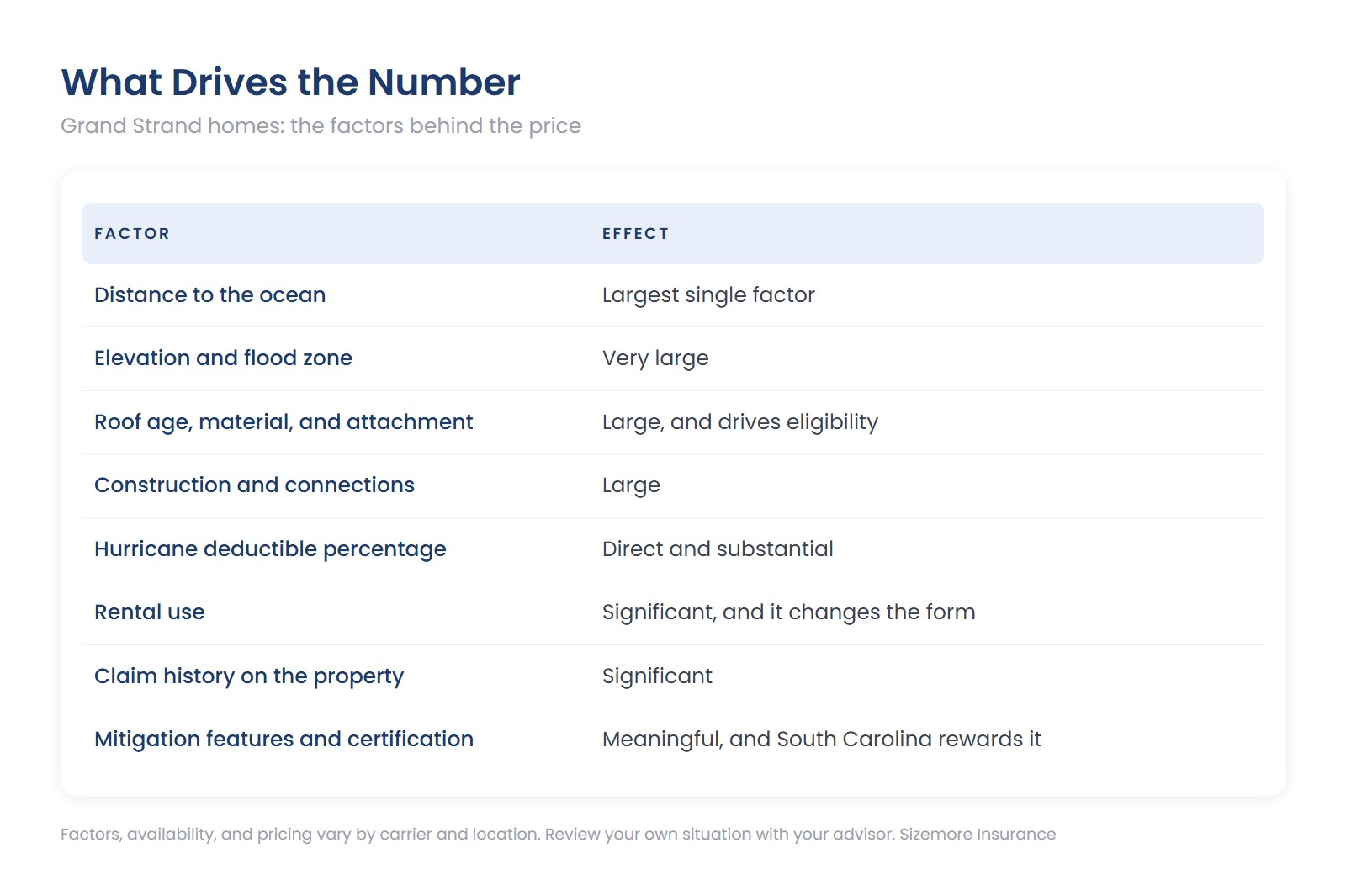
The takeaway: the same factors as the North Carolina coast, with one addition that works in your favor. South Carolina has been more active than most states in incentivizing windstorm mitigation.
Factors, availability, and pricing vary by carrier and location. Review your own situation with your advisor.
This is the part worth knowing if you own on the South Carolina coast.
The state has operated the SC Safe Home program through the Department of Insurance, providing grant funds to help homeowners retrofit against hurricane and windstorm damage. South Carolina has also offered state tax incentives connected to windstorm mitigation costs and to mitigation supplies.
Programs, funding, and eligibility change from year to year, and tax treatment is a question for your tax advisor rather than for us. What is durable is the direction: this state has consistently paid people to strengthen coastal homes, and carriers price mitigation accordingly.
Before you replace a roof or add opening protection on a Grand Strand property, check what is currently available through the Department of Insurance. It can materially change the math on work you were going to do anyway.
The hurricane deductible is a percentage. Five percent of a $600,000 dwelling limit is $30,000. Calculate it in dollars and keep that reserve available before the season. South Carolina requires disclosure of hurricane deductibles, which means the information is in front of you if you read it.
Rental use is common here and it changes the form. A large share of Strand properties are rented, weekly or seasonally, and that is generally outside a standard homeowners policy. Tell your advisor how the property is actually used.
Condominiums dominate parts of the market and they are a different structure entirely, with a master policy, an HO6 unit policy, and loss assessment exposure.
Flood zone matters more than distance in some spots. Elevation and zone drive the flood side, and two properties the same distance from the water can sit in different zones.
Surplus lines participation is significant in the South Carolina coastal market. A non-admitted placement is common and legitimate here, and it is worth understanding what you gain and give up.
Erosion is uninsurable, the same as anywhere.
Is wind included in my Myrtle Beach homeowners policy?
Frequently not. Look for a windstorm and hail exclusion and check whether you have a separate wind policy.
What is the South Carolina wind pool?
The South Carolina Wind and Hail Underwriting Association, the state’s mechanism providing coastal wind and hail coverage where the standard market has retreated.
How is my hurricane deductible calculated?
As a percentage of your dwelling limit, not of the loss. Multiply it out.
Do I need flood insurance?
On the Grand Strand, yes in practical terms, and excess flood above the federal caps on most properties.
Are there mitigation grants in South Carolina?
The state has operated grant and tax incentive programs connected to windstorm mitigation. Confirm current availability with the Department of Insurance and your tax advisor.
Can I rent the house out?
Yes, and tell your advisor first, because it changes which form fits.
Sizemore Insurance is an independent insurance company founded in North Carolina in 1977, and we write in South Carolina as well. Send us the address and we will build all three layers and tell you what mitigation would change. Insurance made just for you.
Sources: South Carolina Department of Insurance, the SC Safe Home mitigation grant program and hurricane deductible disclosure (doi.sc.gov); South Carolina Wind and Hail Underwriting Association, coastal wind and hail coverage (scwind.com); FEMA and the National Flood Insurance Program, federal residential flood limits and flood zones (fema.gov, floodsmart.gov).
Coverage, availability, program terms, and incentive availability vary and change. Tax treatment is a matter for your tax advisor. Confirm current program status with the South Carolina Department of Insurance. Review your own policy or talk to your advisor.
Coverage details: South Carolina Home Insurance