Reviewed for insurance accuracy by Joseph "JJ" Johnson, Chief Operating Officer, NPN 7594559 · November 25, 2026
Most people asking this question are hoping the answer is shopping. Shopping is on the list and it is not at the top, because the items above it change the risk rather than the price of it. The biggest levers, in order, are an accurate dwelling valuation, a roof replacement, and the deductible structure; shopping sits sixth.
Here is the ranking, with an honest note about which ones cost money and which cost a phone call.
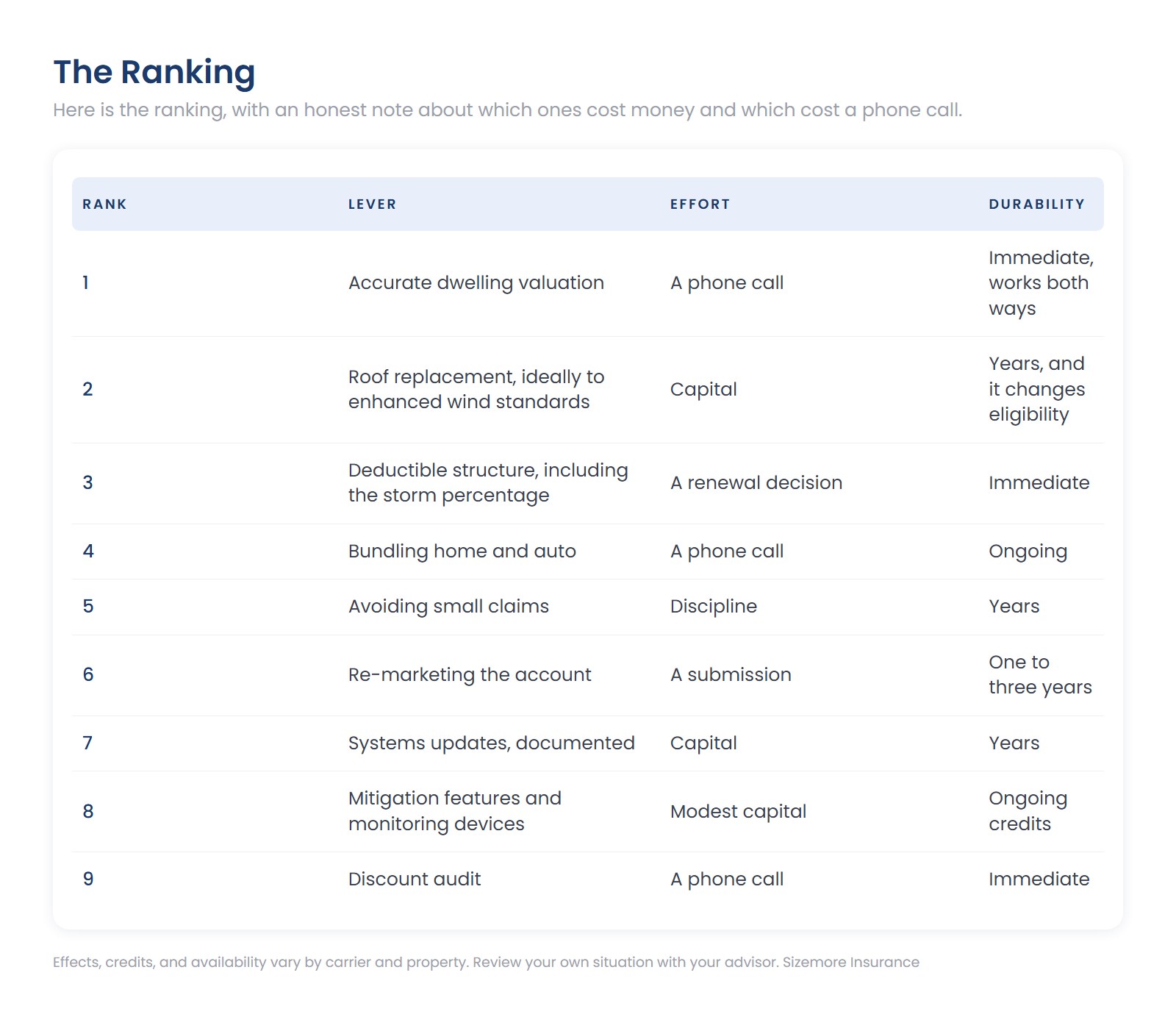
The takeaway: the top item is free and the second is the one that actually changes your market position. Most people spend their energy on shopping, which sits sixth.
Effects, credits, and availability vary by carrier and property. Review your own situation with your advisor.
Valuation. Free, immediate, and it corrects in both directions. A limit above rebuild cost is premium spent on coverage you cannot collect. A limit below it can reduce partial claims. This is the highest return per minute available.
Roof. In much of this state roof age determines whether standard carriers will write the house at all. A replacement, particularly one built to enhanced wind standards, improves price, can remove an age schedule, and can move a house out of the residual or surplus market. In eastern territories mitigation credits are now built into the rate structure.
Deductible structure. Raising the all other perils deductible is usually manageable. On a coastal home, the larger move is trading that increase to fund a lower percentage on the storm side, where the dollars are much bigger. Ask for both priced together.
Bundling. Meaningful on both policies and it also eliminates the gaps that appear when home and auto sit at two companies.
Item nine is last because it is small, and it is free and it takes five minutes.
Ask your advisor to list every discount on the policy and every discount the carrier offers. Then check what you qualify for and are not receiving.
Common ones that go unclaimed: monitored alarm, water leak detection devices, automatic water shutoff, roof material and age credits, new home or new roof credits, claims-free credits, paid-in-full and paperless, retiree or affinity credits, and mitigation credits on the coast.
I have never run this exercise on a policy and found nothing.
Do not cut the dwelling limit below rebuild cost. It creates a coinsurance exposure on partial losses, which are most losses.
Do not drop ordinance or law or extended replacement cost. Small premium, large exposure.
Do not drop water backup or service line. Both are inexpensive and both cover frequent losses.
Do not lower liability to save money. It is the cheapest coverage on the policy relative to what it protects.
Do not buy a lower premium with a narrower form. On a coastal home a favorable number usually means a higher percentage deductible, an age-based roof schedule, or a wind exclusion.
Do not let coverage lapse. Force-placed coverage costs more, protects the lender only, and can breach your mortgage.
What is the fastest way to lower my home premium?
A deductible adjustment at renewal, paired with a valuation to confirm the limit is right.
Will a new roof lower my premium?
Usually, and more importantly it can restore access to carriers that will not write an older roof.
Is shopping worth it?
Yes when something material has changed or when appetite shifted. Less so when the increase is market-wide.
Do monitoring devices really earn credits?
Many carriers credit water leak detection and automatic shutoff devices, and they also prevent the claims.
Should I raise my deductible?
Usually on the all other perils side if you can absorb it. On the coast, ask what the trade buys on the storm percentage.
How often should I re-market?
Every two to three years, and any time the roof, systems, or claim history changes.
Sizemore Insurance is an independent insurance company founded in North Carolina in 1977. Send us your declarations page and we will tell you which of these nine levers is actually available on your house. Insurance made just for you.
Sources: North Carolina Department of Insurance, consumer guidance on homeowners coverage and premiums (ncdoi.gov); North Carolina Rate Bureau, homeowners rating and mitigation credits (ncrb.org); North Carolina Insurance Underwriting Association and Joint Underwriting Association (ncjua-nciua.org).
Credits, discounts, effects, and availability vary by carrier and property. Review your own declarations page or talk to your advisor.
Coverage details: North Carolina Home Insurance