

On this coast the roof has stopped being a rating factor and become an eligibility question.
Twenty years ago an older roof meant a higher premium. Today, in much of eastern North Carolina, it means a shorter list of carriers willing to write the house at all, and past a certain age it can mean the residual market.
That change is one of the most important things a coastal homeowner should understand about their insurance, because unlike almost everything else on the policy, it is something you can act on.
How old is it? Documented, not estimated. Age thresholds vary by carrier and territory, and a roof that crossed one at renewal is why a lot of premiums moved.
What material? Architectural shingle, three-tab, metal, and tile all behave differently in wind and are treated differently in the underwriting and in the claim.
How is it attached? Fastener type and pattern, and whether the deck is sealed. This is where many wind losses begin.
Is there a secondary water barrier? A sealed roof deck keeps water out even when the covering is lost. On a house with people and belongings underneath, this is one of the most valuable upgrades available.
What is the edge like? Drip edge and edge metal. Roof failures usually start at the perimeter and work inward.
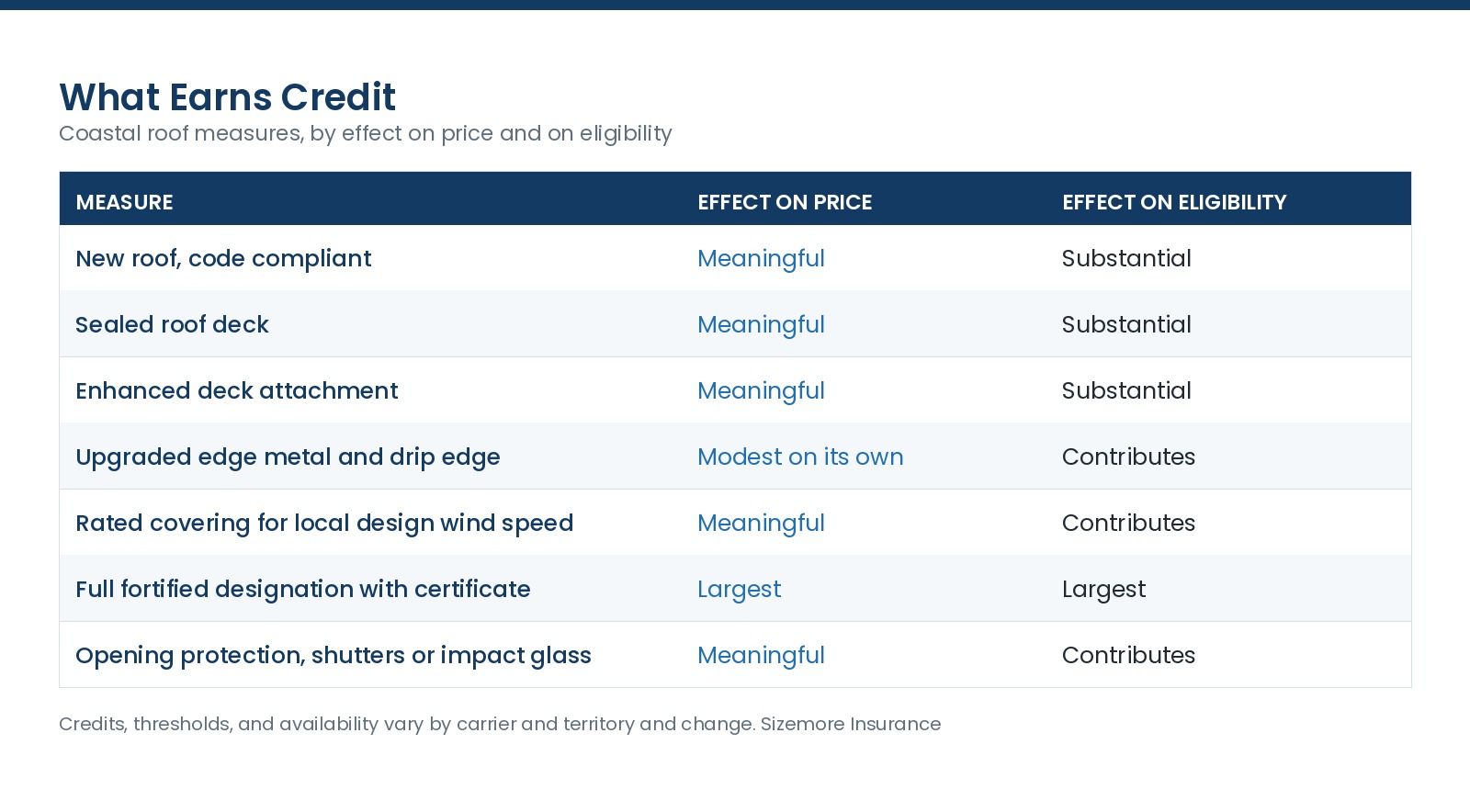
The takeaway: the roof as a system matters more than the shingle. Deck attachment and a sealed deck do more for you than the brand on the wrapper.
Credits, thresholds, and availability vary by carrier and territory and are subject to change.
The direction is not ambiguous. When the North Carolina dwelling rate settlement was announced in April 2026, it included mitigation credits for fortified homes and roofs in many eastern territories. The industry is now paying for this rather than only recommending it.
If a roof replacement is anywhere in your next three years, the sequence matters.
Engage a certified evaluator before work starts if you want a fortified designation. Documentation requires photographs of the deck, fasteners, and sealing during installation. A completed roof cannot be certified afterward, and this is a common way an owner spends the money and gets none of the credit.
Use a contractor who has done it. The specification is not difficult and it is specific, and one unfamiliar with it will miss documentation steps that cannot be recovered.
Get the credit quoted before you set the scope, so you are deciding against a real number.
Ask about grant funding. The North Carolina Insurance Underwriting Association has operated a program providing funding toward fortified roof construction for eligible coastal policyholders. Availability and funding change, so confirm current status before you plan around it.
Re-market the house after certification. Carriers recognize this differently, and the company you are with is not necessarily the one that will value it most.
Correct the roof age in the carrier's records if it is wrong. Under an age-based schedule this is a five-minute fix worth thousands. Send the invoice and the permit.
A roof payment schedule may already be on your policy. It pays roof damage at actual cash value based on age, inside a policy that otherwise says replacement cost. It sits in the endorsement list, not on the summary page.
Cosmetic damage exclusions apply to metal. Hail dents that affect appearance but not function can be excluded. On a metal-roofed coastal home, ask specifically.
Insurance is only part of the case for the work. A sealed deck that keeps water out of the house after the covering is lost prevents the interior loss, the displacement, the claim record, and the deductible. The premium credit is the smallest of those benefits.
Certificates expire. Fortified designations carry a term and require re-evaluation. Calendar it with your renewal.
Trees complicate everything. A large pine over the roof undoes a lot of good construction. Tree work is a legitimate part of the roof conversation.
Does a new roof lower home insurance on the coast?
Usually, and more importantly it changes which carriers will write the house.
What is the roof age limit for coastal home insurance in North Carolina?
It varies by carrier and territory, and thresholds have tightened. In practice, older roofs face schedules, higher rates, or declines.
What is a fortified roof?
A roof built to enhanced standards including sealed deck, upgraded attachment, and improved edge details, verified by an independent evaluator.
Is there funding available?
The North Carolina Insurance Underwriting Association has operated a grant program for eligible coastal policyholders. Confirm current availability before planning around it.
Will a fortified roof get me out of the Beach Plan?
Sometimes. Roof condition is a significant eligibility factor for standard carriers, and it is worth re-marketing after certification.
My roof is fine but my premium went up. Why?
It may have crossed an age threshold. Age matters to underwriters independent of condition.
We have been an independent insurance company in North Carolina since 1977. Tell us the roof age and material and we will tell you where your house sits in the coastal market and what a replacement would change. Insurance made just for you.
Credits, thresholds, program availability, and certification requirements vary by carrier and program and are subject to change. Review your own policy or talk to your advisor.