Reviewed for insurance accuracy by Brad Sizemore, Owner and CEO, NPN 6595451 · November 17, 2026
View reviewer profileA hurricane damages a beachfront condominium building. The master policy responds and the association’s named storm deductible is 5 percent of the building’s insured value. Loss assessment coverage pays your share when the association bills owners for a covered loss, and on a coastal building the default limit rarely covers it.
On a building insured at $30,000,000, that deductible is $1,500,000. The master policy pays nothing until it is satisfied, and the association satisfies it by assessing the owners.
Sixty units. Roughly $25,000 each, before anyone discusses the portion of the damage the master policy did not reach.
Loss assessment coverage is what responds to that. Most condo owners carry it at a default limit of a thousand or a few thousand dollars.
Your share of an assessment levied by the association, when the assessment arises from a covered cause.
Three situations generate one.
Damage to common property exceeding the master policy limits, or falling outside its coverage.
The master policy deductible, which on a coastal building is the largest of the three by a wide margin.
A liability claim against the association that exceeds its coverage.
The coverage responds only where the underlying cause would be covered under your own policy’s terms, so the assessment has to arise from something like a covered peril rather than from ordinary maintenance or a capital improvement.
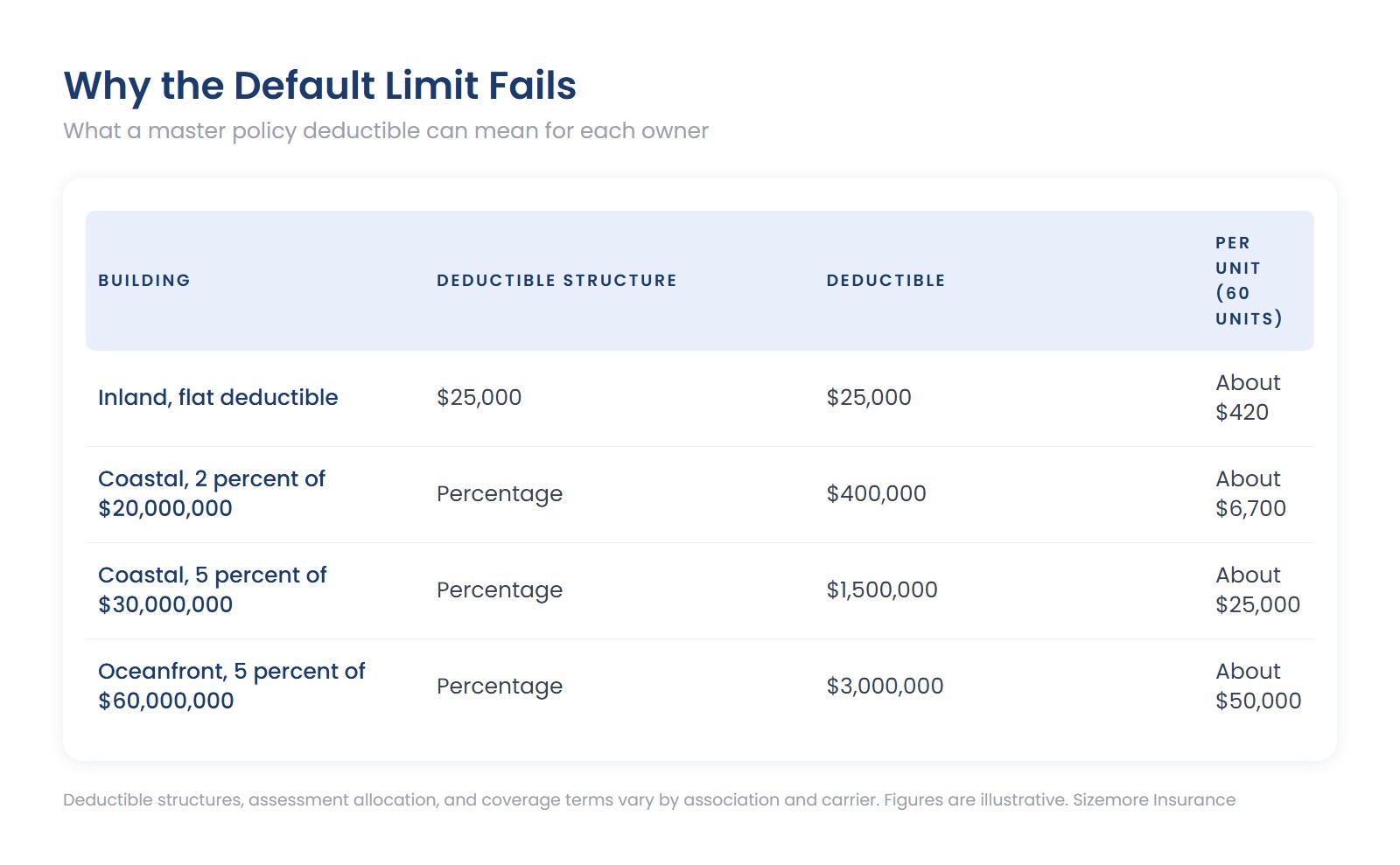
The takeaway: on an inland building the default limit is roughly adequate, and on a coastal building it is off by an order of magnitude.
Deductible structures, assessment allocation, and coverage terms vary by association and carrier. Figures are illustrative.
Many carriers offer loss assessment at higher limits, frequently $10,000, $25,000, $50,000 or more, and the additional premium is generally small. There is also frequently a separate, lower sublimit that applies specifically to assessments arising from the master policy deductible, which is exactly the situation you most need it for. Read that provision.
The sublimit for master deductible assessments is the trap. Some forms cap that specific category at a low figure, often a few thousand dollars, even where your overall loss assessment limit is higher. Ask about it directly.
Allocation is set by the governing documents, and it is not always by unit count. Square footage, percentage interest, or another formula may apply. Read yours.
Assessments for maintenance and improvements are not covered. A new roof because the old one wore out, a repaving project, or an amenity upgrade are ordinary assessments and outside this coverage.
Underinsured associations pass the gap to owners. If the master limit is below the building’s replacement cost, the shortfall lands on the membership. That is an association governance question and it is worth asking about at a meeting.
Wind may be excluded from the master on a coastal building, with a separate wind policy carrying its own deductible.
HOA properties are not only condos. Single-family homes in an association with common property, a clubhouse, a pool, or a shared dock have the same exposure through a different structure.
Check it when you buy. During due diligence, ask for the master declarations page, the deductible structure, the governing documents’ allocation formula, and the reserve study. That is a much better time to learn the association is thinly insured than after a storm.
What is loss assessment coverage?
Coverage for your share of an association assessment arising from a covered loss, including the master policy deductible.
How much should I carry?
Enough to cover a realistic share of your association’s master deductible. On a coastal building that is frequently $25,000 or $50,000 rather than the default.
Does it cover regular assessments?
No. Maintenance, repairs, and capital improvements are ordinary assessments and outside this coverage.
Is there a separate limit for the master deductible?
Frequently yes, and frequently lower than the overall loss assessment limit. Ask specifically.
Does this apply to a single-family HOA?
Yes, where the association owns common property and can assess owners for a covered loss.
How do I find my association’s deductible?
Ask for the master policy declarations page. Any owner is entitled to see it.
Sizemore Insurance is an independent insurance company founded in North Carolina in 1977. Send us your association’s master declarations page and we will calculate your actual assessment exposure and price the coverage against it. Insurance made just for you.
Sources: North Carolina Department of Insurance, consumer guidance on condominium unit-owner and homeowners coverage (ncdoi.gov); South Carolina Department of Insurance, consumer guidance on condominium and homeowners coverage (doi.sc.gov); North Carolina General Assembly, the Condominium Act and Planned Community Act on association insurance and records (ncleg.gov).
Coverage, sublimits, allocation formulas, and availability vary by association, carrier, and form. Figures are illustrative. Review your own documents and policy or talk to your advisor.
Coverage details: North Carolina Home Insurance