

Two groups of people assume flood insurance is not available to them, and both are wrong.
Renters think it is a homeowner product. Condo owners think the association handles it. Neither is right, and in a coastal or riverine area both are carrying real uninsured exposure.
You can buy contents-only flood coverage on your own, without the landlord's involvement and without their permission.
What it covers: your furniture, electronics, clothing, and belongings, up to the limit you choose within the program maximum.
What it does not: the building, which is the landlord's problem, and the landlord's policy does not cover your things.
What it costs: outside a high-risk zone, typically a modest annual amount. This is one of the better values available to a renter in a coastal town.
Your renters policy does not cover flood. No renters policy covers it. It is a separate purchase, and I mention it because renters assume renters insurance is comprehensive in a way it is not.
If you rent a ground-floor unit anywhere near water, in Wilmington, Charleston, Beaufort, Asheville, or a river town, this is worth the conversation.
More complicated, and the pieces are worth understanding separately.
The association's policy. Associations in mapped high-risk areas frequently carry a flood policy on the building. It is written for the structure and it stops somewhere, exactly like a master property policy does.
Your unit policy. You can buy a flood policy covering your contents and, depending on the structure and the association's coverage, improvements and betterments inside your unit.
Loss assessment. If the association is underinsured for flood, or carries a deductible it allocates to owners, that assessment can come to you. Whether your HO6 loss assessment coverage responds to a flood-caused assessment is a specific question worth asking, because many forms exclude flood-related assessments.
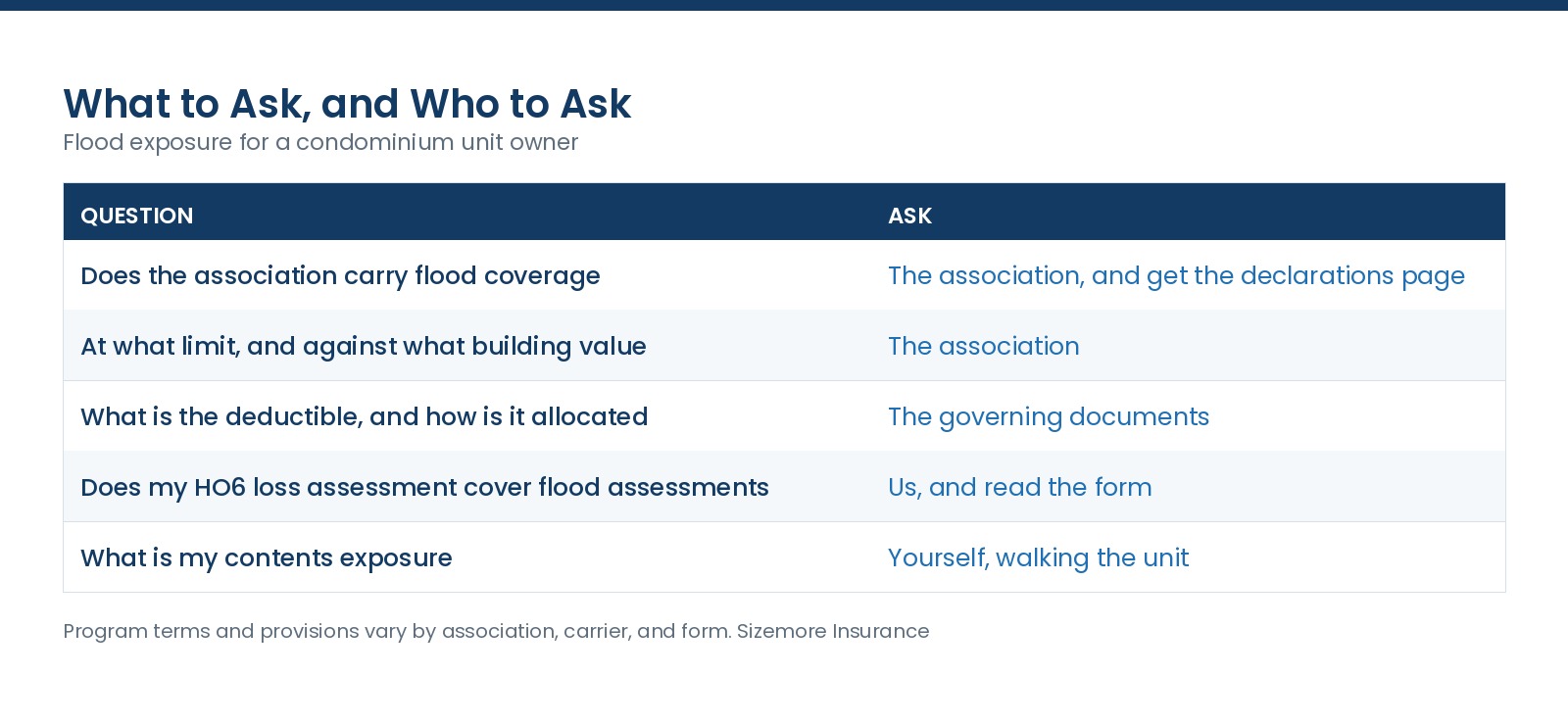
The takeaway: the association's flood policy covers the building, and your belongings and any assessment are yours.
Program terms, limits, and provisions vary and are set federally and by carriers. Review your own documents and policy.
A ground-floor or first-floor unit carries far more exposure than an upper-floor one, and it should be priced accordingly.
An upper-floor unit still has assessment exposure, even with no water in the unit itself, because the building is what floods.
A rented condo you own is a different situation again, with dwelling coverage rather than homeowners and its own flood questions.
Contents settle at actual cash value under the federal program, the same as anywhere.
The 30-day waiting period applies to renters and condo owners the same as to anyone.
Private flood options exist for both groups and are worth comparing, particularly for higher contents values or for living expense coverage.
Storage units and garages below grade or on the ground floor are frequently where the losses happen.
Can renters buy flood insurance?
Yes, contents-only coverage, without the landlord's involvement.
Does my renters policy cover flood?
No. It is a separate purchase.
Does my condo association's flood policy cover my belongings?
No. It covers the building. Your contents are yours to insure.
What if the association is underinsured for flood?
That shortfall can come to owners as an assessment. Ask whether your loss assessment coverage responds to flood-caused assessments, because many forms exclude them.
I am on the fourth floor. Do I need this?
Your contents exposure is lower and your assessment exposure is not, because the building is what floods.
How much does it cost?
Outside a high-risk zone, typically modest. Ask for a quote on the address.
Sizemore Insurance is an independent insurance company serving North Carolina since 1977. Send me the address and your association documents and I will tell you what is covered and what is not. Insurance made just for you.
Program terms, limits, and provisions are set federally and by carriers and vary by association and form. Review your own documents and policy or talk to your advisor.