
Reviewed for insurance accuracy by Brad Sizemore, Owner and CEO, NPN 6595451 · November 13, 2026
View reviewer profileThis is the hardest article in the mountain section to write, because the honest answer is one nobody wants. No homeowners policy in North Carolina covers the ground itself moving.
Earth movement is excluded from every homeowners policy sold in this state. Landslide, debris flow, slope failure, settlement, sinkhole, and earthquake all sit under that exclusion. There is no endorsement in the standard market that adds it back, and after Helene a great many western North Carolina homeowners learned that at the worst possible time.
I would rather you know it now.
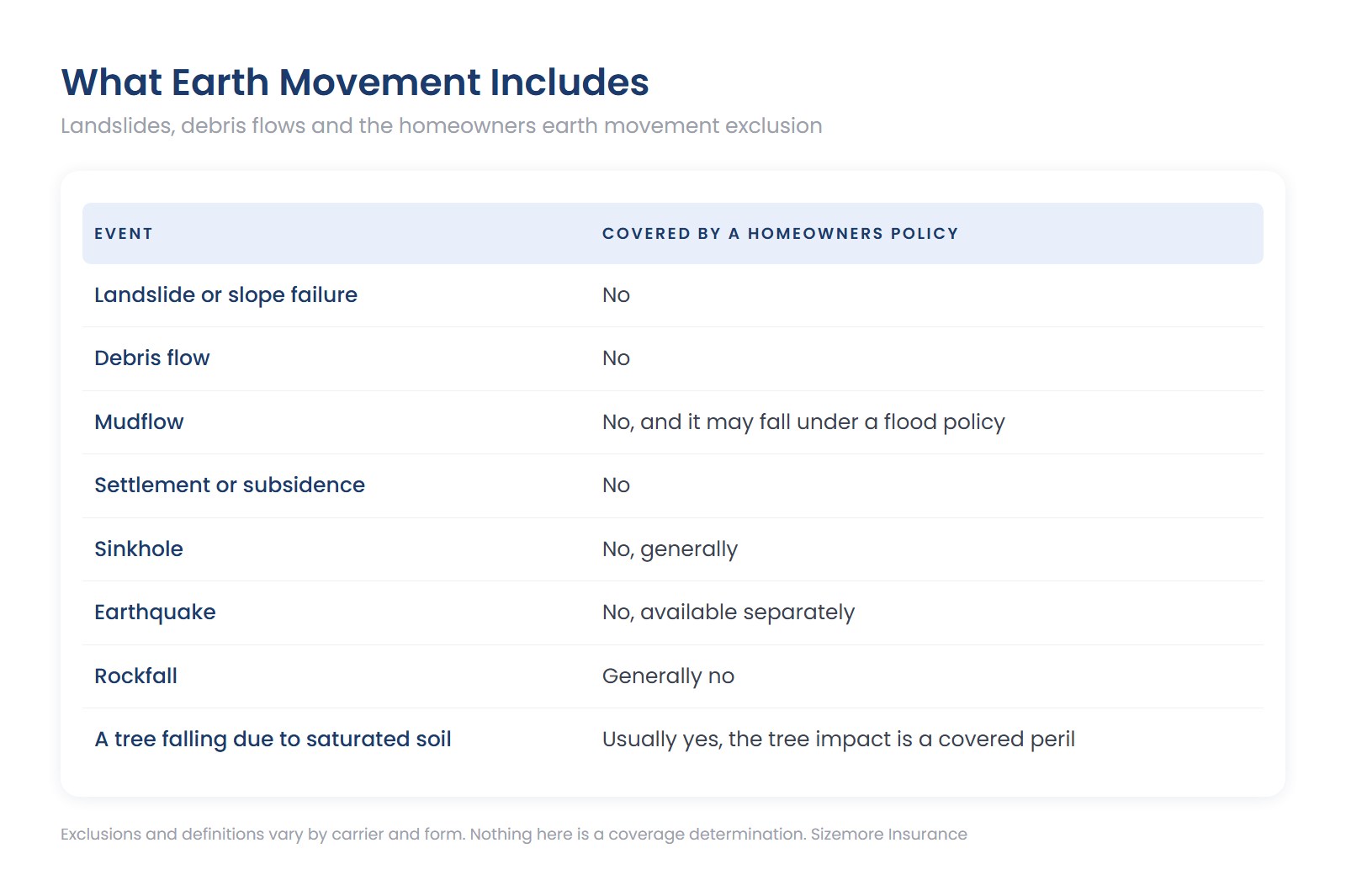
The takeaway: the ground moving is excluded and something falling on the house is generally covered. That line is where most of the post-Helene claim questions lived.
Exclusions and definitions vary by carrier and form. Nothing here is a coverage determination.
There is one meaningful exception worth understanding.
Mudflow is generally within the definition of flood under the National Flood Insurance Program, which means a flood policy may respond to it even though a homeowners policy will not. Mudflow in that context is broadly understood as a river of liquid and flowing mud, distinct from a landslide of earth and rock moving downslope.
The distinction is technical and it is genuinely arguable in real events, particularly in mountain terrain where a saturated slope produces something that looks like both.
Practically, that is another argument for carrying flood coverage on a mountain property. It may respond to a category of event that nothing else will, and the question of which category applies is decided by evidence rather than by argument.
Since the coverage does not exist, the work is in the risk itself.
Understand the slope above and below you. Cut and fill slopes, particularly older ones built before current grading standards, are where failures concentrate. So are slopes above a road cut.
Manage water. Nearly every slope failure is a water story. Roof runoff, driveway drainage, a failed culvert, a septic field on a slope, or a neighbor's discharge above you. Getting water off and away from the slope is the single most effective thing an owner controls.
Look at the history. North Carolina has produced landslide hazard mapping for portions of the mountain counties through the Geological Survey. Availability varies by county. Local knowledge and a geotechnical opinion are worth more than any of it on a specific lot.
Get an engineer before you build or excavate. Cutting into a slope for a driveway, a garage, or an addition is the moment risk is created or avoided.
Maintain retaining structures. A failing wall is both a hazard and a warning.
Document the property. Photographs of the slope, drainage, and any wall or bench, updated annually. If a claim ever turns on whether something was pre-existing, that is the record.
Difference in conditions coverage exists but is limited. Specialty markets write difference in conditions policies that can address earth movement in some circumstances, and availability on residential mountain property in this state is narrow. It is worth asking about on a high-value home, and it is not a routine placement.
Earthquake coverage is separate and available. It is a distinct peril from landslide, and where it is offered it does not solve the slope problem.
Causation after a storm gets contested. When water and slope failure both reached a house, the question of which caused what is real. Anti-concurrent causation language in the policy frequently resolves ambiguity toward the exclusion, which is another reason to have flood coverage rather than an argument.
A lender may not require anything. Flood is federally mandated in mapped zones. Landslide is nobody's requirement, which means nobody prompts the owner.
Buying on a mountain slope deserves a geotechnical conversation. Not an insurance conversation, because insurance has no answer here. The diligence has to happen before purchase.
Does homeowners insurance cover landslides in North Carolina?
No. Earth movement is excluded on every homeowners policy.
Does flood insurance cover a mudslide?
Mudflow is generally within the federal program's definition of flood. A landslide of earth and rock is generally not. The distinction is technical and evidence-driven.
Can I buy landslide coverage?
Difference in conditions policies exist in specialty markets and residential availability in this state is narrow. Ask, and do not plan on it.
Is earthquake coverage the same thing?
No. Earthquake is a separate peril with separate coverage where offered, and it does not address slope failure.
What if my neighbor's drainage caused it?
That becomes a liability question between property owners rather than a first-party coverage question. It is a matter for counsel.
What is the most useful thing I can do?
Manage water, get an engineer before you cut into a slope, and photograph the property annually.
Sizemore Insurance is an independent insurance company founded in North Carolina in 1977. We will tell you plainly what we can cover on a mountain property and what nobody can, so you can plan with the whole picture. Insurance made just for you.
Sources: North Carolina Rate Bureau, homeowners policy forms and earth movement exclusion (ncrb.org); North Carolina Department of Insurance (ncdoi.gov); FEMA and the National Flood Insurance Program, definition of flood and mudflow and the flood purchase requirement (fema.gov, floodsmart.gov); North Carolina Geological Survey, landslide hazard mapping (deq.nc.gov).
Exclusions, definitions, program terms, and specialty market availability vary and change. Nothing here is legal advice or a coverage determination. Review your own policy or talk to your advisor.
Coverage details: North Carolina Home Insurance