Reviewed for insurance accuracy by Brad Sizemore, Owner and CEO, NPN 6595451 · November 25, 2026
A homeowners policy contains a business pursuits exclusion. It is not a footnote and it is not narrowly applied. Homeowners insurance generally does not cover a home business, so a small operation needs a home business endorsement and a real one needs its own policy.
The number of households running some kind of business from home has grown substantially, and most of those policies have not changed to reflect it. A laptop and a spare bedroom is one situation. Inventory in the garage, a workshop out back, employees, and clients at the door is another one entirely.
Liability arising from the business. A client who trips on your steps, a product you made that injures someone, professional advice that turns out to be wrong.
Business property. Inventory, equipment, tools, and materials used in the business, typically limited to a very low sublimit on premises and lower still off premises.
Business use of a detached structure. Many forms exclude other structures used for business, which reaches the workshop, the studio, and the barn where the operation happens.
Employees. Anyone you pay to work is a workers compensation question rather than a homeowners one.
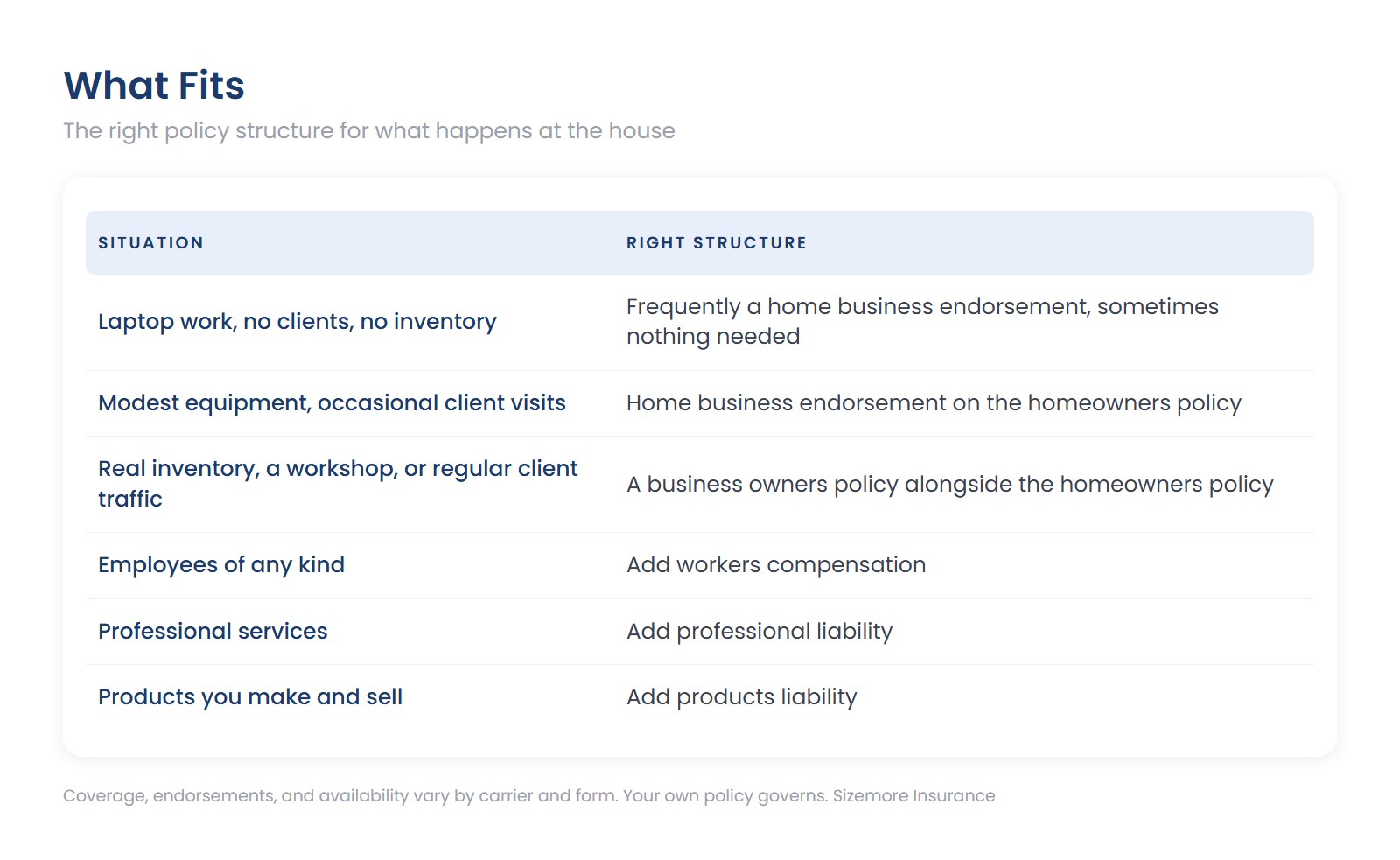
The takeaway: the endorsement handles the small version and stops well short of an actual operation. Where the business has inventory, equipment, employees, or foot traffic, it needs its own policy.
Coverage, endorsements, and availability vary by carrier and form. Your own policy governs.
This is the one owners most often miss.
Coverage B, other structures, frequently excludes structures used for business purposes. A converted barn used as a pottery studio, a shop building where you do woodwork for sale, or an outbuilding storing inventory can sit outside the coverage on the property policy.
The building may be the second most valuable structure you own, and it may be uninsured because of how it is used.
If you built or converted a structure for a business use, tell your advisor. The fix is usually straightforward once someone knows.
Incidental and business are not bright lines. Selling a few things online is different from a storefront operating out of a garage, and carriers draw the line differently. Describe the actual activity.
Clients at the house is the liability trigger. Once people come to your property for the business, premises liability for that activity is the exposure, and the homeowners policy may not respond.
A home office for an employer is different from a business you own. Someone working remotely for a company is usually a simpler question than someone operating their own venture, though equipment ownership still matters.
Vehicles used for the business are an auto question. Deliveries, client visits, and hauling materials can take a personal auto policy outside its terms.
Farm and agricultural activity on acreage has its own path, and a farm policy is frequently the better structure.
Short-term rental is a business too, and it is covered separately in this section.
Nondisclosure is the real risk. A carrier that knows can cover it. A carrier that does not know has a defense.
Does homeowners insurance cover a home business?
Generally no. Business pursuits are excluded, and business property is limited to a low sublimit.
I just work remotely on a laptop. Do I need anything?
Frequently not, and it depends on equipment ownership and whether anyone comes to the house. Ask.
What is a home business endorsement?
An add-on extending limited business property and liability coverage for a small operation. It stops well short of a commercial policy.
Is my workshop covered?
If it is used for business, many forms exclude it under other structures. Tell your advisor.
Do I need workers compensation for one part-time helper?
It depends on the arrangement and on state requirements. Ask rather than assume.
What if clients come to my house?
That is premises liability for a business activity, which is outside the homeowners policy. It needs to be addressed.
Sizemore Insurance is an independent insurance company founded in North Carolina in 1977. Tell us what you actually do at the house and we will tell you what the policy needs to look like. Insurance made just for you.
Sources: North Carolina Department of Insurance, consumer guidance on homeowners coverage in North Carolina (ncdoi.gov); North Carolina Rate Bureau, the standard North Carolina homeowners forms, including the business pursuits exclusion and other structures coverage (ncrb.org).
Coverage, exclusions, endorsements, and availability vary by carrier and form. Employment and workers compensation requirements are set by state law. Review your own policy or talk to your advisor.
Coverage details: North Carolina Home Insurance