
Reviewed for insurance accuracy by Victoria Konczynski, Personal Lines Account Manager, NPN 16516709 · November 25, 2026
This is the call I most want people to make before they act, and the one they most often make afterward. File a large loss right away, pay a small one near your deductible yourself, and call us before you decide on anything in between.
A claim is not free money. It carries a deductible, a three-year rating consequence, and a record that follows the house and the household. On a small loss those costs can exceed what the claim pays.
On a large loss none of that matters and you should file immediately.
Say the damage is $6,000 and the deductible is $2,500.
Net recovery: $3,500.
Then subtract what the claim costs you. A claim typically affects your rating for three years, and the increase depends on the carrier, the claim type, and your prior history. It also goes on your loss history report, which every carrier sees when you shop.
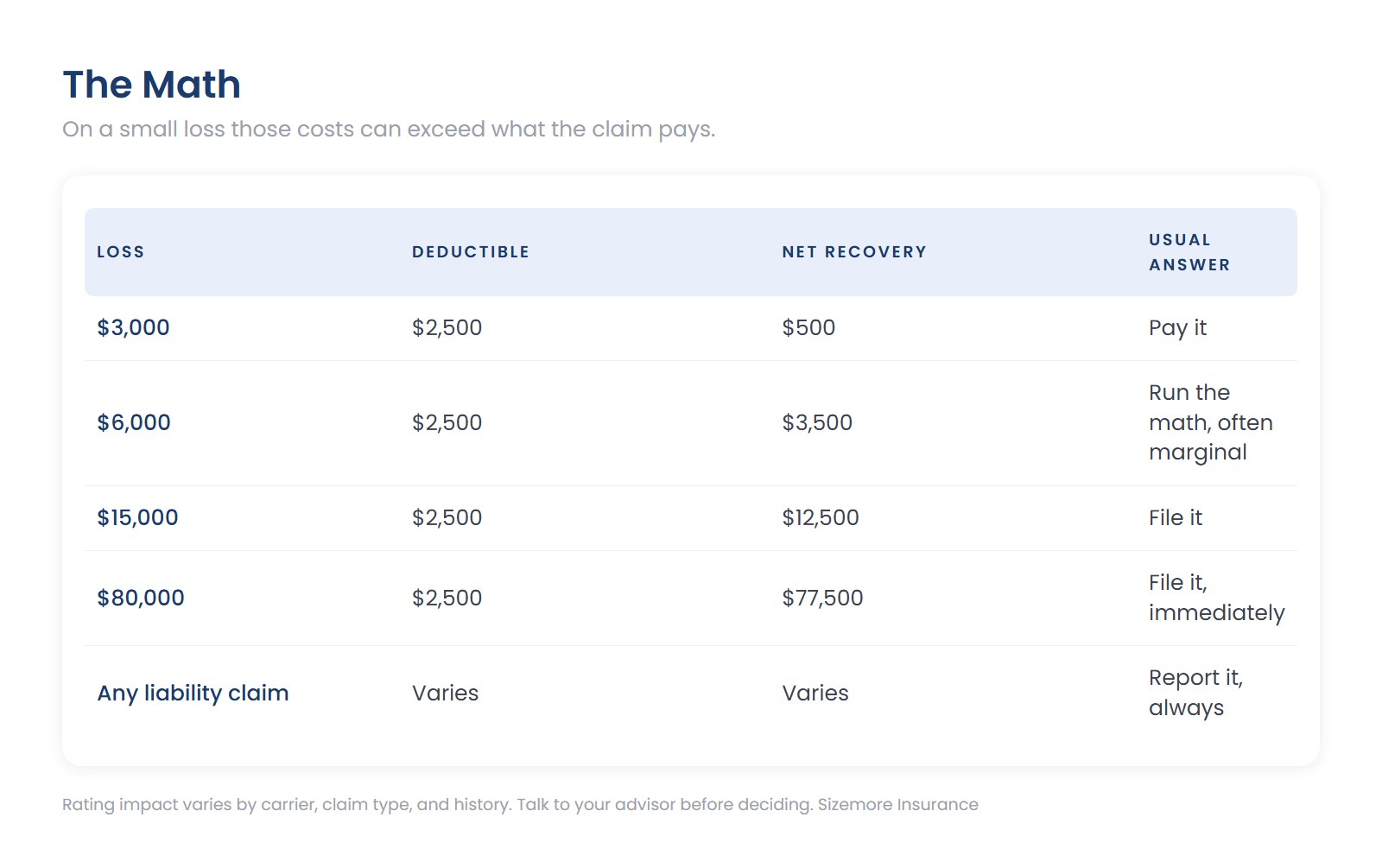
The takeaway: the decision is only difficult in the middle, and the middle is where the call to us matters.
Rating impact varies by carrier, claim type, and history. Talk to your advisor before deciding.
I do not want the caution above to keep anyone from using coverage they need.
Anything involving injury to another person. Report it the same day even if nobody is talking about a claim. Liability claims develop later and late notice can jeopardize your defense.
Any loss you cannot comfortably absorb. That is what the policy is for.
Anything structural. Foundation, framing, roof system. These get worse and a partial repair now complicates a legitimate claim later.
Any potential liability dispute. A tree from your yard on a neighbor's car, a guest who fell, a fence line disagreement.
Storm damage after a neighborhood event. If the roofs around you were damaged, get yours inspected and documented even if you do not end up filing.
Small water losses. These are the claims carriers scrutinize most because they predict future claims. Fix the cause, document the repair, keep the receipts.
Cosmetic damage. Siding scuffs, a cracked window, minor fencing. Real, and rarely worth a claim record.
Anything near the deductible. No benefit and a permanent record.
A second claim within a short window. In this market, frequency drives non-renewal more than severity. If you filed in the last year or two, call before filing again.
Reporting and filing are not the same. You can call us, describe what happened, and ask questions without opening a claim. Have the conversation before the file exists.
Your policy requires prompt notice. Sitting on a significant loss to avoid a claim can jeopardize coverage if you eventually need it. Prompt notice and a thoughtful decision are compatible.
A denied claim still counts as a claim. Filing and being denied puts a record on your history with no recovery, which is the worst outcome available.
Roof settlement changes the math. If your policy carries an age-based roof schedule, the recovery on an older roof may be far less than the repair cost.
A percentage deductible changes it more. On a coastal home, two percent of the dwelling limit means many real losses fall entirely below it.
Mitigation is required regardless. Whether or not you file, you must take reasonable steps to prevent further damage. Stop the water, tarp the roof, start drying.
Will one claim raise my home insurance?
Usually. The size of the effect depends on the carrier, the claim type, and your history.
How long does a claim stay on my record?
Generally three to five years for rating and longer in industry loss history databases.
Can I be dropped for one claim?
Rarely on its own. Multiple claims in a short window is the real risk.
Does asking a question create a claim?
Not with us. Call and ask.
What if I already paid for repairs and want to file now?
Harder without pre-repair documentation and not always impossible. Call us, and next time call first.
Should I file if I am not sure it exceeds my deductible?
Get an estimate first, then call and we will run it with you.
Sizemore Insurance is an independent insurance company founded in North Carolina in 1977. Call me before you file and I will run the numbers with you honestly, including when the answer is not to file. Insurance made just for you.
Sources: North Carolina Department of Insurance, consumer guidance on homeowners claims and rating (ncdoi.gov); North Carolina Rate Bureau, homeowners rating and deductibles (ncrb.org).
Rating impact, claim handling, and non-renewal practices vary by carrier and are subject to policy language. Nothing here is a coverage determination. Review your own policy or talk to your advisor.
Coverage details: North Carolina Home Insurance