

Every year in the last week of August my phone rings with people asking about flood insurance.
By then the answer is already no. The federal program carries a 30-day waiting period, and it does not make exceptions for a storm that already has a name.
That is the pattern with almost everything on this list. The work that protects a coastal home happens in the spring, and by the time it feels urgent the window has closed. Here is the readiness list, in the order it should be done.
Confirm flood coverage is in force. If it is not, buy it now. Thirty days from today is still June. Thirty days from August 25 is a storm you have already watched come ashore.
Calculate your named storm deductible in dollars. Not the percentage. Multiply it by your dwelling limit and write the number down. That is the reserve you need available, and it applies per storm, so an active season can mean it twice.
Confirm wind is actually in your policy. In many coastal territories windstorm and hail is excluded from the homeowners policy and written separately. If you cannot find a wind policy and there is an exclusion on your form, that is an emergency, not a to-do item.
Check your dwelling limit against rebuild cost. Construction costs have outrun the automatic escalation on many policies, and after a regional storm local costs spike further. This is what extended replacement cost coverage addresses.
Look at loss of use. After a widespread coastal storm, alternate housing is scarce and expensive, and a rebuild runs long. The limit and the duration both matter more here than inland.
Find out how your roof settles. Replacement cost or an age-based schedule. It is in the endorsement list. On an older roof this single line decides most of what you collect on the roof itself.
Photograph everything, dated. All four elevations, the roof if you can access it safely, the flashing and penetrations, every room, inside closets and cabinets, the contents of the garage, and any detached structures. Take far more than feels necessary. This is the record that establishes pre-loss condition and it is among the cheapest claim preparation there is.
Store the images and your documents off site. Cloud storage, or with a family member inland. Policies, declarations pages, deed, mortgage information, inventory, and photographs. A fireproof box in the house is not off site.
Do the tree work. Limbs over the roof, dead pines, anything leaning. This is a loss that genuinely happens, and it is one you can prevent.
Service the roof. Loose shingles, failed flashing, and open penetrations are what turn a wind event into an interior loss. They are also what turns a covered claim into a maintenance argument.
Check gutters, drains, and grading. Water that cannot get away from the house gets into it.
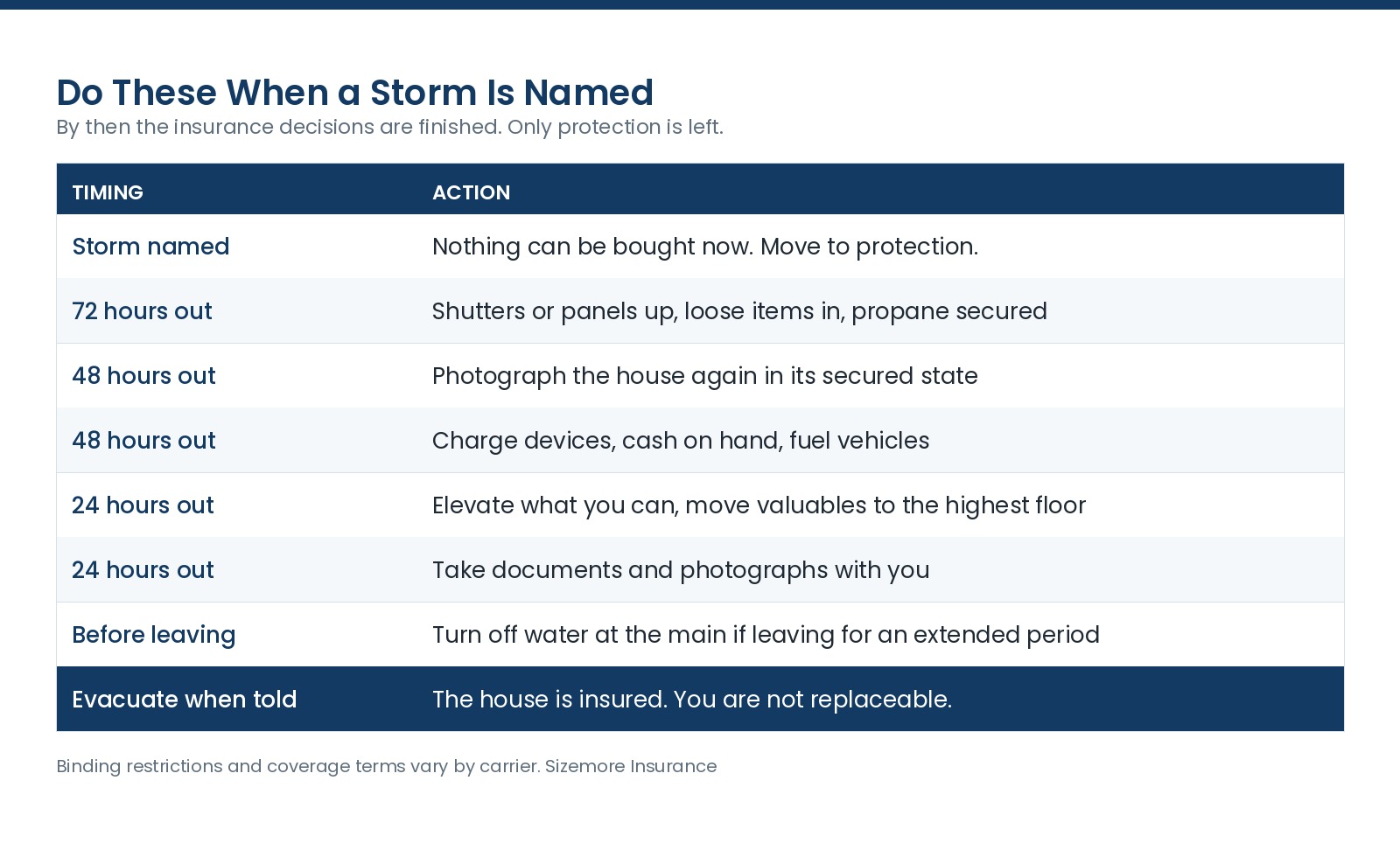
The takeaway: once a storm is named, insurance decisions are finished and only physical protection remains. Everything on the first two lists has to happen months earlier.
Two deductibles can apply after a hurricane. Your named storm deductible on the wind side and your flood deductible. Both come out of your pocket in one event.
The federal flood program does not pay additional living expense on a residential policy. If the house is uninhabitable from surge rather than wind, the cost of living elsewhere may not be covered anywhere. Some private flood policies include it, which is one of the better reasons to look beyond the federal program before the season.
Do not store anything valuable below the flood elevation on an elevated home. Coverage down there is minimal.
Contents in a detached garage or shed are covered differently than contents in the house, frequently at a lower limit.
After the storm, photograph the mud line before anything is touched. It is the physical record of how high the water rose and therefore which damage belongs to the flood claim.
Report to both carriers the same day and write down the sequence of events while you remember it.
When should I buy flood insurance?
By June, and any time that is not hurricane season. The 30-day waiting period makes late purchases useless.
Can I raise my coverage when a storm is coming?
Carriers commonly restrict binding and coverage increases once a storm is in a defined box. Assume the answer is no once a storm is named.
How much should I keep in reserve for a deductible?
Calculate your named storm deductible in dollars and plan for it twice in an active season.
Do I need to photograph everything every year?
Update it annually and after any renovation or significant purchase. It takes an hour and it is one of the best hours you will spend.
What if I cannot get the roof done before the season?
Do what you can, document the condition, and get the work scheduled. A documented, maintained older roof is a better claim position than an undocumented one.
Should I file a claim for minor damage?
Get an estimate first and check it against your deductible. On a percentage storm deductible, a lot of real damage falls underneath it.
We have been an independent insurance company in North Carolina since 1977 and we have worked storms on this coast for most of that time. Call us in May and we will run this list with you while it still does some good. Insurance made just for you.
Coverage, program terms, binding restrictions, and deductible structures vary by carrier and are subject to change. Review your own policy or talk to your advisor.