
Reviewed for insurance accuracy by Joseph "JJ" Johnson, Chief Operating Officer, NPN 7594559 · November 25, 2026
Bundling is the most consistently recommended thing in personal insurance and the advice is usually right. Bundle when one carrier serves both policies well, and split when one of the two policies needs a market the other carrier does not serve.
It is not always right, and knowing when it is not is worth more than the discount.
The multi-policy discount is real and it typically applies to both policies rather than one.
Coverage coordinates. A claim involving both policies, like a tree that hits the house and the car, is handled by one carrier instead of two adjusters pointing at each other.
An umbrella is simpler. A personal umbrella requires underlying liability limits on both the home and auto policies. One carrier makes that easy to maintain and easy to verify.
One renewal, one review. Which means somebody actually looks at the whole picture once a year rather than at two halves at different times.
Fewer gaps. Items that fall between policies, like a golf cart, a trailer, or a detached workshop, are easier to place correctly when one company sees everything.
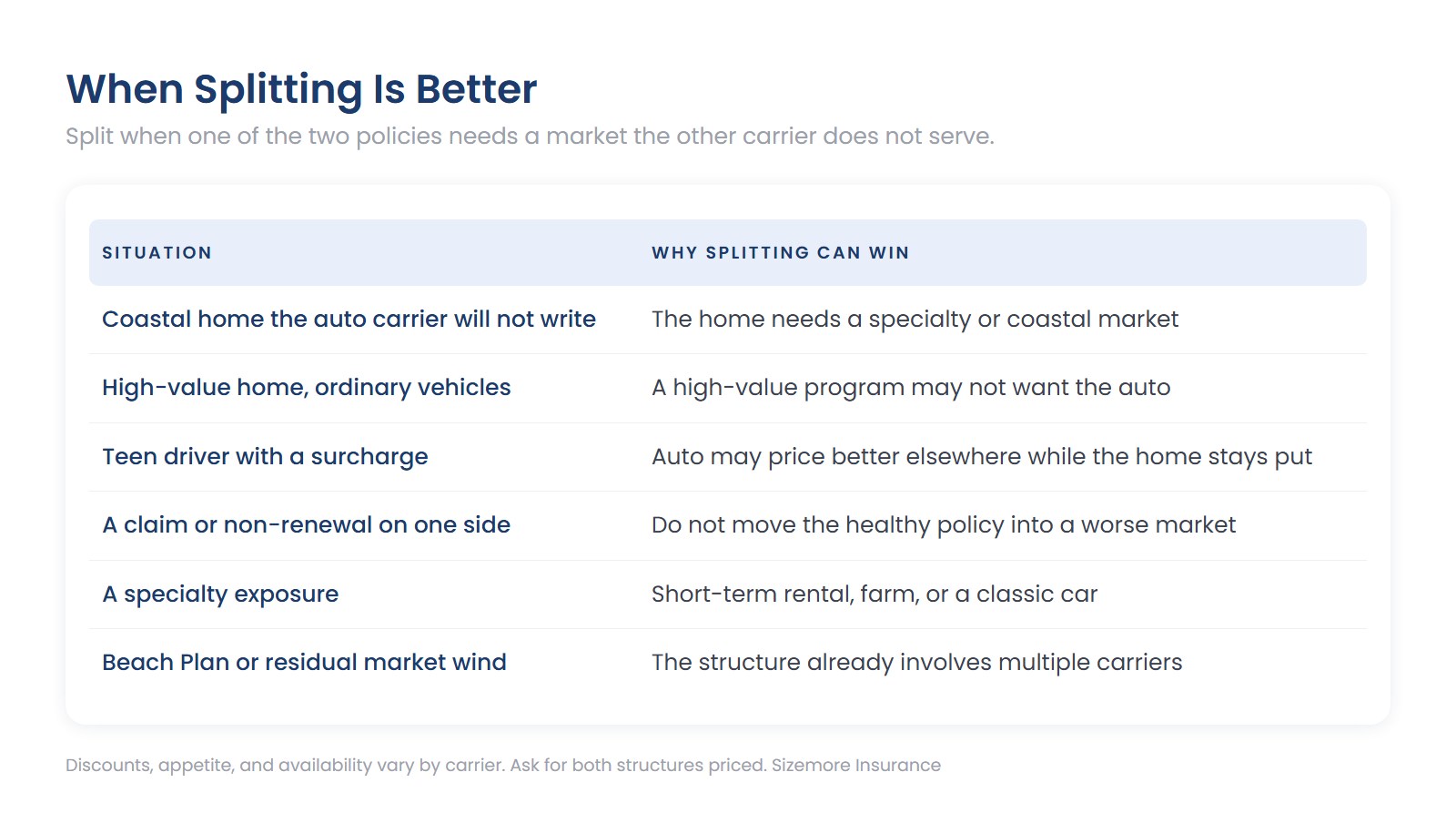
The takeaway: split when one of the two policies needs a market the other carrier does not serve. That describes a lot of coastal and high-value Carolina households.
Discounts, appetite, and availability vary by carrier. Ask for both structures priced.
Get both quoted. Bundled with one carrier, and best-fit separately. Compare the totals, not the individual pieces.
Compare coverage, not just price. A bundled quote with a percentage wind deductible and an age-based roof schedule is not obviously better than a split structure with better terms on the home.
Check the umbrella requirement. If you split, confirm both underlying policies still meet the umbrella's minimums, and confirm the umbrella carrier accepts the structure.
Look at the whole household. Vehicles, home, second home, boat, rental, and umbrella. That is the comparison that matters.
Do not chase the discount into worse coverage. The bundling credit is meaningful and it is smaller than the cost of a roof schedule or a poor deductible structure on the home.
Splitting complicates a shared loss. A single event touching both policies means two adjusters and two deductibles.
The umbrella is the coordination point. If you split, the umbrella carrier still needs to see both underlying policies and they still need to satisfy the minimums.
Coastal households frequently have three or four policies already, with wind and flood written separately. Bundling the home and auto matters less in that structure than getting the wind and flood layers right.
Moving both policies at once has a switching cost. Effective dates, mortgagee notifications, and lender evidence all need handling. Not a reason to avoid it, and a reason to let us manage the dates.
Loyalty is not a discount. Carriers do not reward staying put on its own. Re-market periodically regardless of structure.
How much does bundling save?
It varies by carrier and is typically meaningful on both policies. Ask for it quoted both ways.
Is bundling always better?
No. If one policy needs a market the other carrier does not serve, splitting frequently produces better coverage.
Can I have an umbrella if I split?
Yes. Confirm both underlying policies meet the umbrella's minimum limits and that the umbrella carrier accepts the structure.
Does splitting complicate a claim?
Only where one event touches both policies, which is uncommon but not rare.
Should I move both to save money?
Compare total cost and coverage together. A cheaper bundle with a worse home form is not a savings.
How often should I re-check?
Every two to three years, and any time something material changes.
Sizemore Insurance is an independent insurance company founded in North Carolina in 1977. Send me both declarations pages and I will price it bundled and split so you can see the actual difference. Insurance made just for you.
Sources: North Carolina Insurance Underwriting Association and Joint Underwriting Association, the Beach Plan and residual market wind (ncjua-nciua.org); South Carolina Wind and Hail Underwriting Association (scwind.com).
Discounts, appetite, coverage, and availability vary by carrier. Review your own declarations pages or talk to your advisor.
Coverage details: North Carolina Home Insurance