
Reviewed for insurance accuracy by Victoria Konczynski, Personal Lines Account Manager, NPN 16516709 · November 11, 2026
View reviewer profileEvery major short-term rental platform offers some form of host protection, and hosts routinely treat it as their insurance program. Only in part: it responds to some of what a guest does on a platform booking, and your own policy has to cover the rest.
It is not one. It is a supplement, designed by the platform to make hosting viable, and it is built around bookings made through that platform. Reading the program terms is worth an hour of any host's time, because the gaps are consistent and they are large.
Program terms change, so verify the current version rather than relying on this or on what a forum said two years ago.
Two distinct things, and conflating them is the first mistake.
Liability protection. Typically a stated limit of liability coverage responding to guest bodily injury or damage to a third party's property arising from a stay. This is generally insurance.
Damage protection. Reimbursement for damage a guest causes to your property. On some platforms this is structured as a guarantee or reimbursement program rather than an insurance policy, which matters because a reimbursement program operates under the platform's terms and process rather than under insurance regulation.
Both apply to stays booked through that platform. Neither is a property policy on your building.
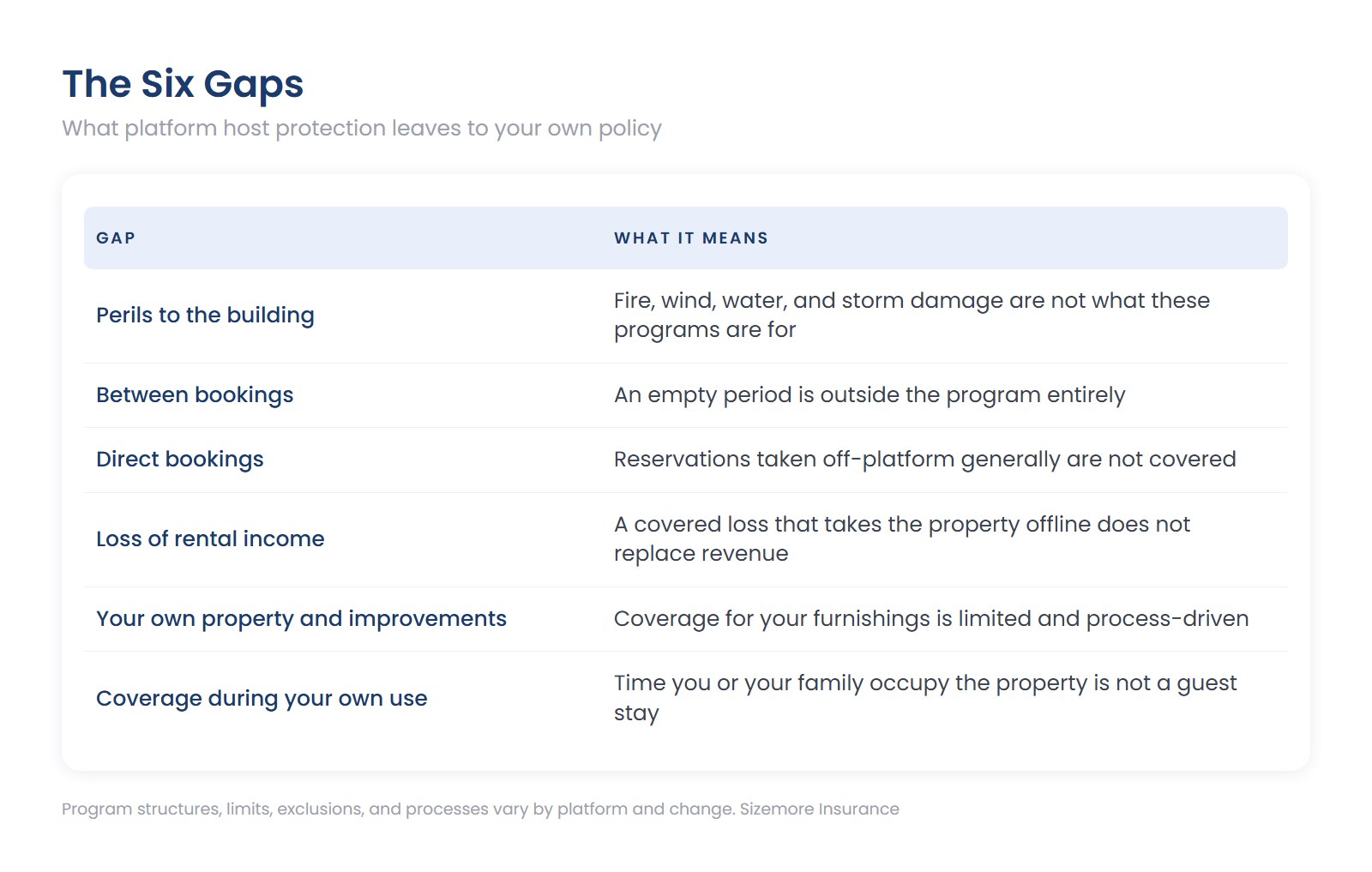
The takeaway: platform protection addresses what a guest does, and your policy has to address everything else. Fire does not care whether a guest is in the house.
Program structures, limits, exclusions, and processes vary by platform and change. Confirm current terms directly with the platform.
A fire in February while the house sits empty between bookings is not a platform question. It is a property insurance question, and if the property is insured under a homeowners policy that excludes rental use, it may be a very bad property insurance question.
A guest slipping on the stairs is closer to what the platform programs are built for, and even there the protection is a layer rather than a program. It does not defend you the way a liability policy with defense obligations does across every scenario, and it does not follow you to a direct booking.
The right structure is a property and liability policy written for short-term rental use, with the platform protection sitting alongside it as a supplement. That is how the programs are designed to work, and the platforms generally say so in their own materials.
A reimbursement program is not an insurance claim. Where damage protection is structured as a platform guarantee, the process, the documentation standard, the timelines, and the appeal path are the platform's. That is not a criticism, it is a structural difference worth understanding before you rely on it.
Conditions and exclusions apply. Common ones involve certain types of property, pets, prior damage, and claims that must be reported within a defined window. Missing a reporting deadline is the most avoidable failure.
Co-hosts and property managers change the analysis. If someone else manages the property, whose coverage responds and who is named on what needs to be settled in the management agreement.
Direct booking is a business decision with an insurance consequence. Many hosts move guests off-platform to avoid fees. That is a legitimate choice and it removes the platform protection from those stays.
Your own policy may need to be primary. Some platform programs contemplate other insurance. If your own policy excludes the rental use, there may be nothing for the platform program to sit above.
Local ordinance compliance can matter. Some programs contemplate lawful operation. Operating outside a local permit requirement is a risk on more than one front.
Is Airbnb's host protection insurance?
The liability component is generally insurance. Damage protection on some platforms is structured as a reimbursement or guarantee program rather than insurance. Check the current terms.
Do I still need my own policy?
Yes. Platform protection does not cover the building against fire, wind, or water, does not cover periods between bookings, and does not replace lost rental income.
Does it cover direct bookings?
Generally no. Protection is tied to stays booked through the platform.
What about when I use the house myself?
That is not a guest stay and is outside the program.
Does it cover my furnishings?
Damage caused by a guest may be addressed through damage protection, subject to conditions and a reporting window. Everything else is your policy.
What is the most common gap hosts discover?
A property loss with no guest involved: a pipe that failed in January, a fire while the house was empty, storm damage in the off season.
Sizemore Insurance is an independent insurance company founded in North Carolina in 1977. Tell us which platforms you use and how the property is operated and we will build the coverage that sits underneath. Insurance made just for you.
Platform program structures, limits, exclusions, and processes vary and change. Nothing here describes a specific current program in detail or constitutes a coverage determination. Confirm terms with the platform and review your own policy with your advisor.
Coverage details: North Carolina Home Insurance