A rental burns and the dwelling coverage rebuilds it. That takes eight months.
For eight months there is no tenant, no rent, and a mortgage payment due on the first of every one of them. Loss of rents is the coverage that bridges that, and it is the coverage most directly tied to why you bought the property in the first place.
It is also the one investors most commonly set at a default and never look at again.
What It Covers
The rental income you lose while a covered loss makes the property unrentable, up to a limit and for a period.
Continuing expenses in some forms, though on a dwelling policy this is generally simpler than a commercial business income calculation.
Additional expense in some forms, for costs that reduce the period of loss.
What It Does Not Cover
A tenant not paying. This is a common misunderstanding. Loss of rents responds to a covered physical loss making the unit unrentable. It is not rent guarantee insurance and it does nothing about a nonpaying tenant, an eviction, or a vacancy while you look for a tenant.
Vacancy for ordinary reasons, including between tenants.
A closure without physical damage, including a government order with no damage to the property.
Rent above the actual rent you were collecting, in most forms.
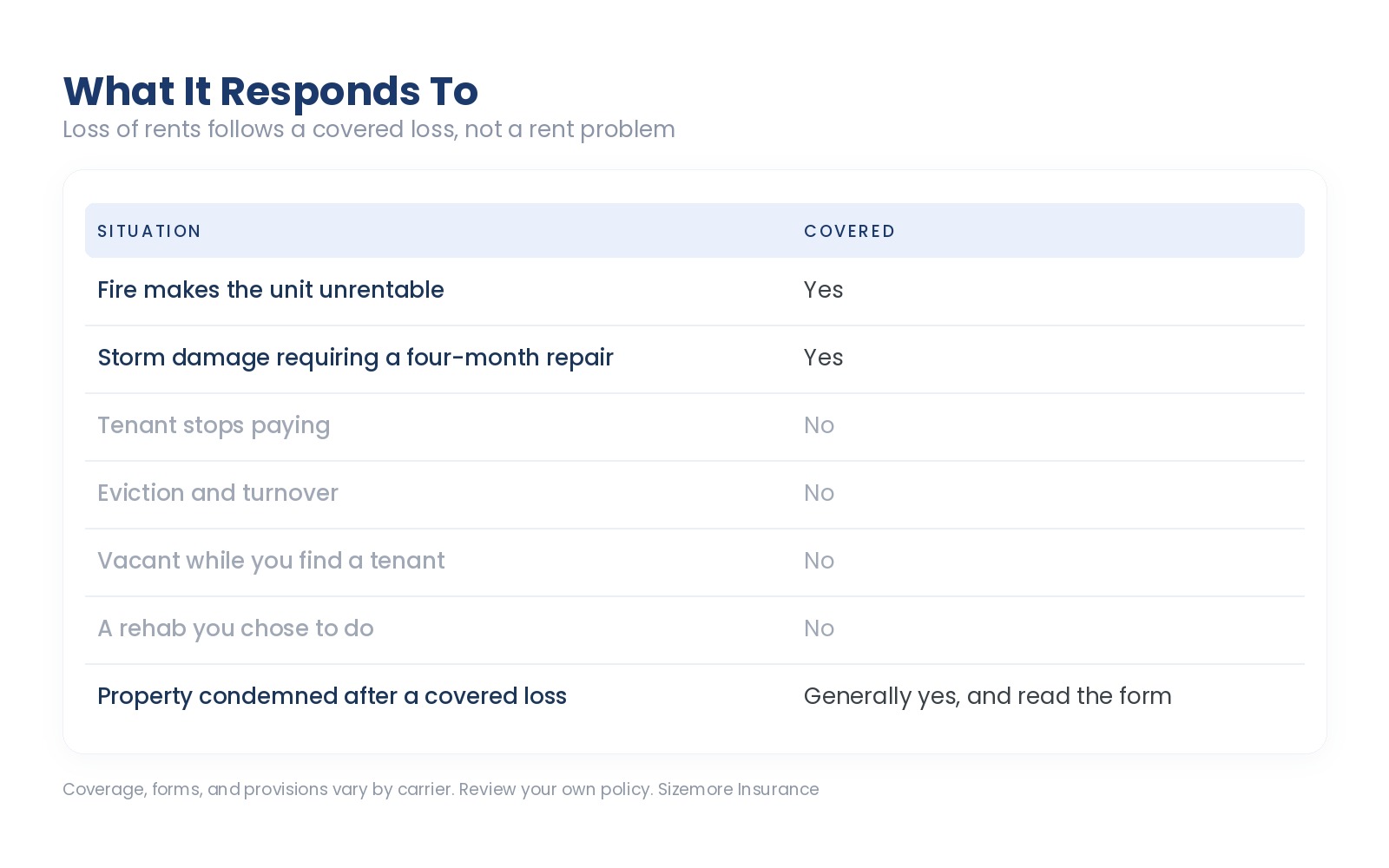
The takeaway: it covers a covered loss, not a rent problem, and the distinction is where investors are disappointed.
Coverage, forms, and provisions vary by carrier. Review your own policy.
How to Size It
Three settings and most investors have looked at none of them.
The limit. On many dwelling policies it is a percentage of the dwelling limit, frequently ten or twenty percent. That percentage has nothing to do with your rent. Do the arithmetic: monthly rent times a realistic repair period.
The period. How long a rebuild actually takes, including permitting, contractor availability, and material lead times. On a total loss in the Carolinas that is frequently a year, and after a regional event longer. A limit sized for four months does not survive a fire.
The basis. Actual loss sustained for a stated period is generally friendlier than a fixed monthly amount, because it pays what you actually lost. Ask which you have.
Multiply your rent by twelve and compare it to the limit on your declarations page. That comparison takes one minute and it is the point of this article.
Where This Gets Complicated
Fair rental value is a related and different term, and it has its own article. Loss of rents generally reflects the rent you were collecting. Fair rental value reflects what the property would rent for.
Multiple units means a per-unit calculation. A fourplex with one unit damaged loses one rent, and a fire affecting the building loses four.
Below-market rent on a long tenancy raises the question of whether you are covered for what you were collecting or what the unit is worth.
Short-term rental income is seasonal and irregular, which makes the calculation different and worth doing specifically.
A regional event extends the period, because every contractor in the county is booked. Helene demonstrated that in western North Carolina.
Your mortgage does not pause, which is the whole reason this coverage matters on a leveraged property.
Coinsurance can apply to loss of rents on some forms, which means an inadequate limit is reduced on top of being inadequate.
Common Questions
What is loss of rents?
Coverage replacing rental income while a covered loss makes the property unrentable, up to a limit and a period.
Does it cover a tenant who stops paying?
No. It responds to a covered physical loss, not to a rent problem.
How much do I need?
Monthly rent times a realistic repair period, which on a total loss is frequently twelve months or more.
How is the limit usually set?
Frequently as a percentage of the dwelling limit, which has nothing to do with your actual rent. Check it.
What is the difference from fair rental value?
Loss of rents generally reflects the rent collected. Fair rental value reflects what the property would rent for. Both terms appear on policies.
Does it cover a rehab?
Not one you chose. It follows a covered loss.
The Bottom Line
- Multiply your rent by twelve and compare it to your current limit today.
- Set the period to a realistic rebuild, including permits and contractor availability.
- Ask which basis you are on, and prefer actual loss sustained.
- Do the calculation per unit on multifamily.
- Recalculate when rent increases, because the limit does not follow on its own.
- Understand it is not rent guarantee, so a nonpaying tenant is a lease problem rather than a claim.
Sizemore Insurance is an independent insurance company founded in North Carolina in 1977, writing in both North Carolina and South Carolina. Send us your rent roll and your declarations pages and we will tell you whether the limits hold up. Insurance made just for you.
Coverage, forms, limits, and provisions vary by carrier and are subject to change. Nothing here is a coverage determination. Review your own policy or talk to your advisor.